










Data-Driven Insights for small business have become a defining factor in how modern enterprises achieve growth, efficiency, and competitive resilience in 2026. As digital tools continue to generate vast amounts of operational and customer data, small businesses are no longer limited to intuition-based decision-making but can instead rely on measurable evidence to guide strategy. This shift toward analytics-driven operations enables entrepreneurs to better understand market trends, optimize performance, and uncover opportunities that were previously difficult to identify. In an increasingly data-centric economy, the ability to transform raw information into actionable insights is not just an advantage,it is a necessity for sustainable success.
Data-Driven Insights for Small Business: Why They Matter More Than Ever in 2026
The modern business environment reflects an accelerating reliance on Data-Driven Insights for small business, as companies increasingly depend on analytical evidence rather than intuition when evaluating business performance and planning future strategies, while the rapid expansion of digital technologies across commerce, marketing, and operations generates significant volumes of operational information through online platforms, financial systems, and customer interactions. Consequently, these expanding digital footprints provide valuable opportunities to examine patterns in demand, operational efficiency, and consumer engagement that previously remained difficult to observe, while advances in analytics platforms and cloud computing technologies gradually reduce the technical barriers that once limited sophisticated data analysis to large corporations.

The growing importance of Data-Driven Insights for small business appears clearly within competitive markets where rapid technological change and evolving consumer expectations continuously reshape industry dynamics, while the availability of digital dashboards and reporting systems allows small firms to monitor performance indicators such as sales trends, marketing outcomes, and operational productivity in near real time. Consequently, this analytical visibility strengthens the ability of organizations to recognize emerging opportunities and potential risks before they significantly influence financial outcomes, while the increasing affordability of analytics tools enables entrepreneurs to interpret complex information without requiring extensive data science expertise.
The integration of analytics into everyday operations indicates a gradual shift toward more resilient business strategies grounded in measurable evidence, while Data-Driven Insights for small business support improved financial planning, more efficient allocation of resources, and clearer evaluation of marketing effectiveness across digital and physical channels. Consequently, the systematic interpretation of operational data transforms large volumes of information into strategic knowledge that supports long-term decision making, while the evolving digital economy reinforces analytical insight as a fundamental component of sustainable growth and competitiveness.
How Small Businesses Can Use Business Data Analytics to Identify Growth Opportunities
Modern business technologies demonstrate strong analytical capabilities through the examination of operational datasets that reveal patterns associated with potential expansion and improved profitability, while Data-Driven Insights for small business enable the analysis of sales records, marketing metrics, and operational performance indicators in order to detect opportunities that may not be visible through traditional observation. Consequently, structured data analysis transforms fragmented business information into meaningful indicators of product demand, customer engagement, and market performance, while the growing availability of cloud-based analytics tools allows small enterprises to interpret these indicators without extensive technical infrastructure.
Predictive analytical techniques reveal patterns by examining historical datasets to estimate future trends in consumer demand and product performance, while data segmentation methods categorize customers into groups based on purchasing behavior, geographic patterns, or engagement levels. Consequently, these segmentation processes strengthen the ability to identify promising market segments and emerging consumer preferences, while analytical interpretation of these patterns guides more efficient allocation of marketing budgets and operational resources across business activities.
Data-Driven Insights for small business support the discovery of growth opportunities by revealing correlations between operational decisions and measurable outcomes, while visual analytics dashboards present trends in sales performance, customer acquisition, and marketing effectiveness through clear graphical representations. Consequently, interpretation of these visual patterns enables refinement of pricing strategies, prioritization of high-performing products, and exploration of new distribution channels, while systematic data analysis gradually becomes an essential strategic capability supporting sustained growth in competitive markets.
The Role of Customer Data Analysis in Understanding Buyer Behavior
Customer analytics has increasing importance in contemporary business environments where understanding buyer behavior influences competitive positioning and strategic development, while Data-Driven Insights for small business enable the examination of information collected from customer interactions, transaction histories, and digital engagement across multiple platforms. Consequently, analysis of these datasets reveals patterns in purchasing preferences, transaction frequency, and levels of brand engagement that contribute to deeper understanding of consumer behavior, while these behavioral insights clarify the motivations and expectations influencing purchasing decisions.
Analytical tools evaluate customer data in order to segment audiences according to demographic attributes, purchasing habits, and levels of engagement with marketing campaigns, while segmentation processes identify groups of customers who share similar needs or preferences. Consequently, this deeper understanding of consumer behavior supports more relevant marketing communication and improved product positioning, while alignment of business offerings with genuine consumer interests strengthens long-term customer relationships.
The predictive capacity of Data-Driven Insights for small business emerges through the analysis of historical interaction patterns that allow estimation of future consumer behavior, while interpretation of transaction histories and browsing activities provides indications of potential purchasing intentions and levels of customer loyalty. Consequently, these predictive insights strengthen customer retention strategies and personalized marketing efforts across multiple communication channels, while continuous analysis of customer data improves the ability of organizations to respond effectively to changing consumer expectations and evolving market conditions.
Turning Raw Data into Actionable Business Insights
Organizations convert extensive operational data into meaningful strategic knowledge that informs business decision making, while Data-Driven Insights for small business emerge when information collected from sales systems, customer interactions, and digital platforms becomes organized within structured analytical frameworks. Consequently, integrated data systems combine multiple sources of information to reveal patterns associated with operational efficiency, customer behavior, and financial performance, while modern analytics platforms increasingly automate aggregation and processing of large datasets through advanced computational methods.
Statistical analysis and visualization tools enable interpretation of complex datasets through charts, dashboards, and measurable performance indicators, while visual representations facilitate recognition of emerging trends and relationships between operational activities and financial outcomes. Consequently, interpretation of these patterns transforms numerical information into insights that influence pricing strategies, marketing initiatives, and operational planning, while continuous monitoring of performance indicators strengthens adaptive and informed business strategies.
Data-Driven Insights for small business bridge the gap between data collection and practical decision making, while analytical findings guide operational adjustments such as modifications to inventory management, promotional strategies, and customer service processes. Consequently, systematic analytical practices convert operational information into measurable improvements in productivity and profitability, while increasing integration of analytics technologies allows small enterprises to transform routine business data into valuable strategic intelligence.
Common Data Collection Methods for Small Businesses (CRM, POS, and Website Analytics)
Technological systems collect operational and customer information that forms the foundation of analytical processes within modern organizations, while Data-Driven Insights for small business rely on consistent and accurate data collection from multiple digital and transactional sources. Consequently, customer relationship management systems record detailed information about interactions, purchase histories, and communication activities across marketing and sales channels, while these systems maintain comprehensive customer profiles that support deeper behavioral analysis.
Point-of-sale systems function as essential data collection tools by recording real-time information about product purchases, pricing details, and transaction frequency, while transactional datasets generated by these systems provide insight into product demand patterns, peak purchasing periods, and inventory turnover rates. Consequently, interpretation of these datasets enables evaluation of product performance and improvement of operational planning, while integration of transactional data with other analytical systems strengthens understanding of overall business performance.
Website analytics platforms track digital engagement indicators including page visits, navigation paths, and conversion behaviors across online channels, while these metrics reveal patterns related to customer interests and the effectiveness of marketing activities in attracting and retaining visitors. Consequently, integration of CRM data, POS records, and website analytics enables the development of comprehensive Data-Driven Insights for small business that connect customer behavior with operational performance, while these integrated datasets support a holistic understanding of business activities that strengthens strategic planning and long-term decision making.
How Can Data-Driven Insights for Small Business Improve Decision-Making?
The growing importance of Data-Driven Insights for small business in modern entrepreneurship reflects the increasing reliance of organizations on structured data analysis rather than intuition when making operational and strategic decisions. This approach consequently enables small enterprises to transform large volumes of customer, sales, and operational data into meaningful insights that align business strategies with measurable outcomes, while it strengthens decision accuracy by grounding choices in objective evidence that reduces guesswork and allows managers to evaluate performance trends more reliably across departments and time periods. At the same time, analytical evaluation supports long-term competitiveness because organizations can detect shifts in customer demand and operational performance earlier than through traditional decision approaches.
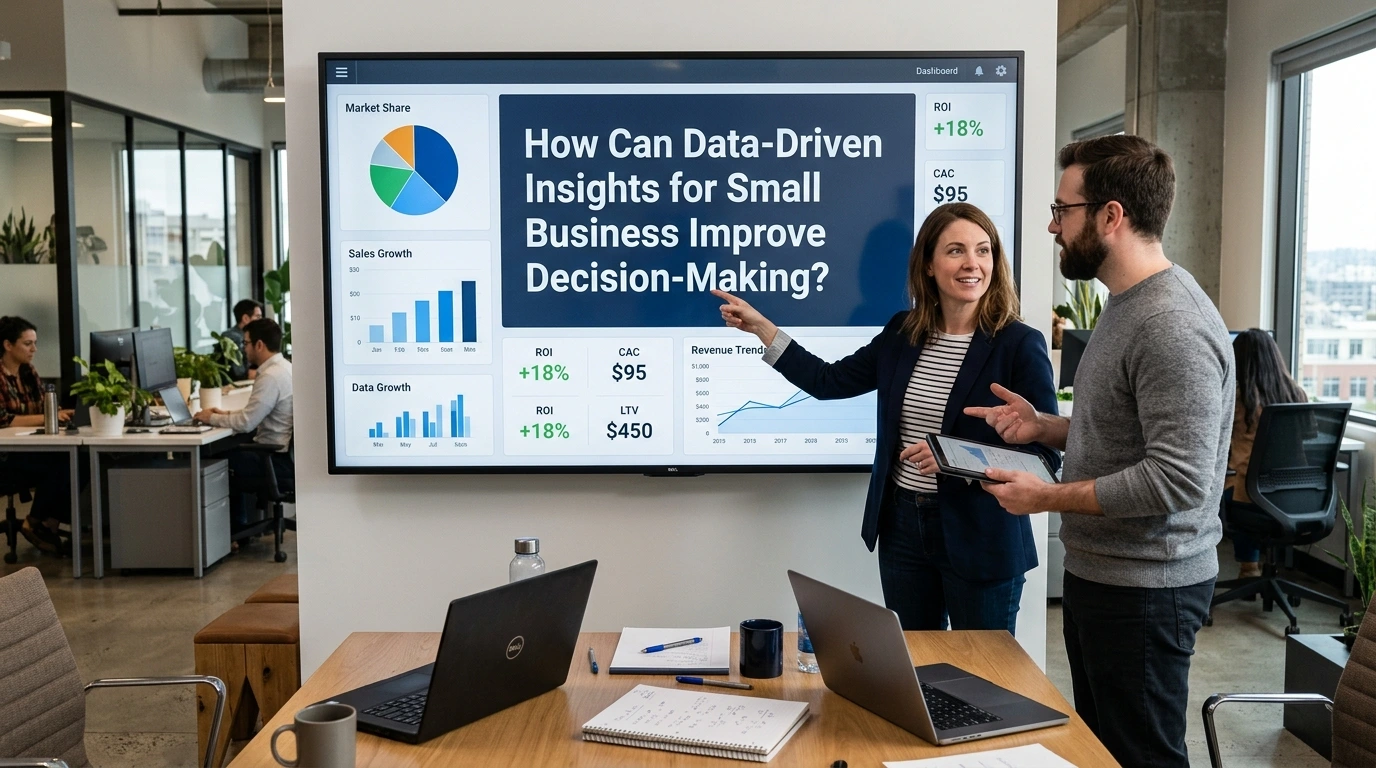
Analytical platforms additionally contribute to productivity gains because these systems reveal inefficiencies, identify growth opportunities, and expose patterns in customer behavior that might otherwise remain unnoticed in raw operational data, thereby increasing organizational confidence in decision processes as business leaders connect each conclusion to verifiable datasets and measurable indicators. These systems moreover encourage continuous improvement cycles since performance metrics can be monitored, interpreted, and refined through ongoing analytical feedback, while they simultaneously integrate multiple business functions such as marketing, operations, finance, and customer management into a shared analytical environment that improves coordination.
Data-Driven Insights for small business also reinforce the strategic planning process by linking operational information with broader market intelligence, thereby enabling more reliable long-term planning and allowing decision makers to evaluate alternative scenarios through examination of historical performance patterns alongside emerging industry signals. This analytical orientation consequently strengthens organizational adaptability because leadership teams can refine strategies quickly when new data reveals changing customer needs or economic conditions, while it ultimately establishes a decision culture in which evidence, measurable trends, and analytical interpretation guide business development and strategic growth.
Using Predictive Analytics to Forecast Sales and Market Trends
Predictive analytics within Data-Driven Insights for small business establishes a strategic capability in which statistical models evaluate historical data to estimate future outcomes and market developments. This analytical approach consequently enables organizations to forecast sales patterns and anticipate fluctuations in consumer demand across different periods, while predictive models strengthen planning accuracy by analyzing purchasing behavior, seasonal cycles, and broader economic indicators to generate probability-based projections. In this way, business analytics evolves from retrospective reporting into a forward-looking analytical capability that supports informed strategic planning.
Predictive insights additionally support operational planning because companies can align inventory levels, staffing decisions, and marketing strategies with expected demand patterns, thereby improving financial stability as revenue projections become more realistic and budgeting decisions rely on measurable patterns rather than assumptions. Predictive algorithms moreover enhance marketing effectiveness because these systems identify customer segments with higher purchase probability or stronger engagement potential, while the integration of predictive modeling with operational dashboards reinforces the strategic value of Data-Driven Insights for small business.
Predictive analytics also encourages proactive decision-making because organizations can evaluate potential outcomes before committing resources to major initiatives, while this capability improves market awareness as predictive analysis highlights emerging industry developments and evolving consumer preferences earlier than conventional analytical approaches. This predictive capacity consequently allows organizations to adjust pricing strategies, promotional campaigns, and supply chain operations in anticipation of market changes, thereby strengthening strategic planning and supporting sustainable business growth.
Leveraging Real-Time Business Intelligence for Faster Decisions
Real-time analytics within Data-Driven Insights for small business plays an increasingly significant role as modern business intelligence systems continuously collect and process operational data streams. These systems consequently enable entrepreneurs to monitor performance indicators such as sales activity, customer engagement, and operational efficiency as events occur, while real-time dashboards accelerate managerial response times because they reveal deviations from expected performance almost immediately. Continuous data visibility simultaneously strengthens situational awareness by providing constant insight into daily operational metrics across business functions.
Shared analytical platforms additionally enhance coordination across departments because marketing, finance, and operations teams gain access to synchronized information within integrated data environments, thereby improving decision speed as managers evaluate current operational conditions instead of relying on delayed reports. Real-time data monitoring moreover supports rapid response strategies when unexpected changes occur in customer demand or operational performance, while the use of Data-Driven Insights for small business reinforces the practical value of real-time analytics within dynamic market environments.
Real-time business intelligence also enables organizations to test pricing adjustments, promotional initiatives, or operational modifications while observing their impact in near real time, thereby increasing organizational agility as leadership teams refine strategies in response to immediate market signals. This capability consequently allows small enterprises to compete more effectively with larger organizations that traditionally relied on advanced analytics infrastructures, while it positions real-time business intelligence as a central component of responsive and adaptive business management.
How Data Visualization Tools Help Small Business Owners Understand Metrics
Visualization tools within Data-Driven Insights for small business play an essential analytical role because graphical dashboards convert complex datasets into accessible visual formats. These visual systems consequently enable entrepreneurs to interpret performance metrics through charts, graphs, and interactive visual interfaces that reveal trends more clearly than traditional numerical reports, while visual analytics improves comprehension by highlighting correlations and patterns that remain difficult to detect within spreadsheets or raw data tables. Visual representations simultaneously simplify the interpretation of operational performance across multiple business activities.
Visual dashboards additionally strengthen collaboration because they provide a shared analytical reference that supports discussions about performance indicators and organizational goals, thereby reducing analytical complexity for small business owners who may not possess advanced data science expertise but still require reliable insights for informed decision-making. Visualization technologies moreover enhance communication among teams by translating analytical findings into visual narratives that are easier to interpret, while these tools reinforce the strategic relevance of Data-Driven Insights for small business through accessible and transparent data interpretation.
Visualization platforms also support continuous monitoring of key performance indicators because interactive dashboards update metrics dynamically and highlight meaningful performance patterns, while visual pattern recognition enables organizations to detect anomalies or performance shifts earlier. These visualization capabilities consequently improve strategic evaluation processes as decision makers identify operational areas requiring improvement or optimization more efficiently, thereby demonstrating the role of visualization technologies in connecting complex analytics with practical business management.
Reducing Risk Through Data-Based Strategic Planning
Analytical planning within Data-Driven Insights for small business plays a strategic role because structured data analysis enables organizations to evaluate uncertainties before implementing major strategic decisions. This analytical framework consequently strengthens long-term planning because systematic evaluation identifies operational vulnerabilities and potential market risks that may affect performance, while forecasting reliability improves through the integration of historical performance data, predictive modeling, and scenario analysis. Early analytical indicators simultaneously support proactive adjustments when organizations detect potential financial or operational challenges.
Analytical insights additionally enhance financial planning because these insights reveal revenue patterns, cost fluctuations, and variations in market demand that influence profitability, thereby increasing organizational resilience as leaders allocate resources toward opportunities supported by measurable evidence. Analytical evaluation moreover enables organizations to examine multiple strategic planning scenarios in order to estimate the potential outcomes of major initiatives, while the consistent application of Data-Driven Insights for small business supports sustainable organizational development.
Data-based strategic planning also strengthens accountability in decision-making because leaders can evaluate strategic choices against measurable performance indicators and historical operational trends, while transparency across leadership structures improves as planning discussions rely on verifiable analytical information rather than subjective assumptions. Continuous monitoring of risk indicators consequently enables organizations to refine strategies as new information emerges, thereby supporting stable and informed growth in the evolving business environment of 2026.
Building a Data-Driven Strategy for Small Business Growth
Modern small-business leadership increasingly relies on structured analysis of operational, customer, and market data, integrating Data-Driven Insights for small business into strategic planning frameworks that guide growth decisions across marketing, finance, and operations. Analytical approaches gradually replace intuition-based decision making as entrepreneurs depend on measurable indicators to interpret market conditions, evaluate performance, and identify opportunities for expansion. Systematic analysis transforms raw information collected from sales systems, digital platforms, and customer interactions into meaningful metrics that reveal trends, risks, and growth opportunities. Consequently, Data-Driven Insights for small business function as a central mechanism through which organizations interpret customer behavior, product demand patterns, and revenue performance to support long-term strategic decisions.

Consistent measurement of performance indicators enables small firms to align marketing strategies, product offerings, and operational improvements with evidence-based analysis rather than assumptions about consumer demand. Analytical evaluation helps identify inefficiencies in processes, underperforming marketing channels, and operational obstacles that reduce profitability or limit growth. Structured data analysis also supports continuous learning cycles in which organizations evaluate outcomes, refine strategies, and improve operational performance over time. Data-Driven Insights for small business therefore contribute to clearer recognition of patterns in financial performance, customer engagement, and operational efficiency.
Sustainable growth depends on establishing a continuous loop of data collection, analysis, and strategic adjustment that progressively refines business decisions and strengthens organizational agility. Businesses capable of translating data into practical insights identify profitable market segments, anticipate customer needs, and respond more effectively to competitive pressures. Clearer visibility into market dynamics allows leaders to allocate resources efficiently and prioritize initiatives that produce measurable results through Data-Driven Insights for small business. Integration of analytics into strategic planning strengthens the capacity of small enterprises to scale operations and maintain long-term competitiveness in data-intensive economic environments.
Choosing the Right Data Analytics Tools for Small Businesses
Selecting appropriate analytics platforms plays a central role in operationalizing Data-Driven Insights for small business, particularly because small organizations frequently operate with limited technical resources and therefore require accessible yet powerful analytical solutions. Modern analytics tools collect and process information from multiple business systems, including websites, social media platforms, financial software, and customer management systems. These tools transform dispersed information into visual dashboards and analytical reports that reveal performance patterns across diverse business activities. Effective Data-Driven Insights for small business depend on technologies capable of simplifying complex data through intuitive visualization and integrated reporting.
Analytics platforms allow organizations to identify relationships between marketing performance, customer behavior, and revenue generation, thereby strengthening the analytical foundation for strategic decisions. Many contemporary tools incorporate automated insights and artificial intelligence functions that assist smaller businesses in identifying patterns without requiring specialized data science expertise. Simplified reporting interfaces enable non-technical employees to explore operational metrics and interpret performance trends across departments. These capabilities increase the practical accessibility of Data-Driven Insights for small business within organizations that operate with limited technological infrastructure.
Evaluation of analytics platforms commonly considers operational factors including usability, integration capability, scalability, and long-term cost efficiency. Compatibility with existing systems such as customer relationship management platforms, accounting software, and marketing automation tools strongly influences the effectiveness of analytical workflows. A suitable technological environment enables organizations to expand analytical capacity as data volumes increase and operational complexity grows. Such technological foundations support the consistent generation of Data-Driven Insights for small business by transforming operational information into actionable knowledge.
Integrating Marketing Analytics to Optimize Campaign Performance
Digital marketing environments generate large volumes of customer interaction data, requiring analytical evaluation within campaign planning processes to produce Data-Driven Insights for small business that improve marketing efficiency. Marketing analytics examines metrics derived from advertising platforms, websites, email campaigns, and social media engagement in order to understand how audiences interact with promotional content. Analytical interpretation of these datasets reveals which marketing channels generate measurable engagement and which contribute most effectively to customer acquisition. Data-Driven Insights for small business consequently support the transition from intuition-based promotion to evidence-based marketing optimization.
Campaign evaluation frequently relies on indicators such as click-through rates, engagement levels, lead generation outcomes, and customer acquisition costs. Examination of these metrics reveals patterns that indicate whether specific campaigns resonate with targeted audiences or require adjustment. Analytical comparison of different promotional messages, designs, or targeting strategies identifies variations that produce stronger engagement outcomes. Data-Driven Insights for small business therefore guide marketing investments toward strategies that demonstrate measurable effectiveness.
Continuous analytical evaluation allows organizations to refine campaigns progressively by learning from measurable performance results. Iterative improvement increases marketing efficiency while reducing expenditure on ineffective advertising channels. Interpretation of analytical findings enables the design of more relevant messaging, targeted promotions, and stronger relationships with audiences. Data-Driven Insights for small business connect promotional strategies directly with measurable customer behavior and revenue outcomes.
Using Customer Segmentation and Behavioral Data to Increase Conversions
Analysis of customer demographics and behavioral patterns provides a foundation for generating Data-Driven Insights for small business, particularly in efforts to improve engagement and increase sales conversions. Segmentation techniques divide customer populations into groups defined by shared characteristics such as purchasing history, geographic location, interests, and online behavior. This differentiation between customer groups enables organizations to design communication strategies tailored to specific audience needs. Data-Driven Insights for small business derived from segmentation analysis reveal patterns in consumer motivations, purchasing cycles, and product preferences.
Behavioral analytics systems track customer actions across digital platforms including website visits, product searches, and purchasing activity. Examination of these behavioral signals reveals stages within the customer journey where potential buyers disengage or abandon transactions. Behavioral analysis supports improvements in user experience design, personalized recommendations, and targeted marketing campaigns aligned with the needs of specific customer segments. Data-Driven Insights for small business therefore provide a detailed understanding of how customers interact with products and services.
Segmentation insights support the development of personalized marketing messages that correspond closely with defined audience interests. Targeted promotions aligned with consumer preferences increase engagement levels and strengthen brand loyalty. Interpretation of segmentation data enables organizations to deliver more relevant customer experiences that encourage repeat purchases and long-term relationships. Data-Driven Insights for small business transform customer information into actionable strategies that increase conversions while improving marketing effectiveness.
Automating Data Reporting with Business Intelligence Platforms
Business intelligence technologies streamline analytical processes through automated data collection, integration, and reporting systems that generate continuous Data-Driven Insights for small business. BI platforms combine information from operational systems, financial databases, marketing platforms, and customer management tools within unified analytical environments. Consolidated performance data becomes accessible through real-time dashboards and interactive visualizations. Data-Driven Insights for small business become more accessible when these platforms present complex datasets through clear visual analytics and automated reporting structures.
Automated reporting significantly reduces manual data compilation and spreadsheet processing, lowering the time required to produce performance evaluations. Continuous dashboards allow managers to monitor metrics such as revenue growth, campaign effectiveness, customer acquisition trends, and operational efficiency in real time. Consistent reporting standards across departments improve organizational alignment around shared performance indicators. Continuous availability of Data-Driven Insights for small business ensures that decision makers operate with current and reliable information.
Automated analytics environments support scalability by enabling organizations to manage expanding data volumes without increasing manual reporting effort. Many business intelligence platforms include tools for data preparation, transformation, and modeling that improve analytical accuracy. Reliable analytical outputs strengthen confidence in Data-Driven Insights for small business as a basis for operational and strategic decisions. Automated reporting systems transform operational data streams into ongoing analytical intelligence that supports business planning and sustainable growth.
Turning Business Data into Competitive Advantage
The modern small-business environment increasingly reflects the systematic interpretation of information and positions Data-Driven Insights for small business as a strategic capability that transforms raw operational data into measurable competitive advantage. Furthermore, analytical tools and integrated data platforms enable organizations to identify patterns in customer behavior, operational efficiency, and emerging market dynamics, thereby strengthening long-term competitiveness and profitability. Moreover, data analytics reveals relationships between customer preferences, product performance, and sales patterns, which collectively support more informed strategic planning and innovation. Additionally, organizations that consistently apply analytical approaches frequently achieve higher productivity and profitability because managerial decisions rely on verified evidence rather than assumptions.
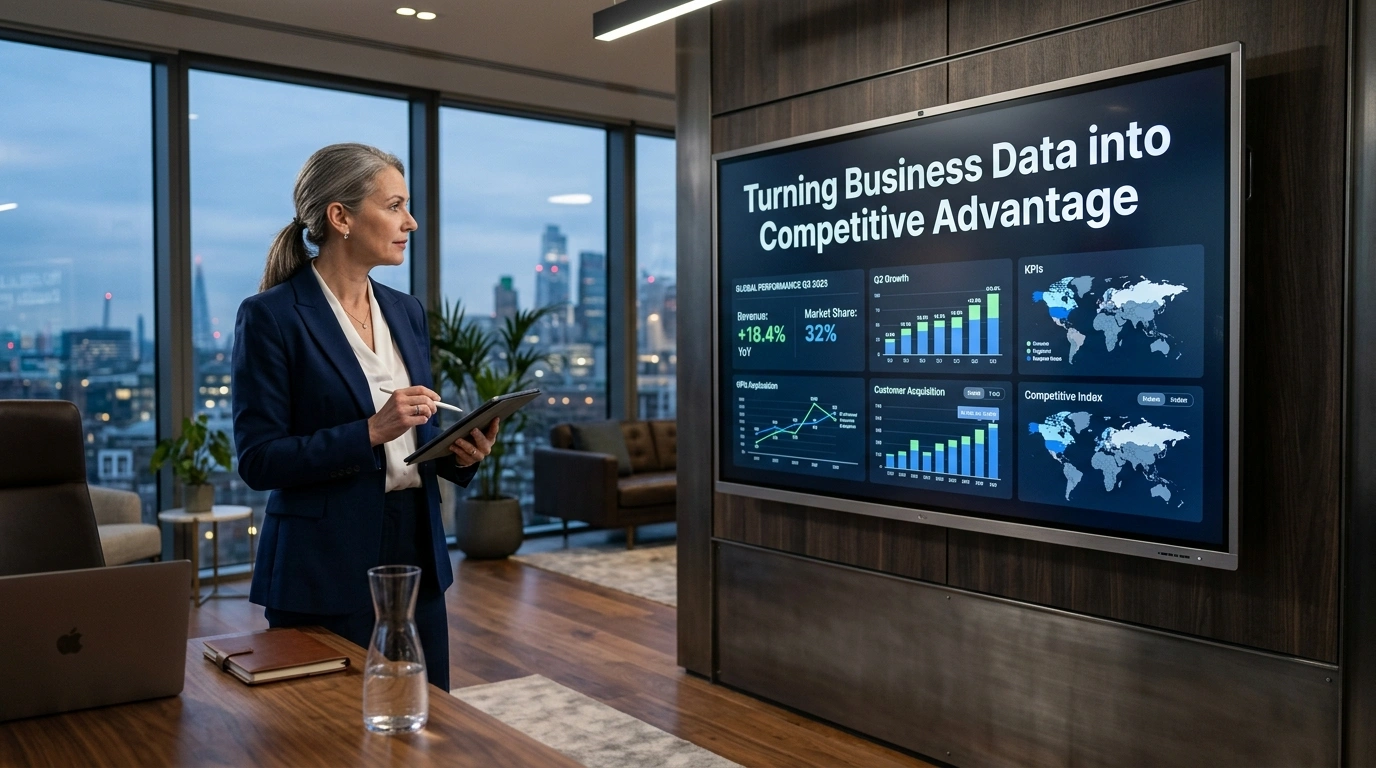
Consequently, Data-Driven Insights for small business contribute to operational optimization by enabling organizations to analyze supply chains, forecast demand, and reduce inefficiencies across internal processes. Similarly, the democratization of analytics technologies, including artificial intelligence and predictive analytics, has allowed smaller companies to access advanced decision-support capabilities that were previously limited to large enterprises. In addition, the integration of multiple data sources such as sales systems, customer relationship management platforms, and digital marketing channels creates a unified perspective that strengthens strategic alignment across departments. Subsequently, Data-Driven Insights for small business reinforce market agility by allowing organizations to identify evolving consumer expectations and adjust product offerings accordingly.
Moreover, data-driven enterprises frequently gain a competitive edge because analytical insights enable faster and more accurate responses to economic uncertainty, technological disruption, and competitive pressures. Meanwhile, continuous monitoring of operational and market data enables organizations to anticipate shifts in demand and adjust strategies before competitors respond. Consequently, the strategic use of Data-Driven Insights for small business transforms information into a long-term organizational resource that supports innovation, risk management, and sustained business resilience. Ultimately, systematic analysis converts everyday business data into strategic intelligence that supports growth and competitive stability.
Measuring Key Performance Indicators (KPIs) That Matter for Small Businesses
The measurement of key performance indicators represents a central component of Data-Driven Insights for small business because KPIs provide quantifiable evidence of how effectively a company progresses toward operational and financial objectives. Furthermore, performance indicators convert abstract business goals into measurable outcomes that guide strategic planning, operational improvement, and resource allocation. Additionally, KPI frameworks enable organizations to evaluate business health through structured metrics that reveal trends in profitability, customer engagement, and operational efficiency. Consequently, Data-Driven Insights for small business depend on carefully selected indicators that reflect both short-term performance and long-term sustainability.
Moreover, small businesses commonly monitor a combination of financial, customer, and operational indicators that reveal whether business activities produce sustainable outcomes. Similarly, revenue growth, profit margins, and cash-flow stability provide insight into financial resilience, while operational metrics such as productivity and cost efficiency reveal how effectively resources are utilized. Additionally, customer-related indicators such as retention rates, customer lifetime value, and satisfaction levels provide important signals regarding long-term market viability. Consequently, Data-Driven Insights for small business transform these indicators into practical knowledge that supports evidence-based management.
Furthermore, KPI dashboards integrate real-time information from multiple operational systems, thereby improving transparency and coordination among teams. Likewise, continuous performance monitoring allows managers to detect performance gaps early and refine strategies accordingly. Moreover, Data-Driven Insights for small business strengthen organizational learning because measurable outcomes support ongoing evaluation and improvement of business processes. Ultimately, structured KPI frameworks translate operational data into reliable performance intelligence that supports sustainable development.
Using Data Insights to Improve Customer Experience and Retention
Customer analytics represents a fundamental element of Data-Driven Insights for small business because understanding behavioral patterns enables organizations to deliver experiences that increase satisfaction, loyalty, and long-term customer value. Furthermore, analytical evaluation of customer interactions allows businesses to identify motivations behind purchasing decisions and engagement behaviors. Consequently, organizations that interpret customer data effectively can personalize services, refine marketing communication, and improve product recommendations according to observed preferences. Additionally, retention analytics examines behavioral signals such as purchase frequency, service feedback, and engagement trends in order to determine the factors influencing continued loyalty or disengagement.
Moreover, customer retention strategies benefit from systematic data interpretation because behavioral insights reveal opportunities to strengthen relationships and improve service quality. Similarly, Data-Driven Insights for small business enable organizations to identify patterns of satisfaction and dissatisfaction throughout different stages of the customer journey. Furthermore, organizations analyze customer feedback, support interactions, and purchase histories to identify service gaps that influence long-term loyalty. Consequently, data-driven customer strategies assist businesses in designing products and services that more closely align with user expectations.
Additionally, predictive analytics allows organizations to anticipate customer needs and respond proactively through personalized communication and tailored offers. Likewise, segmentation techniques allow businesses to categorize customers according to preferences, behavioral characteristics, and purchasing history. Consequently, Data-Driven Insights for small business strengthen customer relationships by enabling organizations to deliver more relevant and responsive experiences. Ultimately, customer-focused analytics supports both satisfaction and sustainable retention.
Tracking Market Trends and Competitor Data for Strategic Positioning
Market intelligence represents a strategically important component within the framework of Data-Driven Insights for small business because systematic analysis of external information enables organizations to anticipate changes in industry dynamics and consumer demand. Furthermore, market research integrates demographic trends, economic indicators, and consumer behavior data to reveal opportunities and risks affecting business development. Consequently, organizations that consistently monitor external signals gain improved awareness of emerging opportunities and competitive pressures. Additionally, strategic market observation strengthens the ability of companies to adapt products, pricing strategies, and marketing approaches.
Moreover, competitor analysis forms a critical element of strategic positioning because understanding rival strategies enables businesses to differentiate their offerings more effectively. Similarly, Data-Driven Insights for small business allow organizations to evaluate competitor pricing, product features, and customer engagement strategies. Furthermore, digital platforms generate valuable intelligence through social media trends, search analytics, and online customer sentiment. Consequently, organizations use these insights to refine brand positioning and market communication strategies.
Additionally, trend monitoring supports long-term planning by identifying shifts in technology adoption, consumer expectations, and industry innovation. Likewise, predictive analytics helps organizations forecast potential market developments and evaluate future scenarios. Consequently, Data-Driven Insights for small business provide entrepreneurs with a clearer understanding of competitive landscapes and strategic opportunities. Ultimately, continuous market analysis supports informed strategic positioning and long-term business stability.
Scaling Small Business Operations Through Data-Driven Decision Frameworks
Structured analytical frameworks play an important role in expanding operational capacity and organizational efficiency, demonstrating how Data-Driven Insights for small business support sustainable scaling. Furthermore, data-driven decision frameworks integrate analytics, performance monitoring, and predictive modeling to guide operational planning and resource allocation. Consequently, organizations that rely on structured analytical approaches often achieve improved efficiency because operational adjustments rely on measurable evidence rather than assumptions. Additionally, centralized analytics platforms consolidate operational, financial, and customer data into unified dashboards that enhance managerial visibility.
Moreover, Data-Driven Insights for small business assist companies in detecting operational bottlenecks and improving workflow efficiency through systematic performance evaluation. Similarly, predictive forecasting enables businesses to anticipate fluctuations in demand, inventory requirements, and workforce needs. Furthermore, analytical insights support financial planning by revealing trends in revenue, costs, and profitability across various business activities. Consequently, organizations can expand operational capacity more effectively when managerial decisions rely on structured analysis.
Additionally, scenario modeling and predictive analytics allow organizations to evaluate alternative strategies before implementing significant operational changes. Likewise, Data-Driven Insights for small business strengthen organizational agility by enabling companies to respond rapidly to shifting market conditions and technological developments. Consequently, continuous data analysis transforms decision-making into an ongoing strategic process rather than an occasional managerial activity. Ultimately, data-driven frameworks convert operational information into strategic guidance that enables sustainable expansion.
In a rapidly evolving business landscape, the strategic use of Data-Driven Insights for small business ultimately determines how effectively organizations can adapt, compete, and grow. By integrating analytics into decision-making, marketing, operations, and customer engagement, small businesses gain clearer visibility into performance and future opportunities. This analytical foundation not only improves efficiency and reduces risk but also supports innovation and long-term resilience. As 2026 continues to emphasize digital transformation, businesses that consistently leverage data as a core asset will be best positioned to achieve sustainable growth and maintain a competitive edge.