










Power BI Training for business owners has become an essential investment for leaders seeking to make smarter, data-driven decisions in increasingly competitive markets. By developing the ability to analyze business performance, visualize critical metrics, and transform raw data into strategic insights, business owners can strengthen operational efficiency and long-term growth. Effective training empowers decision-makers to confidently use data as a leadership tool, improving forecasting, resource management, and organizational agility.
Power BI Training for business owners: Building a Data-Driven Leadership Mindset
Recognizing competitive pressure across modern markets, Power BI Training for business owners increasingly shapes leadership by transforming fragmented operational data into continuous strategic intelligence that supports stronger forecasting, faster adaptation, and more measurable business growth. Emphasizing accessible business intelligence tools, Power BI Training for business owners develops executive familiarity with dashboards, data modeling, KPI frameworks, and performance visualization, thereby reducing dependence on delayed static reports while expanding strategic clarity. Strengthening analytical awareness, this training enables business owners to interpret financial, operational, customer, and marketing trends within unified ecosystems, consequently improving resource allocation and organizational responsiveness.

Supporting broader organizational transformation, Power BI Training for business owners reinforces data literacy as a leadership discipline rather than a technical specialty, allowing decision-makers to integrate measurable evidence into planning, hiring, expansion, and risk management. Encouraging proactive governance, real-time reporting structures reshape how leaders monitor margins, customer retention, supply chain shifts, and market opportunities while simultaneously increasing accountability across departments. Building long-term strategic resilience, business owners increasingly rely on live metrics to strengthen judgment, reduce uncertainty, and maintain competitive relevance.
Advancing beyond software familiarity, Power BI Training for business owners cultivates a leadership environment where information functions as a strategic asset, operational blind spots diminish, and executive decisions increasingly reflect evidence-based judgment rather than intuition alone. Reinforcing executive adaptability, this transformation strengthens sustainable decision-making across evolving industries. Positioning business intelligence as a foundational leadership capability, Power BI increasingly supports long-term organizational stability and measurable growth.
Why business owners need Power BI Training for business owners
Facing increasingly volatile business conditions, owners require faster access to operational truth, and Power BI Training for business owners addresses this requirement by simplifying data aggregation, visualization, and executive oversight. Replacing siloed spreadsheets and inconsistent reporting systems, Power BI enables owners to consolidate sales, finance, marketing, and operational indicators into centralized dashboards, thereby improving strategic visibility. Strengthening leadership precision, Power BI Training for business owners enhances the ability to identify inefficiencies, recognize revenue opportunities, and evaluate performance anomalies before they escalate into broader strategic failures.
Reducing reaction time, integrated reporting tools support quicker responses to customer behavior changes, market fluctuations, and internal productivity gaps. Supporting sustainable expansion, this training helps business owners align strategic planning with measurable benchmarks, ensuring that scaling decisions rely on validated performance metrics rather than unsupported assumptions. Encouraging disciplined governance, Power BI literacy reduces excessive dependence on analysts while empowering executives to question trends, evaluate narratives, and verify strategic priorities directly.
Positioning data as an executive necessity, Power BI Training for business owners serves as a foundational capability for modern leadership, where sustainable success depends on visibility, speed, and analytical confidence rather than isolated managerial instinct. Strengthening organizational resilience, these capabilities improve forecasting, resource allocation, and strategic coordination. Reinforcing long-term competitiveness, Power BI literacy increasingly defines stronger executive performance across modern enterprises.
How data literacy strengthens executive decision-making
Building stronger executive intelligence, data literacy transforms leadership by enabling business owners to interpret metrics, trends, and predictive insights with greater confidence, while Power BI Training for business owners accelerates this transformation through practical business application. Expanding beyond technical understanding, data literacy strengthens strategic reasoning by helping leaders distinguish between correlation and causation, identify hidden performance drivers, and evaluate decisions against measurable outcomes. Improving strategic agility, executives with stronger data fluency increasingly navigate uncertainty through dashboard analysis, scenario planning, and trend forecasting instead of relying on fragmented departmental narratives.
Supporting more objective governance, Power BI Training for business owners sharpens the ability to challenge unsupported assumptions, reduce bias, and prioritize initiatives based on operational evidence. Encouraging organizational alignment, data-literate executives create clearer KPI structures, stronger accountability systems, and more consistent performance management cultures. Enhancing long-term competitiveness, stronger data literacy improves budgeting discipline, operational optimization, and strategic adaptation across changing business environments.
Strengthening executive authority, Power BI Training for business owners fosters a leadership environment where informed decisions become repeatable organizational practices, thereby improving resilience, profitability, and strategic clarity across increasingly complex markets. Reinforcing evidence-based governance, data literacy consistently strengthens leadership outcomes. Positioning measurable intelligence at the center of executive strategy, business owners gain greater confidence in both immediate and long-term decision-making.
Core Power BI concepts every owner should understand
Understanding essential business intelligence architecture, owners benefit significantly when Power BI Training for business owners introduces core concepts that support strategic decision-making without requiring deep technical specialization. Beginning with data connectivity, Power BI integrates multiple business sources such as CRM systems, accounting software, operational databases, and marketing platforms into unified analytical ecosystems. Advancing insight quality, data modeling organizes relationships between datasets, thereby improving reporting consistency and analytical depth.
Strengthening strategic interpretation, dashboards and reports visualize KPIs, trends, and exceptions in formats that simplify executive oversight. Supporting deeper performance analysis, DAX enhances calculated measures and business logic, allowing more customized operational intelligence. Expanding leadership flexibility, drill-down features enable owners to investigate performance anomalies from summary views into operational specifics.
Improving governance reliability, refresh schedules and real-time data integrations ensure decisions rely on current information rather than outdated snapshots. Building strategic literacy, Power BI Training for business owners transforms these technical concepts into practical leadership tools, thereby strengthening executive independence and expanding the ability to govern organizations through measurable operational intelligence. Reinforcing technical confidence, these concepts collectively improve leadership adaptability and business performance.
Leadership habits shaped by real-time business intelligence
Embracing continuous performance visibility, real-time business intelligence reshapes leadership habits by encouraging more responsive, evidence-centered management behaviors, while Power BI Training for business owners provides the framework for sustaining these developments. Replacing delayed quarterly reactions, real-time dashboards encourage daily strategic awareness, enabling leaders to detect revenue shifts, operational disruptions, or customer behavior changes with greater immediacy. Strengthening adaptability, executives increasingly prioritize iterative adjustments over rigid long-term assumptions, thereby improving resilience in dynamic markets.
Supporting disciplined strategic reviews, live intelligence tools encourage regular KPI monitoring, faster resource reallocation, and more transparent accountability practices. Encouraging stronger organizational communication, data-driven leaders increasingly align team discussions around measurable outcomes rather than subjective interpretations. Reinforcing operational discipline, continuous business intelligence strengthens organizational consistency and strategic responsiveness.
Transforming leadership from reactive oversight into proactive strategic governance, Power BI Training for business owners strengthens executive precision, organizational alignment, and competitive sustainability by embedding intelligence directly into daily decision-making structures. Reinforcing sustainable leadership development, these habits increasingly define successful business modernization. Positioning real-time intelligence as a core leadership asset, Power BI supports stronger long-term strategic execution.
Turning Business Data into Strategy with Power BI Training for business owners
Transforming fragmented operational figures into strategic intelligence defines the central value of Power BI Training for business owners, as modern organizations increasingly depend on leadership that interprets data rather than merely collects it. Moreover, strengthened executive understanding of dashboards, data models, and visualization frameworks enables owners to align revenue objectives, operational efficiency, and long-term planning through evidence-based management. Consequently, Power BI Training for business owners supports a shift from reactive decision-making toward proactive strategic leadership by converting isolated reports into unified performance ecosystems.

Furthermore, integrating financial metrics, customer trends, supply chain indicators, and productivity benchmarks within one environment improves strategic visibility while reducing informational blind spots. As a result, business owners gain stronger control over profitability, resource allocation, and competitive positioning through real-time insight rather than delayed reporting. Additionally, enhanced data literacy through Power BI strengthens confidence in interpreting market fluctuations, forecasting growth scenarios, and evaluating strategic risks with greater precision.
In contrast to spreadsheet-dependent workflows, visual business intelligence ecosystems accelerate comprehension and strengthen communication between leadership teams and departmental managers. Likewise, embedded KPI governance within executive practices ensures that leadership decisions remain centered on measurable outcomes rather than assumptions. Ultimately, Power BI Training for business owners functions as a foundational leadership development mechanism that reinforces data-driven culture, strategic oversight, and evidence-centered business transformation.
Using dashboards to track sales, cash flow, and operations
Monitoring business performance through centralized dashboards significantly strengthens executive awareness by presenting essential operational indicators in an immediately accessible visual format. Furthermore, Power BI Training for business owners enhances leadership capacity by developing the ability to structure dashboards that unify sales pipelines, expense ratios, cash reserves, inventory movement, and workforce productivity into one continuous strategic interface. Consequently, decision-makers develop a more accurate understanding of organizational health without relying on disconnected departmental summaries.
Additionally, dynamic dashboards that track sales performance clarify customer behavior, product performance, and revenue fluctuations in real time while simultaneously improving responsiveness to commercial opportunities. Likewise, visual cash flow reporting strengthens financial discipline by exposing liquidity patterns, expense volatility, and profitability pressure points before they develop into larger strategic challenges. Meanwhile, operational dashboards reveal production bottlenecks, service inefficiencies, or staffing gaps that often remain concealed within manual reporting systems.
As a result, Power BI Training for business owners reduces reporting delays and strengthens strategic precision by replacing fragmented oversight with integrated operational transparency. In addition, translating complex operational data into visual analytical frameworks improves communication between executives, finance teams, and operations managers. Ultimately, Power BI Training for business owners enables organizations to establish dashboards as strategic control systems that support faster decisions, stronger financial resilience, and measurable operational optimization.
Connecting multiple data sources for a unified view
Integrating disconnected business systems into one analytical framework significantly increases leadership effectiveness by eliminating data silos and establishing a consistent organizational information base. Moreover, Power BI Training for business owners develops the technical and strategic capacity to connect accounting platforms, CRM systems, e-commerce tools, inventory databases, marketing channels, and operational software into centralized reporting environments. Consequently, fragmented information becomes unified intelligence that supports more coherent executive planning.
Furthermore, combining multiple data sources reduces reporting inconsistencies while improving confidence in KPI accuracy across departments. As a result, leadership gains a consolidated perspective that supports faster strategic assessments and more reliable cross-functional collaboration. Additionally, unified data environments simplify performance evaluation by revealing relationships between customer acquisition, operational cost, financial return, and employee productivity.
In contrast to siloed reporting systems, connected business intelligence frameworks improve strategic clarity while reducing duplication, inefficiency, and decision fatigue. Likewise, reinforced governance principles through Power BI Training for business owners maintain data quality, consistency, and accessibility throughout the organization. Ultimately, Power BI Training for business owners establishes integrated data ecosystems as the foundation for strategic growth, operational coherence, and competitive resilience.
Translating KPIs into practical leadership insights
Converting key performance indicators into meaningful leadership intelligence strengthens business governance by linking measurable outcomes directly to strategic priorities. Furthermore, Power BI Training for business owners improves executive interpretation of financial, operational, and customer KPIs by emphasizing context, trends, and decision relevance rather than isolated metrics. Consequently, leadership becomes better equipped to evaluate organizational performance through actionable indicators that reflect profitability, efficiency, and sustainability.
Moreover, comprehensive understanding of KPI behavior enables business owners to identify growth opportunities, operational weaknesses, and strategic risks with greater precision. As a result, Power BI Training for business owners transforms dashboards from passive monitoring systems into active leadership instruments that guide resource allocation, team accountability, and performance optimization. Additionally, visual KPI frameworks simplify strategic communication by presenting complex business realities in accessible, measurable formats.
Therefore, KPI literacy strengthens leadership maturity by ensuring that executive actions correspond directly to measurable business conditions. In addition, contextual KPI analysis reduces dependence on instinct while reinforcing structured planning and performance management. Ultimately, Power BI Training for business owners cultivates a leadership culture in which KPIs function as strategic instruments for sustainable business advancement, informed governance, and continuous organizational improvement.
Reducing guesswork through visual reporting and analysis
Replacing intuition-based management with visual evidence significantly strengthens business stability by improving the speed, clarity, and reliability of executive decisions. Moreover, Power BI Training for business owners develops analytical confidence by enabling leaders to interpret visual trends, comparative performance models, and predictive indicators with greater precision. Consequently, decision-making becomes more disciplined, reducing the costly uncertainty associated with assumption-driven leadership.
Furthermore, visual reporting frameworks simplify complex datasets into understandable analytical narratives that accelerate executive comprehension without compromising analytical depth. As a result, organizations respond more effectively to revenue fluctuations, market changes, and operational inefficiencies. Additionally, Power BI Training for business owners strengthens scenario planning by enabling business leaders to model outcomes, test assumptions, and identify strategic opportunities before committing resources.
In contrast to static spreadsheet systems, visual analytics improve strategic responsiveness while strengthening long-term planning discipline. In addition, reduced uncertainty strengthens organizational trust because strategic decisions remain visibly connected to measurable evidence. Ultimately, Power BI Training for business owners provides the analytical foundation necessary to establish evidence-centered leadership systems that reduce uncertainty, improve business agility, and support sustained strategic success through transparent analysis.
Power BI Training for business owners for Smarter Forecasting and Growth Planning
Leveraging Power BI Training for business owners strengthens strategic forecasting by transforming fragmented operational, financial, and market data into unified decision frameworks that improve long-term business planning. Moreover, integrating data from sales systems, accounting platforms, customer behavior analytics, and supply chain operations enables business owners to recognize emerging performance patterns with greater precision. Consequently, visual dashboards clarify revenue cycles, demand fluctuations, and operational bottlenecks, allowing leadership to align expansion strategies with measurable evidence rather than assumptions.
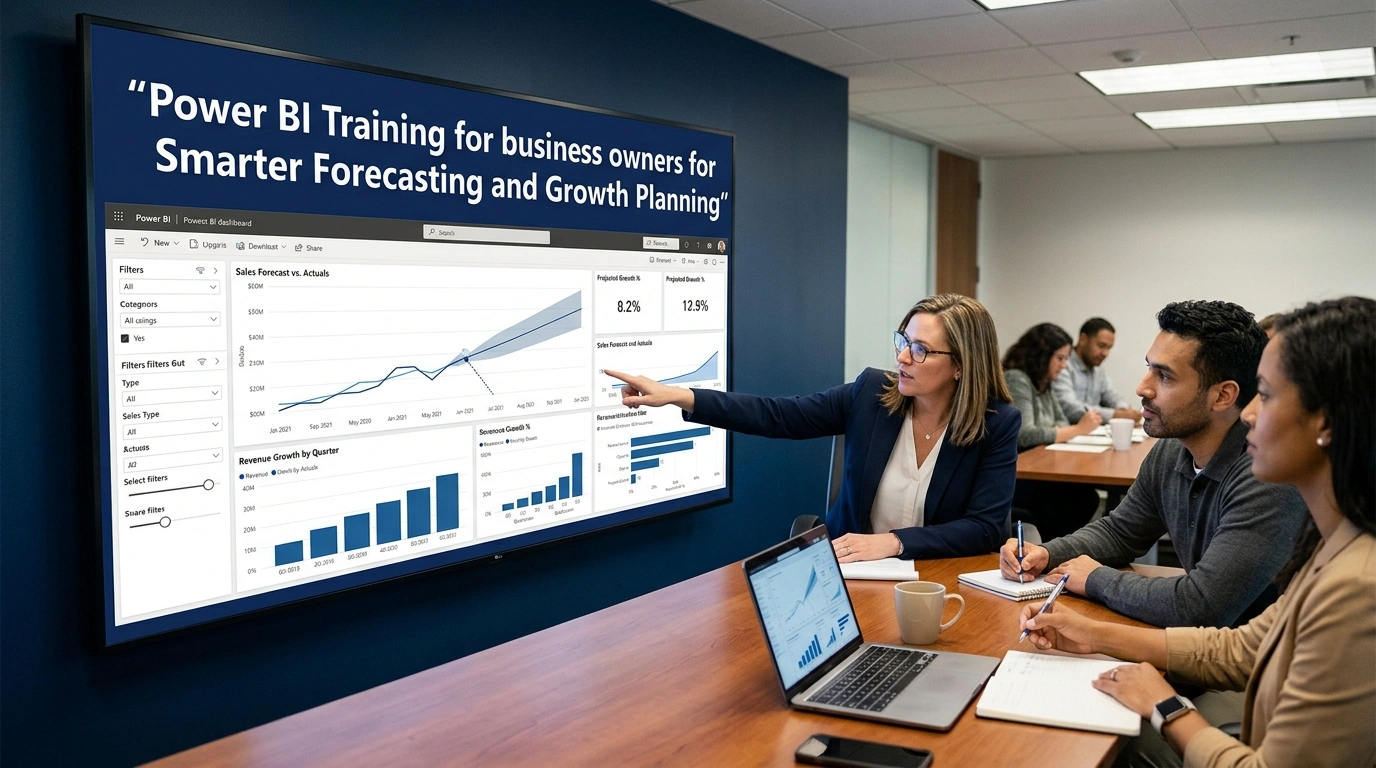
Furthermore, Power BI Training for business owners enhances predictive modeling capabilities by introducing scenario analysis, trend projections, and historical comparisons that improve preparedness for uncertainty. As a result, growth planning becomes more disciplined through consistent performance reviews, actionable KPI structures, and reliable forecasting mechanisms. Additionally, improving data literacy through Power BI Training for business owners strengthens executive oversight by connecting tactical performance indicators with broader organizational objectives.
Therefore, business owners gain greater confidence when evaluating market opportunities, expansion timing, hiring strategies, and capital investments. Meanwhile, automating reporting workflows reduces delays in leadership reviews, supporting faster adaptation to economic shifts and competitive pressures. Ultimately, strengthening forecasting discipline through Power BI Training for business owners establishes a foundation for strategic decisions informed by measurable insights, balanced risk assessment, and sustainable operational growth.
Identifying trends, risks, and opportunities with Power BI
Utilizing Power BI Training for business owners improves organizational visibility by converting complex datasets into accessible visual intelligence that highlights strategic opportunities and operational vulnerabilities. Additionally, monitoring trend lines across revenue, customer acquisition, inventory movement, and departmental productivity enables business leaders to detect shifts before they develop into more significant challenges. Consequently, identifying underperforming segments, rising costs, or declining customer retention becomes more immediate and actionable.
Furthermore, integrating real-time dashboards with historical performance comparisons strengthens leadership’s capacity to recognize patterns associated with seasonality, market expansion, and emerging threats. Therefore, Power BI Training for business owners supports proactive risk management through earlier intervention and more precise strategic planning. Meanwhile, uncovering hidden correlations between financial metrics and operational outputs creates pathways for innovation and competitive advancement.
As a result, leaders can prioritize investments more effectively while reducing dependence on intuition alone. Moreover, analyzing scenario-based outcomes enables business owners to evaluate multiple strategic directions with clearer evidence. Ultimately, strengthening trend analysis capabilities through Power BI Training for business owners enhances strategic agility, reduces avoidable losses, and supports growth strategies grounded in measurable intelligence.
Improving budgeting and forecasting through business intelligence
Applying Power BI Training for business owners improves budgeting accuracy by centralizing financial data and connecting expenditures, revenues, operational costs, and growth projections into cohesive analytical systems. Furthermore, replacing static spreadsheets with dynamic dashboards allows leadership to evaluate budget performance continuously rather than through isolated review periods. Consequently, identifying overspending, underperforming investments, and cash flow inconsistencies becomes significantly more efficient.
Additionally, Power BI Training for business owners enhances forecasting through automated financial trend analysis, variance tracking, and predictive scenario modeling. Therefore, resource allocation decisions increasingly reflect actual business conditions rather than outdated assumptions. Meanwhile, integrating department-level financial data strengthens strategic budgeting by ensuring operational realities remain aligned with executive goals.
As a result, budgeting frameworks become more adaptable during economic volatility and organizational expansion. Moreover, visualizing profitability trends and expense distributions supports stronger accountability across departments. Ultimately, improving budgeting discipline through Power BI Training for business owners creates more sustainable growth models, stronger fiscal oversight, and greater strategic confidence.
Measuring team and departmental performance accurately
Strengthening performance management through Power BI Training for business owners enables more precise measurement of departmental efficiency, employee productivity, and strategic contribution across the organization. Additionally, consolidating operational KPIs into interactive dashboards improves transparency by linking team performance directly to business objectives. Consequently, leadership gains clearer insight into sales effectiveness, operational output, customer service quality, and financial accountability.
Furthermore, Power BI Training for business owners enhances performance analysis by supporting benchmark comparisons, target tracking, and role-specific metrics. Therefore, identifying high-performing departments and operational inefficiencies becomes faster and more objective. Meanwhile, integrating performance analytics with broader forecasting systems ensures workforce strategies remain aligned with long-term business goals.
As a result, hiring decisions, resource distribution, and leadership development initiatives become more strategically informed. Moreover, visual reporting reduces ambiguity by presenting measurable outcomes in accessible formats for executives and managers alike. Ultimately, using Power BI Training for business owners to monitor departmental performance improves leadership precision, operational consistency, and sustainable organizational scaling.
Scaling decisions with consistent and reliable reporting frameworks
Implementing Power BI Training for business owners supports organizational scaling by creating standardized reporting frameworks that maintain strategic consistency across expanding operations. Furthermore, consolidating data sources into unified dashboards strengthens governance by ensuring leadership decisions are informed by consistent metrics. Consequently, reducing reporting fragmentation improves executive coordination, departmental alignment, and long-term planning reliability.
Additionally, Power BI Training for business owners enhances scalability by automating reporting structures that adapt to larger datasets, expanded departments, and increasing operational complexity. Therefore, growth no longer depends on disconnected systems or inconsistent analytical standards. Meanwhile, reliable KPI frameworks improve investor communication, strategic partnerships, and expansion planning by providing verifiable performance narratives.
As a result, scaling strategies become more structured, measurable, and sustainable. Moreover, establishing repeatable reporting standards improves leadership efficiency while preserving strategic clarity during organizational transitions. Ultimately, strengthening reliable reporting systems through Power BI Training for business owners ensures scaling decisions remain informed, controlled, and aligned with sustainable business objectives.
Choosing the Right Power BI Training Path for Business Owners
Strengthening leadership capacity through data literacy increasingly positions Power BI Training for business owners as a strategic investment rather than a technical expense, while enabling decision-makers to translate operational complexity into measurable performance intelligence. Supporting this transformation, effective training paths often balance business context, executive availability, and organizational maturity, thereby ensuring that learning aligns with commercial outcomes rather than isolated software proficiency. Addressing varying leadership requirements, self-paced digital programs frequently provide flexibility for busy entrepreneurs, whereas structured workshops often accelerate collaborative application through concentrated scenario-based exercises.
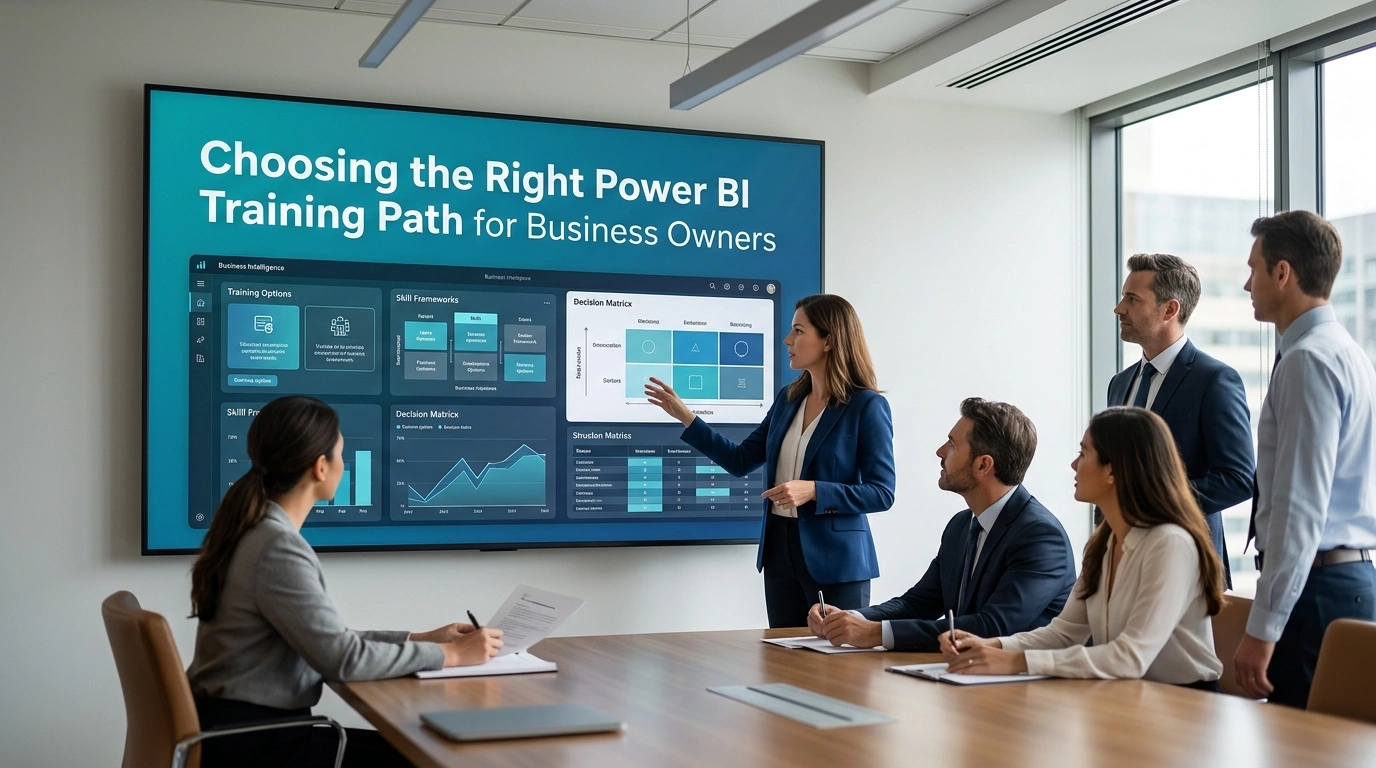
Instructor-led programs typically deliver deeper strategic insight through guided interpretation of dashboards, forecasting models, and KPI systems, thereby supporting more effective executive decision-making. Successful Power BI Training for business owners frequently emphasizes revenue analysis, financial forecasting, customer behavior evaluation, and operational efficiency metrics, thus creating direct relevance to business growth priorities. Carefully selected learning pathways often reinforce long-term value by integrating practical implementation with governance frameworks, helping business leaders institutionalize reporting consistency across teams.
Comprehensive programs additionally support sustainable competitive advantage by strengthening confidence in data governance, decision modeling, and performance monitoring. This foundation allows Power BI Training for business owners to contribute not only to immediate analytical capability but also to broader organizational resilience, where informed leadership increasingly shapes adaptive growth, innovation readiness, and evidence-based management culture. Selecting the appropriate training pathway frequently determines how effectively business owners expand beyond software mastery and transform data into strategic leadership assets.
Comparing self-paced, workshop, and instructor-led learning options
Examining educational formats reveals that Power BI Training for business owners produces varying outcomes depending on instructional structure, learner discipline, and implementation urgency, while each pathway serves distinct executive development priorities. Self-paced programs commonly offer convenience through independent progression, cost efficiency, and repeatable access to technical resources, although they often require stronger personal accountability and may limit strategic contextual discussion. Workshops frequently provide more immersive collaboration by creating focused environments where participants apply business intelligence concepts to practical forecasting, budgeting, and reporting scenarios.
Instructor-led learning often delivers the highest degree of strategic mentorship by providing customized feedback, deeper governance insight, and executive-level application, thus supporting more complex organizational transformations. Instructor-led Power BI Training for business owners often proves particularly valuable when adoption involves multiple departments or enterprise-scale reporting reforms because it bridges technical learning with business outcomes. Organizations frequently evaluate flexibility, cost, strategic depth, and implementation speed when clarifying comparative distinctions among available learning models.
Blended models often strengthen informed selection by combining digital flexibility with strategic workshops, thereby maximizing both accessibility and implementation effectiveness. Power BI Training for business owners performs most successfully when educational delivery aligns with operational realities, leadership capacity, and intended business intelligence maturity. The selected learning format often determines the sustainability and scalability of analytics adoption across evolving business environments, thereby advancing organizational capability.
Evaluating course outcomes, ROI, and adoption readiness
Assessing educational effectiveness increasingly requires business owners to measure Power BI Training for business owners through operational outcomes rather than course completion alone, while emphasizing strategic return over technical participation. Organizations often improve this evaluation by examining post-training dashboard adoption, forecasting accuracy improvements, reporting efficiency gains, and enhanced executive responsiveness to business fluctuations. Successful programs frequently strengthen ROI analysis by demonstrating measurable reductions in manual reporting workloads, improved visibility into revenue and cost drivers, and stronger alignment between departmental KPIs and strategic objectives.
Businesses additionally support broader adoption readiness by evaluating whether trained leaders can champion organizational change, reinforce analytical governance, and scale data practices across teams. Power BI Training for business owners often generates the strongest transformation potential when implementation roadmaps, internal accountability systems, and executive sponsorship provide sustained support. Operational efficiency, budgeting precision, and decision-making speed frequently measure practical value by revealing whether training has successfully translated into measurable business advancement.
Readiness assessments often reinforce sustainable analytics maturity by determining whether businesses possess sufficient data infrastructure, employee engagement, and reporting governance to capitalize on training outcomes. Power BI Training for business owners therefore represents a leadership development initiative whose true ROI emerges through operational integration, cultural adoption, and strategic performance improvement rather than software mastery alone. Consistent evaluation strengthens future scalability by ensuring that business intelligence investments continue generating competitive and financial value.
Aligning Power BI skills with long-term business goals
Positioning analytics education strategically allows Power BI Training for business owners to function as a foundational mechanism for sustained competitive growth, while linking technical insight directly to expansion priorities, innovation, and resilience. Business leaders increasingly support this strategic alignment by applying Power BI capabilities to long-term objectives such as market forecasting, customer retention optimization, operational scalability, and financial scenario planning. Power BI skills frequently strengthen executive foresight by improving the capacity to anticipate trends, identify inefficiencies, and align resource allocation with evolving strategic targets.
Power BI Training for business owners often reinforces organizational agility by ensuring that data-driven leadership remains integrated into succession planning, departmental accountability, and enterprise modernization initiatives. Strategic alignment often extends beyond immediate dashboard functionality by requiring analytics integration into planning cycles, KPI governance within leadership structures, and reporting framework scalability alongside business growth. Business owners frequently facilitate this broader transformation by establishing stronger adaptive infrastructures capable of responding intelligently to market volatility.
Power BI Training for business owners consequently advances leadership maturity by becoming a long-range investment that supports both measurable present performance and resilient future enterprise development. Strategic analytics education frequently strengthens organizational continuity by empowering leaders to balance immediate operational requirements with sustainable long-term ambitions. Aligned Power BI capabilities increasingly expand business resilience by shaping how organizations innovate, compete, and grow over time.
Creating a culture of continuous improvement through analytics
Embedding analytical capability into organizational culture increasingly transforms Power BI Training for business owners into a catalyst for continuous improvement, where leadership behavior directly influences enterprise-wide data engagement. Trained business owners frequently support this evolution by establishing reporting standards, dashboard accountability, and evidence-based review cycles that normalize performance transparency across departments. Power BI Training for business owners often encourages sustained optimization by strengthening employee confidence in metrics interpretation while reducing dependence on intuition-driven decisions.
Analytics-centered cultures commonly reinforce operational discipline by prioritizing iterative forecasting, measurable experimentation, and routine KPI reviews, thereby promoting consistent refinement rather than reactive correction. Organizations often strengthen these systems by integrating data accessibility, continuous learning initiatives, and strategic reporting into daily workflows, ensuring that improvement remains continuous rather than episodic. Leadership-driven analytics cultures frequently support enterprise maturity by creating stronger internal accountability and faster organizational responsiveness.
Power BI Training for business owners therefore builds durable strategic advantage by supporting not merely technical education but a broader cultural transformation in which continuous improvement becomes embedded in leadership philosophy, operational management, and long-term enterprise excellence. Business owners who consistently champion analytics often advance this culture by accelerating innovation, strengthening adaptability, and reinforcing sustainable competitive performance. Continuous improvement increasingly becomes a defining characteristic of resilient modern enterprises by establishing data-driven leadership as a core organizational principle.
In conclusion, Power BI Training for business owners provides far more than technical knowledge,it builds the foundation for stronger leadership through informed decision-making. Business owners who embrace advanced data analysis capabilities can improve performance oversight, identify new opportunities, and lead with greater precision in dynamic markets. Investing in these skills supports sustainable growth while positioning organizations for continued competitive advantage.