
Maximize Profits with Custom BI Solutions for E-commerce Stores by transforming fragmented operational data into unified, actionable intelligence that drives measurable growth. In an increasingly competitive digital marketplace, online retailers generate vast volumes of transactional, marketing, inventory, and customer data, yet sustainable profitability depends on how effectively this information is consolidated and analyzed. Custom BI solutions for e-commerce provide the structured analytics frameworks, real-time dashboards, and predictive capabilities required to align daily operations with long-term revenue objectives. By embedding advanced business intelligence into pricing strategies, marketing optimization, inventory management, and customer experience initiatives, organizations move beyond reactive reporting and establish a scalable foundation for continuous profit expansion.
Custom BI Solutions for E-commerce: Turning Data into Scalable Profit
Unlocking the full value of digital commerce depends on Custom BI Solutions for e-commerce as organizations convert fragmented data into scalable profit, and this process begins with integrating sales transactions, marketing metrics, inventory records, and customer interactions into a unified analytical environment. Consequently, businesses gain a consolidated operational view that reduces data silos, improves analytical consistency, and enables accurate performance evaluation across channels. Furthermore, aligning governance frameworks with Custom BI Solutions for e-commerce enhances data quality and reliability, thereby establishing a stable foundation for sustained strategic growth.

Organizations build on this integrated structure by using tailored analytics models that transform raw datasets into structured insights revealing purchasing patterns, seasonal demand shifts, and campaign effectiveness, thereby supporting evidence-based planning rather than assumption-driven decisions. In addition, scalable architectures embedded within Custom BI Solutions for e-commerce expand analytical capacity as transaction volumes and customer bases grow, ensuring that insight generation evolves alongside operational complexity. As a result, leadership teams strengthen their ability to anticipate risks, allocate resources efficiently, and optimize revenue streams in competitive digital markets.
Embedding analytics directly into operational workflows ensures that insights influence pricing, inventory management, marketing performance, and customer retention strategies in real time, thereby strengthening profitability across functional areas. Moreover, a culture of data transparency supported by Custom BI Solutions for e-commerce encourages cross-departmental collaboration, since stakeholders rely on shared metrics and consistent reporting standards. Ultimately, alignment between analytics and strategic objectives transforms business intelligence into a scalable profit engine that supports sustainable e-commerce growth.
Leveraging Real-Time E-commerce Analytics for Smarter Pricing Decisions
Adopting real-time analytics within Custom BI Solutions for e-commerce enables pricing strategies that reflect live market conditions, thereby strengthening competitiveness in rapidly shifting online environments. Consequently, pricing teams gain immediate visibility into demand fluctuations, competitor adjustments, and promotional impacts, which reduces dependence on static pricing models. Furthermore, the integration of streaming data pipelines ensures that price optimization decisions rely on the most current transactional information available.
Analyzing live behavioral and transactional data refines pricing accuracy by incorporating historical performance trends alongside immediate purchasing signals, thereby supporting balanced margin management. In addition, predictive components embedded within Custom BI Solutions for e-commerce evaluate potential outcomes of pricing adjustments before implementation, which minimizes financial risk while maximizing revenue opportunities. As a result, dynamic pricing strategies align more precisely with broader profitability targets.
Continuous monitoring of pricing adjustments in real time strengthens iterative optimization cycles, since conversion rates, cart abandonment levels, and average order values update continuously. Moreover, alignment between these insights and inventory levels and promotional calendars within Custom BI Solutions for e-commerce enhances coordination between pricing, merchandising, and marketing functions. Ultimately, the use of real-time analytics transforms pricing into a strategically guided activity that contributes directly to scalable profit growth.
Using Custom BI Dashboards to Track Sales Performance and Revenue Growth
Centralizing key performance indicators within Custom BI Solutions for e-commerce provides a comprehensive framework for tracking sales performance and revenue growth, thereby eliminating fragmented reporting practices. Consequently, executives and operational teams access unified dashboards that present consistent metrics across sales channels, customer segments, and product categories. Furthermore, synchronization of financial and marketing data within a single analytical interface enhances clarity in evaluating revenue drivers.
Visualization of revenue trends, conversion patterns, and customer acquisition costs strengthens strategic oversight, as interactive dashboards translate complex datasets into accessible performance intelligence. In addition, configuration of Custom BI Solutions for e-commerce to display real-time updates ensures that emerging sales patterns are identified promptly, which supports timely corrective or expansion-oriented actions. As a result, performance monitoring evolves from periodic review cycles into continuous strategic assessment.
Integration of forecasting models into dashboard environments enhances forward-looking analysis because predictive insights estimate future revenue scenarios based on historical and current indicators. Moreover, alignment of departmental objectives with shared dashboard metrics within Custom BI Solutions for e-commerce improves organizational cohesion and accountability. Ultimately, customized dashboards not only track revenue growth effectively but also reinforce data-driven alignment across the entire e-commerce ecosystem.
Identifying High-Margin Products with Advanced Business Intelligence Tools
Application of advanced analytics within Custom BI Solutions for e-commerce enables detailed evaluation of product-level profitability by incorporating cost structures, sales velocity, return rates, and discount impacts. Consequently, organizations obtain a granular understanding of which products contribute most significantly to net margins. Furthermore, integration of operational cost data alongside revenue metrics enhances the precision of margin calculations.
Segmentation of products based on profitability patterns refines portfolio management strategies, since clustering techniques reveal categories that consistently outperform others in financial contribution. In addition, integration of these analytical capabilities within Custom BI Solutions for e-commerce facilitates continuous margin monitoring, which allows detection of shifts caused by supply chain variations or competitive pressures. As a result, product assortment decisions align more closely with long-term profitability objectives.
Connection of margin insights with demand forecasting and promotional analysis strengthens merchandising strategy, as high-margin items receive prioritization in campaigns and inventory allocation plans. Moreover, correlation of profitability metrics with customer segmentation data within Custom BI Solutions for e-commerce uncovers opportunities to tailor offers around the most valuable product segments. Ultimately, advanced business intelligence tools convert product evaluation into a strategic lever for maximizing sustainable profit.
Transforming Raw Customer Data into Actionable Insights with BI Reporting
Consolidation of diverse customer data streams within Custom BI Solutions for e-commerce enables structured analysis of purchasing histories, browsing behaviors, and demographic attributes, thereby reducing fragmentation across platforms. Consequently, analytical reporting frameworks transform raw transactional records into coherent intelligence that supports strategic evaluation. Furthermore, implementation of standardized data models enhances consistency in interpreting customer engagement trends.
Analysis of segmented customer cohorts deepens understanding of loyalty patterns, churn risks, and lifetime value potential, as detailed reporting highlights variations in engagement and spending behavior. In addition, integration of predictive analytics within Custom BI Solutions for e-commerce forecasts future purchasing tendencies based on historical data, which strengthens proactive retention and personalization strategies. As a result, marketing initiatives align more precisely with measurable customer value indicators.
Integration of interactive reporting tools across departments enhances collaboration because stakeholders access shared customer intelligence through consistent visual and analytical formats. Moreover, alignment of these insights with revenue and product performance metrics within Custom BI Solutions for e-commerce creates a comprehensive view of how customer behavior drives profitability. Ultimately, transformation of raw customer data into actionable intelligence elevates strategic decision-making and reinforces scalable profit generation across e-commerce operations.
How Can Custom BI Solutions for E-commerce Improve Conversion Rates?
Leveraging Custom BI Solutions for e-commerce enables online retailers to improve conversion rates by transforming fragmented data from multiple channels into unified and actionable intelligence, consequently supporting more accurate decision-making across the entire sales funnel. Integrating transactional, behavioral, and operational datasets into a centralized system creates a comprehensive view of performance, thereby allowing businesses to detect patterns that influence purchasing decisions with greater precision. Connecting these insights to clearly defined conversion metrics reveals where potential revenue is lost, resulting in prioritized adjustments that directly influence profitability.
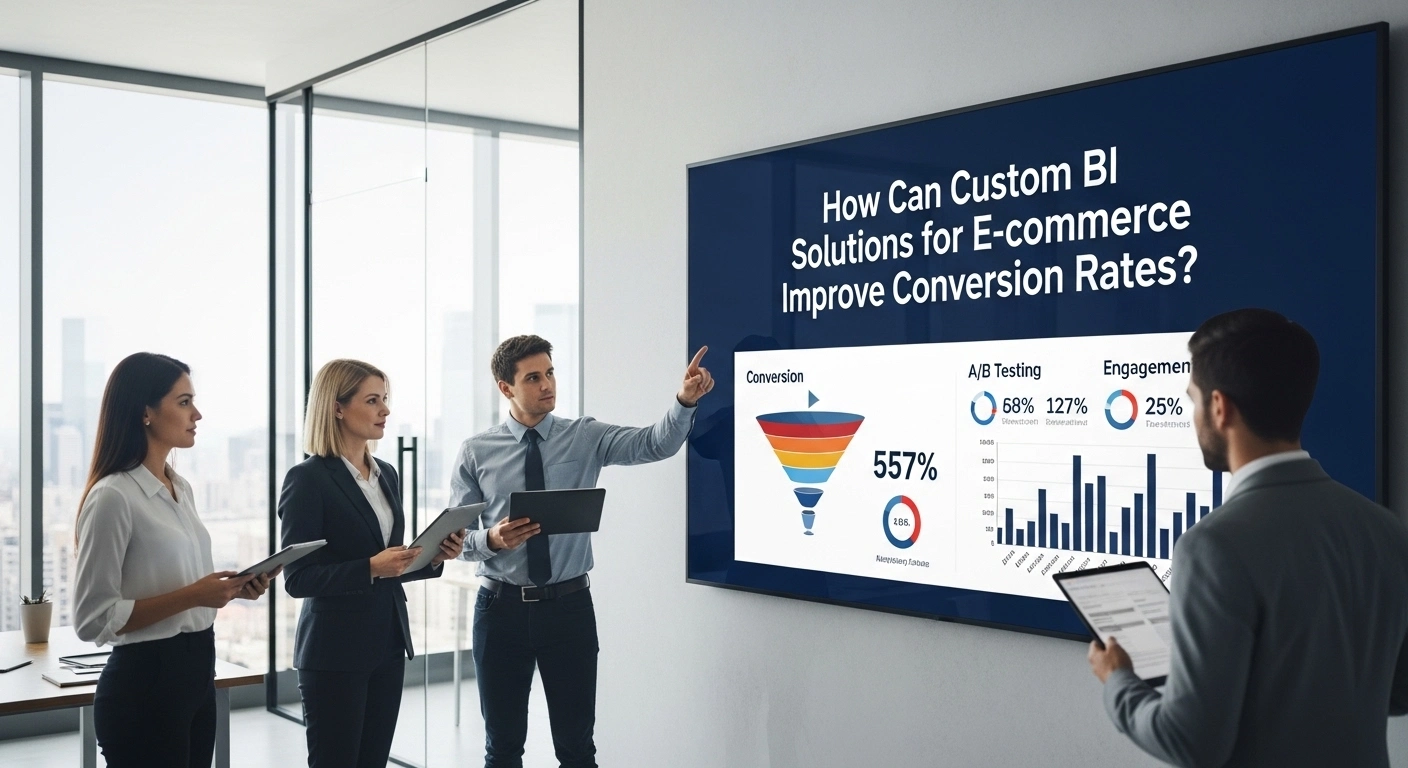
Utilizing Custom BI Solutions for e-commerce strengthens customer segmentation capabilities, enabling retailers to align marketing messages, pricing strategies, and product placements with the expectations of distinct audience groups. Applying predictive analytics within these systems refines forecasts of purchase intent, which allows targeted interventions such as personalized promotions or optimized landing pages to be timed with greater accuracy. Monitoring real-time dashboards simultaneously enhances responsiveness, allowing organizations to address emerging friction points before they significantly affect conversion performance.
Aligning Custom BI Solutions for e-commerce with broader commercial objectives supports long-term strategic planning, enabling organizations to balance immediate sales improvements with sustainable growth initiatives. Continuously evaluating conversion funnels generates an evidence-based feedback loop that leads to systematic refinement of site design, checkout processes, and promotional strategies. Embedding data-driven optimization across departments strengthens competitive positioning, contributing to higher conversion rates and improved profit performance in digital markets.
Analyzing Customer Behavior Data to Reduce Cart Abandonment
Examining customer behavior data through Custom BI Solutions for e-commerce provides detailed insight into how shoppers navigate digital storefronts and where they disengage, thereby clarifying the underlying causes of cart abandonment. Tracking metrics such as time on page, exit rates, and checkout progression exposes patterns of hesitation that analysts can associate with usability barriers or unexpected costs. Correlating behavioral signals with transactional outcomes strengthens predictive indicators of drop-off and improves the reliability of abandonment forecasting models.
Integrating Custom BI Solutions for e-commerce with advanced analytics tools enables segmentation of users according to their likelihood of abandoning purchases and supports differentiation between exploratory visitors and high-intent shoppers. Applying predictive models to these segments identifies early warning signals and allows timely responses such as personalized reminders or contextual incentives while engagement remains active. Analyzing checkout funnel performance in granular detail highlights technical or design barriers and informs improvements based on verified behavioral evidence.
Refining abandonment reduction strategies through continuous data analysis improves overall conversion efficiency and allows incremental performance gains to accumulate into measurable revenue growth. Aligning insights derived from Custom BI Solutions for e-commerce with user experience enhancements ensures that modifications address empirically identified customer pain points. Sustained analytical evaluation cultivates a more seamless purchasing environment, leading to reduced cart abandonment and stronger profit outcomes.
Optimizing Marketing Campaign Performance with Data-Driven Insights
Aggregating campaign data within Custom BI Solutions for e-commerce establishes a unified analytical environment that clarifies how various marketing channels contribute to conversions and enables more precise performance comparisons. Measuring metrics such as customer acquisition cost, engagement rates, and return on ad spend within a single framework strengthens accountability by linking marketing expenditure directly to revenue outcomes. Associating campaign activity with customer lifecycle stages contextualizes performance results and supports strategic alignment with profitability objectives.
Segmenting audiences through Custom BI Solutions for e-commerce enhances targeting accuracy by aligning promotional messages with behavioral and demographic characteristics. Monitoring real-time performance indicators enables timely adjustments when campaigns underperform and facilitates budget reallocation before inefficiencies escalate. Interpreting attribution models within integrated dashboards clarifies the contribution of each touchpoint and strengthens understanding of how engagement translates into completed transactions.
Projecting trends using predictive components embedded in Custom BI Solutions for e-commerce supports proactive campaign planning by anticipating engagement patterns based on historical data. Evaluating past performance alongside current metrics refines forecasting accuracy and guides the evolution of creative strategies in response to measurable audience preferences. Maintaining continuous data-driven optimization strengthens return on marketing investment and contributes to improved conversion rates and sustained profitability.
Personalizing Product Recommendations Through Predictive Analytics
Utilizing predictive analytics within Custom BI Solutions for e-commerce enhances personalization of product recommendations by analyzing historical purchasing and browsing behavior to anticipate future preferences. Identifying correlations between customer activity and product affinity strengthens recommendation algorithms and ensures that displayed items align with projected interests. Integrating these predictive insights into website interfaces increases contextual relevance and results in higher engagement levels and improved conversion potential.
Adapting recommendations dynamically through Custom BI Solutions for e-commerce ensures that recent interactions influence displayed products in real time and maintain responsiveness to evolving customer interests. Linking predictive models with refined customer segmentation enhances targeting precision and positions cross-selling and upselling opportunities more strategically. Evaluating recommendation effectiveness through analytical dashboards supports continuous algorithm refinement and improves personalization performance over time.
Extending predictive insights beyond on-site interactions into email and remarketing campaigns promotes consistency across channels and reinforces relevance throughout the customer lifecycle. Aligning recommendation systems with revenue objectives through Custom BI Solutions for e-commerce supports measurable increases in average order value across transactions. Sustained personalization based on continuous data analysis strengthens customer loyalty and retention and contributes to long-term profit maximization.
Enhancing the Customer Journey Using E-commerce Data Visualization
Transforming complex datasets into visual dashboards through Custom BI Solutions for e-commerce clarifies how customers progress across digital touchpoints and enables immediate identification of performance patterns. Mapping stages from awareness to post-purchase retention highlights behavioral trends that reveal friction points within the journey. Presenting metrics in visual formats reduces interpretive ambiguity and supports shared understanding of customer interactions across organizational teams.
Integrating real-time data streams into visualization tools within Custom BI Solutions for e-commerce enables observation of behavioral shifts as they occur and facilitates timely responses to unexpected performance changes. Comparing customer segments through interactive visualizations reveals variations in channel effectiveness and strengthens evidence-based resource allocation decisions. Connecting visual insights with operational and financial metrics links customer experience indicators directly to revenue outcomes.
Shared visual reporting facilitates collaboration and enhances organizational alignment around customer experience objectives. Reinforcing analytical transparency via Custom BI Solutions for e-commerce supports the development of a data-driven culture focused on measurable performance improvement. Sustained visualization-driven evaluation refines the overall customer journey and leads to higher satisfaction levels, improved conversion rates, and stronger profitability.
Scaling Operations with Advanced Business Intelligence for Online Stores
Growing online stores increasingly rely on Custom BI Solutions for e-commerce to convert fragmented operational data into structured intelligence that supports sustainable expansion. As transaction volumes, product catalogs, and customer touchpoints expand, centralized analytics environments consolidate information from storefronts, payment gateways, marketing platforms, and logistics systems into unified dashboards, and decision-makers consequently obtain a comprehensive operational view that links sales performance, marketing efficiency, fulfillment speed, and customer behavior within a single analytical framework.
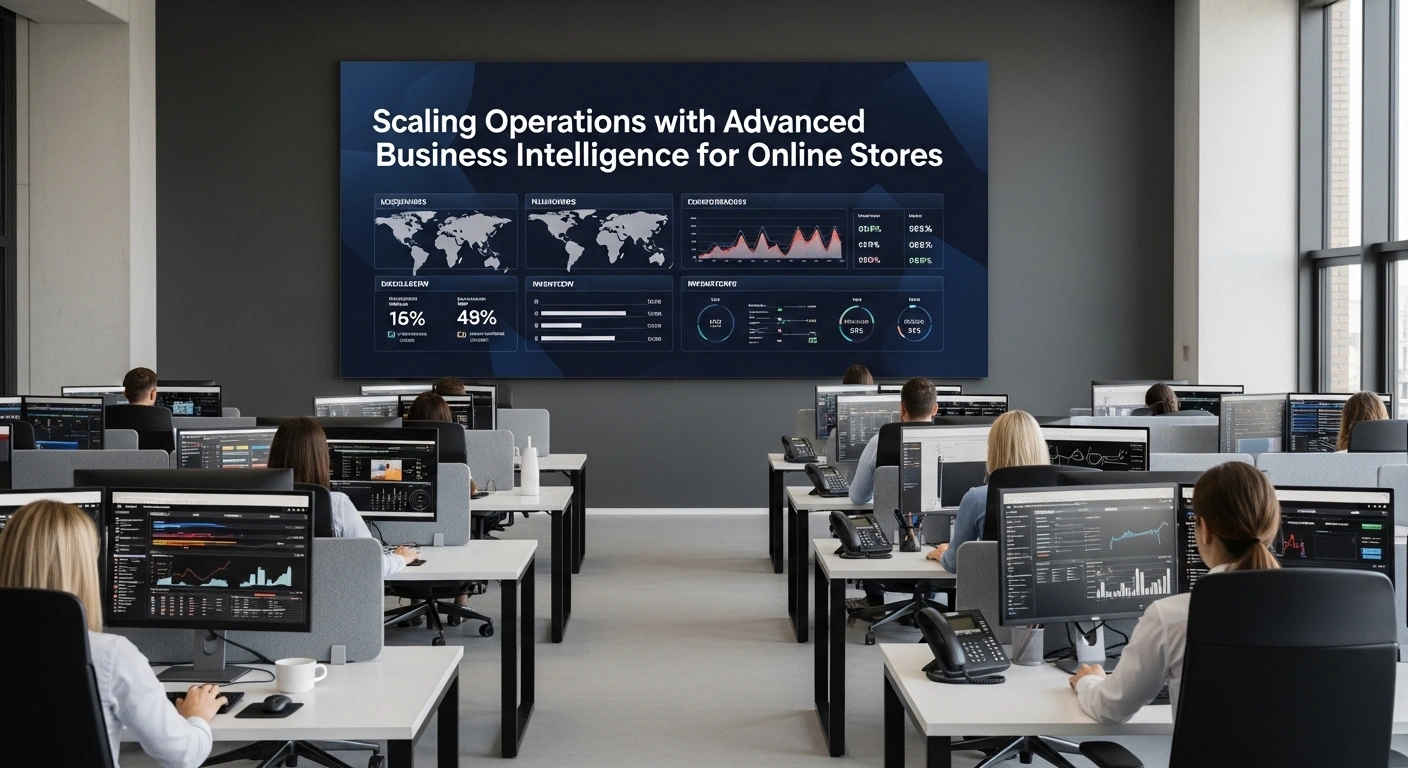
Furthermore, the integration of advanced analytics enables detailed evaluation of key performance indicators such as conversion rates, cart abandonment patterns, average order value, and customer lifetime value, thereby allowing organizations to identify operational bottlenecks and growth opportunities with greater precision. As these insights accumulate, daily activities align more closely with long-term revenue objectives, while automated reporting reduces reliance on manual spreadsheet consolidation and shortens decision cycles with improved accuracy across departments.
Moreover, the integration of predictive models and real-time monitoring tools within Custom BI Solutions for e-commerce enhances responsiveness to seasonal demand shifts, promotional surges, and market volatility, since continuous data flows allow earlier detection of anomalies and timely adjustments to pricing, inventory allocation, or marketing expenditure. Structured intelligence therefore supports scalable processes, cost control, and profit optimization, reinforcing the strategic contribution of Custom BI Solutions for e-commerce to financial performance in online retail environments.
Automating Inventory Management with Custom BI Reporting Systems
Managing inventory at scale becomes increasingly complex as product assortments diversify and omnichannel sales expand, and Custom BI Solutions for e-commerce provide automated visibility and control through integrated reporting environments. The consolidation of stock data from warehouses, online platforms, and third-party logistics providers into synchronized dashboards presents accurate views of available quantities and replenishment cycles, thereby reducing discrepancies between recorded and actual stock levels while improving transparency across supply networks.
Additionally, automated alerts and threshold-based triggers support timely reordering decisions by identifying low-stock situations before fulfillment capacity is affected, and the incorporation of historical sales patterns with supplier lead times into analytical models increases the precision of replenishment planning. Custom BI Solutions for e-commerce consequently reduce financial strain associated with overstocking slow-moving items while lowering the risk of stockouts that can undermine customer confidence.
Furthermore, continuous monitoring of SKU performance enables categorization based on sales velocity, margin contribution, and seasonality trends, and evolving insights align procurement strategies more closely with observed demand behavior rather than assumptions. Automated, analytics-driven inventory management therefore strengthens cash flow efficiency, minimizes storage costs, and enhances service reliability, demonstrating the direct contribution of Custom BI Solutions for e-commerce to operational profitability.
Forecasting Demand Accurately Using Predictive Analytics for E-commerce
Accurate demand forecasting constitutes a critical determinant of profitability in digital retail, and Custom BI Solutions for e-commerce enhance this capability through predictive analytics that integrate historical sales data with real-time behavioral signals. The analysis of seasonality patterns, promotional impacts, browsing trends, and macroeconomic indicators through machine learning models identifies correlations that conventional forecasting methods may overlook, and retailers consequently gain clearer visibility into anticipated demand fluctuations across product categories.
As predictive models continuously retrain using updated transactional and customer interaction data, forecast precision improves over time, and purchasing decisions, warehouse allocations, and marketing budgets align more effectively with projected sales volumes. Scenario modeling capabilities also enable the evaluation of potential outcomes under varying pricing strategies, promotional campaigns, or supply constraints, thereby reducing uncertainty in strategic planning and resource allocation.
Moreover, the embedding of predictive outputs directly into dashboards ensures that operational teams access forward-looking insights alongside current performance metrics, which supports a transition from reactive adjustments to proactive preparation. Custom BI Solutions for e-commerce thus transform demand forecasting into a strategic capability that reduces waste, improves customer satisfaction, and supports revenue stability in competitive online markets.
Monitoring Supply Chain Performance with Real-Time Data Dashboards
Maintaining supply chain efficiency requires continuous visibility across sourcing, warehousing, and distribution processes, and Custom BI Solutions for e-commerce deliver this visibility through real-time data dashboards that integrate transportation metrics, supplier lead times, fulfillment rates, and delivery performance indicators. Centralized platforms consequently provide dynamic overviews of operational conditions, enabling early identification of delays, bottlenecks, or inconsistencies before these issues escalate into customer-facing disruptions.
As real-time data flows into visual analytics interfaces, cross-functional teams gain shared access to standardized performance indicators, and collaboration between procurement, logistics, and customer service functions becomes more coordinated and data-driven. Automated alerts further highlight deviations from service-level agreements or expected transit durations, thereby supporting timely corrective measures that protect operational continuity.
Furthermore, predictive risk indicators strengthen monitoring by signaling potential disruptions associated with supplier instability, demand surges, or transportation constraints, and the integration of these insights into broader performance evaluations enhances resilience and continuity planning. Custom BI Solutions for e-commerce therefore support supply chain optimization that reduces operational costs, safeguards brand reputation, and contributes to long-term profitability.
Improving Operational Efficiency Through Data Integration and BI Automation
Operational efficiency in digital commerce depends on seamless data integration, and Custom BI Solutions for e-commerce establish unified environments in which sales, marketing, finance, and logistics data converge within consistent analytical structures. The elimination of data silos creates standardized reporting frameworks and shared performance metrics across departments, thereby reducing duplication of effort and improving analytical consistency.
As automated extract, transform, and load processes standardize incoming data streams, reporting accuracy improves while manual intervention declines, allowing analytical teams to concentrate on interpretation and performance optimization rather than dataset preparation. Workflow automation embedded within BI platforms also streamlines recurring activities such as performance tracking, revenue reconciliation, and campaign evaluation, accelerating operational cycles and reinforcing accountability.
Moreover, centralized governance frameworks within Custom BI Solutions for e-commerce enhance data quality, security, and controlled accessibility across the enterprise, and reliable information availability strengthens strategic alignment while reducing operational friction. Integrated and automated BI ecosystems consequently drive cost efficiency, scalability, and sustained profit growth, supporting consistent financial returns in competitive e-commerce environments.
Why Invest in Custom BI Solutions for E-commerce Growth and Competitive Advantage?
Recognizing the accelerating complexity of digital commerce reflects the expansion of data volumes across marketplaces, social platforms, payment gateways, and logistics networks, thereby increasing the necessity for unified intelligence frameworks. Acknowledging that fragmented analytics tools generate siloed insights highlights how integrated Custom BI Solutions for e-commerce consolidate operational, marketing, financial, and customer data into a centralized environment that supports consistent performance evaluation. Considering that scalable dashboards and automated reporting reduce manual reconciliation efforts demonstrates how leadership teams interpret trends in real time and respond with agility to market fluctuations. Observing that advanced analytics capabilities such as predictive modeling, cohort analysis, and demand forecasting strengthen revenue planning accuracy contrasts with traditional reporting structures that limit forward-looking visibility.
Emphasizing tailored architectures illustrates how alignment with specific business models, including direct-to-consumer, subscription-based, omnichannel, or marketplace-driven operations, ensures that insights reflect commercial realities. Noting that Custom BI Solutions for e-commerce improve cross-department collaboration explains how synchronized metrics across marketing, supply chain, finance, and customer support promote shared accountability for profitability objectives. Highlighting automation of recurring analytics tasks demonstrates how operational overhead declines while data accuracy and governance standards improve simultaneously. Illustrating the transformation of raw data into structured intelligence clarifies how integrated systems support coordinated growth initiatives.
Connecting these operational improvements with measurable outcomes such as higher conversion rates, optimized inventory turnover, reduced acquisition costs, and improved cash flow visibility reinforces the financial rationale for strategic investment. Stressing the influence of data maturity on investor confidence underscores how transparent and scalable analytics infrastructures signal long-term sustainability. Concluding that sustained adoption of Custom BI Solutions for e-commerce strengthens competitive resilience reflects how informed organizations consistently demonstrate superior responsiveness, efficiency, and profitability.
Gaining Competitive Insights with Market and Competitor Analysis Tools
Recognizing the intensifying rivalry within digital retail ecosystems reflects how global competitors implement pricing automation, personalized marketing, and accelerated fulfillment models, thereby increasing the strategic value of structured competitive intelligence. Identifying the role of Custom BI Solutions for e-commerce demonstrates how integration of external market data, competitor pricing feeds, keyword performance metrics, and promotional tracking systems transforms dispersed information into actionable comparative benchmarks. Observing consolidated dashboards reveals fluctuations in assortment breadth, discount cycles, advertising patterns, and customer sentiment trends, whereas isolated monitoring tools lack contextual alignment with internal performance metrics.
Analyzing predictive analytics models embedded within Custom BI Solutions for e-commerce explains how detection of emerging market gaps and seasonal demand variations supports proactive product positioning strategies. Noting segmentation frameworks clarifies how classification of competitors by pricing tier, geographic reach, and value proposition enables clearer differentiation and brand positioning. Highlighting synchronized internal and external data streams demonstrates how reduced response time to market shifts strengthens forecasting accuracy.
Connecting these insights with structured decision-making processes illustrates how leadership teams align promotional timing, assortment expansion, and branding initiatives with verified competitive benchmarks. Emphasizing continuous monitoring explains how reduced exposure to abrupt pricing conflicts and promotional miscalculations contrasts with reliance on anecdotal observation that increases strategic vulnerability. Concluding that sustained investment in Custom BI Solutions for e-commerce cultivates informed adaptability reflects reinforcement of durable competitive positioning in dynamic digital marketplaces.
Measuring Customer Lifetime Value with Tailored Business Intelligence Solutions
Acknowledging the central role of retention economics in e-commerce profitability models reflects how acquisition expenses frequently exceed margins generated by initial transactions. Recognizing that Custom BI Solutions for e-commerce integrate transactional histories, engagement metrics, support interactions, and return behaviors into unified customer profiles demonstrates how precise lifetime value calculations become possible. Observing cohort-based analysis reveals behavioral differences among acquisition channels, geographic markets, and product categories, whereas conventional analytics obscure such variations through aggregated reporting.
Analyzing predictive lifetime value models explains how forecasting repeat purchase probability and churn risk informs targeted retention and loyalty strategies. Noting integration between marketing platforms and Custom BI Solutions for e-commerce clarifies how enhanced attribution modeling accuracy reveals the extended revenue impact of campaigns beyond immediate conversions. Highlighting deeper customer segmentation demonstrates how improved personalization precision increases engagement efficiency.
Connecting these measurements with optimized marketing allocation illustrates how high-value segments receive proportionate investment in loyalty programs and tailored communications. Emphasizing refined lifetime value tracking explains how sustainable revenue expansion depends on accurate visibility, whereas incomplete data distorts profitability assessments and misguides resource distribution. Concluding that comprehensive implementation of Custom BI Solutions for e-commerce transforms customer intelligence into a strategic growth driver reflects strengthened retention-led profit maximization.
Enhancing Profit Margins Through Data-Driven Decision-Making Strategies
Recognizing tightening margin pressures affecting online retailers reflects the impact of escalating advertising costs, fluctuating supplier pricing, and intensified discount competition on financial performance. Identifying the function of Custom BI Solutions for e-commerce demonstrates how consolidation of cost-of-goods data, shipping expenses, transaction fees, promotional impacts, and advertising expenditures into unified profitability dashboards delivers granular margin transparency. Observing SKU-level contribution analysis reveals underperforming products, while automated alerts identify deviations from established profitability thresholds.
Analyzing scenario modeling capabilities within Custom BI Solutions for e-commerce explains how simulation of pricing adjustments, discount structures, and supplier negotiations enables evidence-based evaluation of strategic alternatives. Noting real-time monitoring clarifies how accelerated corrective interventions reduce the lag between performance fluctuations and managerial response. Highlighting integrated reporting demonstrates how strengthened collaboration between finance, operations, and marketing teams minimizes data discrepancies.
Connecting these analytical capabilities with disciplined pricing and sourcing strategies illustrates how decision-makers align operational adjustments with verified financial indicators. Emphasizing transparent cost allocation models explains how reduced reliance on assumptions contrasts with fragmented spreadsheets that increase error risk and obscure underlying profitability drivers. Concluding that sustained reliance on Custom BI Solutions for e-commerce reinforces structured margin optimization reflects enhanced financial resilience and long-term profit growth.
Building a Scalable E-commerce Growth Strategy with Custom BI Infrastructure
Recognizing evolving expansion patterns of digital commerce enterprises reflects how widening product assortments, expanding geographic markets, and diversifying sales channels increase data architecture complexity. Identifying the role of Custom BI Solutions for e-commerce demonstrates how scalable cloud-based data warehouses and analytics frameworks integrate new platforms without disrupting existing reporting environments. Observing modular dashboard configurations clarifies how accommodation of emerging performance indicators occurs alongside API-driven integrations that streamline synchronization with advertising, logistics, and marketplace systems.
Analyzing forecasting engines embedded within Custom BI Solutions for e-commerce explains how modeling revenue trajectories under varying pricing, demand, and marketing conditions supports long-term strategic planning. Noting standardized governance protocols demonstrates how consistent data definitions across departments safeguard analytical integrity during rapid growth phases. Highlighting scalable infrastructures reveals how reduced redundancy and maintained system performance persist as data volumes increase.
Connecting these structural strengths with sustainable growth strategies illustrates how leadership teams rely on consolidated intelligence to evaluate investment priorities, expansion risks, and operational capacity constraints. Emphasizing flexible BI ecosystems clarifies how reduced technical debt accumulation contrasts with fragmented analytics stacks that restrict adaptability during scaling initiatives. Concluding that comprehensive deployment of Custom BI Solutions for e-commerce anchors resilient expansion frameworks reflects sustained profitability and competitive advantage in dynamic digital markets.
Custom BI Solutions for E-commerce ultimately redefine how online retailers convert data into strategic advantage. By integrating real-time analytics, predictive modeling, automated reporting, and scalable infrastructure, businesses strengthen visibility across operations, marketing, finance, and supply chain functions while reinforcing alignment with profitability goals. From improving conversion rates and reducing cart abandonment to optimizing margins and forecasting demand with precision, tailored BI ecosystems create a measurable pathway toward sustainable growth. Organizations that invest in intelligent, customized analytics frameworks position themselves to adapt quickly, allocate resources efficiently, and consistently maximize profits with Custom BI Solutions for E-commerce Stores in an increasingly complex digital economy.