
Power BI consulting for logistics companies is redefining how organizations harness data to drive efficiency, visibility, and strategic decision-making across complex supply chains. As logistics operations generate vast amounts of data from transportation, warehousing, and distribution systems, the ability to transform this information into actionable insights has become essential rather than optional. By integrating fragmented data sources into unified dashboards and analytics frameworks, businesses gain real-time visibility, improve forecasting accuracy, and uncover hidden inefficiencies. This shift toward data-driven operations enables logistics companies to move beyond reactive management and adopt proactive, insight-led strategies that enhance performance, reduce costs, and strengthen competitive positioning.
Power BI Consulting for Logistics Companies: How It Transforms Data into Actionable Insights
Organizations convert fragmented operational data into unified intelligence through Power BI consulting for logistics companies, thereby strengthening decision-making foundations across transportation and warehousing functions. Integrated reporting frameworks facilitate deeper visibility into key performance indicators while simultaneously aligning logistics strategies with measurable outcomes. Consolidation of data streams from fleet management, inventory systems, and delivery networks enhances analytical clarity, consequently allowing stakeholders to interpret trends with greater precision.
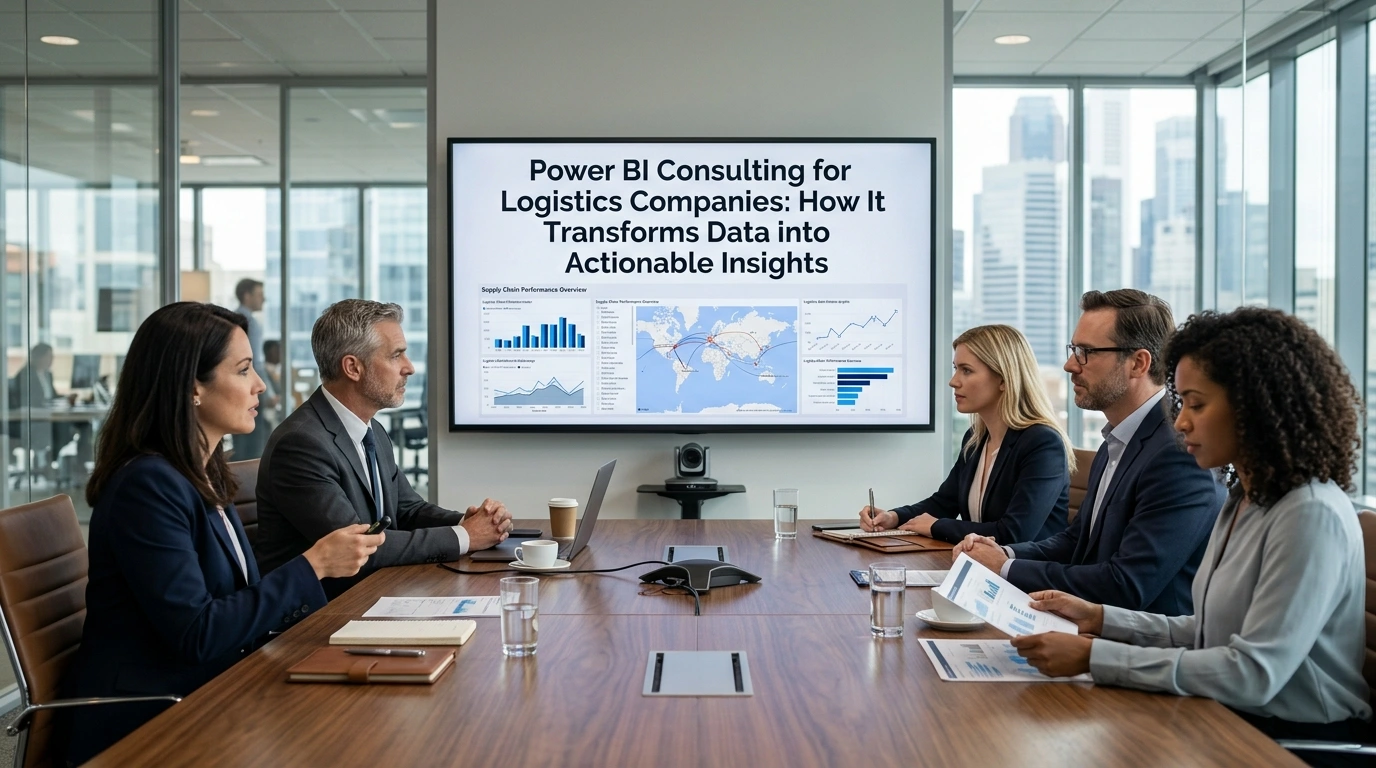
Continuously updated dashboards strengthen responsiveness to market fluctuations, thus ensuring that logistics leaders remain informed about disruptions and opportunities. The transformation of historical and real-time data into meaningful visualizations supports strategic planning, which in turn reveals inefficiencies and cost drivers across the supply chain. Centralized dashboards improve collaboration across departments as they standardize reporting formats, thereby reducing inconsistencies in interpretation.
Linking performance metrics to operational benchmarks reinforces accountability while enabling continuous monitoring of logistics workflows. The adaptability of Power BI consulting for logistics companies to growing data volumes expands scalability, ensuring that insights remain relevant as operations expand. The identification of hidden patterns within previously siloed systems drives competitive advantage, thus enabling proactive rather than reactive decision-making and establishing Power BI consulting for logistics companies as a central component of logistics transformation.
Leveraging real-time logistics data analytics for smarter decisions
Real-time analytics enabled by Power BI consulting for logistics companies provide immediate operational awareness, thereby allowing decision-makers to respond effectively to dynamic logistics environments. Live tracking data integrated into dashboards enhance route optimization, consequently enabling adjustments that reduce delays and fuel consumption. The incorporation of continuously updated order and shipment data improves demand forecasting accuracy while ensuring that inventory planning aligns with actual market conditions.
The identification of disruptions such as delays or bottlenecks strengthens risk management, thus minimizing operational impact through timely intervention. Monitoring vehicle performance metrics in real time enables proactive maintenance strategies, thereby reducing unexpected breakdowns. The provision of accurate delivery estimates based on current logistics conditions facilitates improvements in customer satisfaction while increasing transparency across service channels.
Reliance on continuously refreshed insights rather than static reports supports agile decision-making, consequently enhancing responsiveness. Shared dashboards that provide synchronized views of logistics performance encourage cross-functional coordination, thus reducing delays associated with miscommunication. The real-time identification of inefficiencies reinforces efficiency gains while demonstrating the strategic role of Power BI consulting for logistics companies in transforming live data into informed operational decisions.
Integrating supply chain data with Power BI dashboards
Integration capabilities associated with Power BI consulting for logistics companies unify diverse data sources, thereby creating a cohesive view of supply chain operations. The combination of data from procurement, inventory, transportation, and distribution systems ensures that stakeholders access consistent and reliable information. End-to-end visibility presented through dashboards enhances transparency across the supply chain, consequently enabling improved coordination among suppliers, warehouses, and distribution centers.
The reduction of reliance on manual reporting processes improves data accuracy, thus minimizing errors and inconsistencies. Structuring integrated datasets into meaningful visualizations supports advanced analytics while allowing users to examine detailed operational layers. The connection between operational metrics and broader business objectives facilitates strategic alignment, thereby ensuring that logistics performance supports organizational goals.
Linking historical trends with current supply chain conditions strengthens forecasting capabilities, consequently enabling more accurate planning. Shared insights that foster a unified understanding of supply chain performance encourage collaboration across departments, thus reducing operational silos. Integration frameworks that accommodate additional data sources over time enhance scalability while reinforcing the role of Power BI consulting for logistics companies in establishing unified and actionable data environments.
Improving operational efficiency through business intelligence tools
Insights generated by business intelligence tools supported by Power BI consulting for logistics companies optimize workflows, thereby improving overall operational efficiency. The analysis of performance metrics across logistics activities identifies process bottlenecks while enabling targeted improvements that reduce delays. Data-driven insights that reveal underutilized assets enhance resource allocation, consequently allowing more effective deployment of vehicles, personnel, and inventory.
The identification of inefficiencies in transportation routes and warehouse processes reduces operational costs, thus supporting cost optimization initiatives. Real-time dashboards that track key efficiency indicators strengthen performance monitoring while ensuring continuous improvement. The replacement of manual data compilation with Power BI dashboards facilitates automation of reporting processes, thereby reducing time requirements and minimizing human error.
A data-driven organizational culture emerges as employees rely on analytical insights rather than assumptions, consequently improving decision quality across operational levels. The alignment of operational performance with customer expectations improves service delivery while increasing reliability and consistency. The identification of trends and deviations supports continuous improvement initiatives, thereby reinforcing the contribution of Power BI consulting for logistics companies to sustained efficiency improvements.
Turning raw transportation data into predictive insights
Advanced analytics enabled by Power BI consulting for logistics companies transform unstructured transportation data into predictive intelligence, thereby enhancing strategic foresight. The use of historical shipment data combined with machine learning models enables the forecasting of demand patterns while supporting proactive planning. The analysis of past traffic and delivery performance improves route planning, consequently identifying optimal routing strategies for future operations.
The identification of patterns associated with delays or disruptions enhances risk mitigation, thus supporting preventive measures. Predictions of demand fluctuations based on transportation trends support inventory optimization while reducing stock imbalances. Scenario simulations that model different logistics conditions enable organizations to prepare for potential operational challenges.
Forward-looking insights strengthen decision-making rather than reliance solely on historical data, consequently improving competitiveness. Predictive analytics that reveal opportunities for efficiency and cost reduction encourage innovation in logistics strategies while supporting long-term development. Greater accuracy in anticipating delivery timelines improves customer experience, thereby reinforcing the role of Power BI consulting for logistics companies in advancing predictive and intelligence-driven logistics management.
Why Is Power BI Consulting for Logistics Companies Essential for Supply Chain Optimization?
Power BI consulting for logistics companies establishes a unified analytics layer across ERP, WMS, TMS, telematics, procurement, and supplier systems, transforming fragmented operational data into a cohesive decision-making environment where performance, cost, and risk are evaluated collectively rather than separately, while bridging data silos across departments standardizes critical metrics such as on-time delivery, lead-time variability, and inventory turnover, thereby reducing inconsistencies that often delay responses to operational disruptions, and strengthening visibility across the supply chain enables stakeholders to access synchronized insights that improve coordination between planning, execution, and strategic oversight.
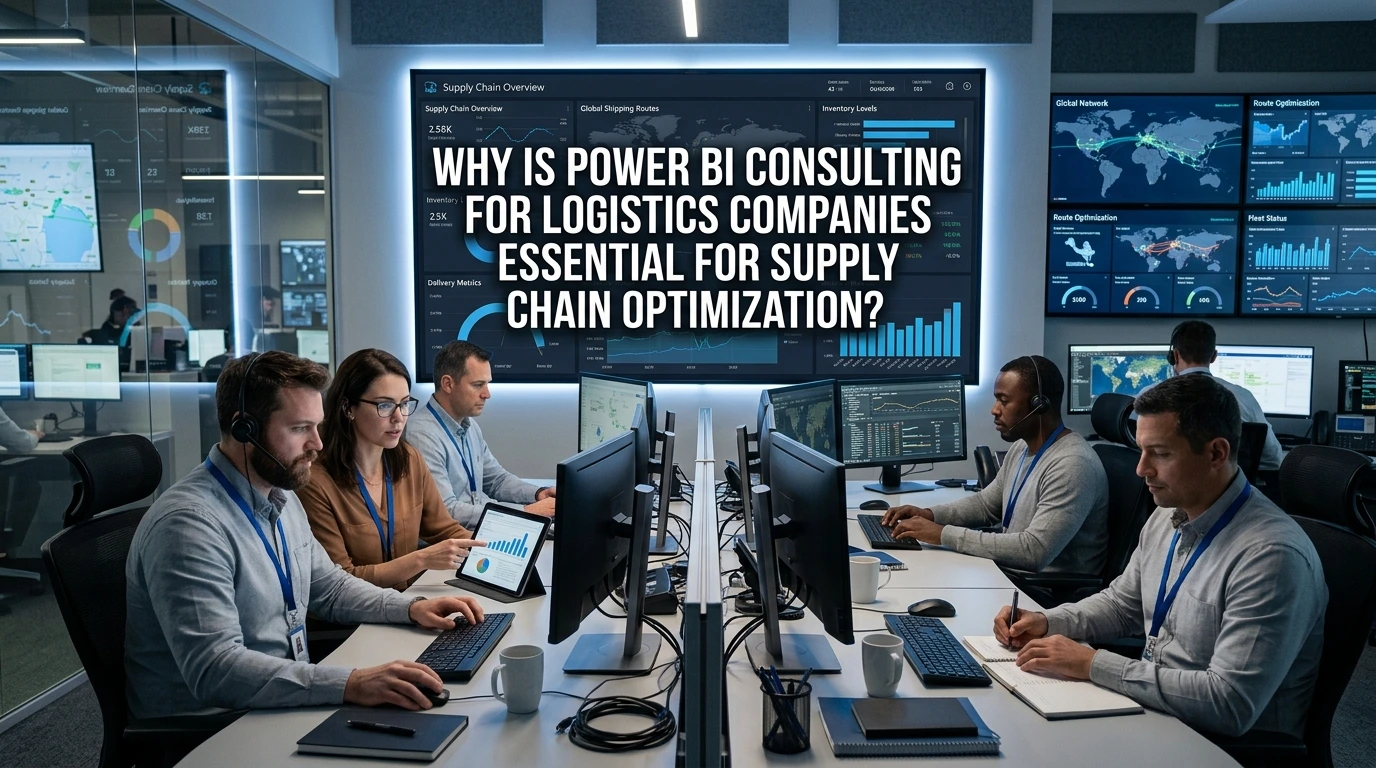
The integration of real-time and historical data streams enhances operational clarity by allowing logistics teams to monitor ongoing activities while contextualizing trends over time, and this alignment supports more accurate and timely interventions, while the extension of analytical capabilities beyond descriptive reporting introduces diagnostic and predictive insights that help organizations understand root causes and anticipate future disruptions, and Power BI consulting for logistics companies supports a transition from reactive management toward proactive and predictive supply chain strategies.
Structured data models and consistent reporting frameworks reinforce governance and reliability by improving trust in analytics outputs, which is critical for high-stakes logistics decisions, while reducing reliance on disconnected spreadsheets enhances data accuracy and consistency across teams, and this consistency ensures that decisions are based on reliable information, and strengthened exception management through visual dashboards enables faster identification of delays and inefficiencies, positioning Power BI consulting for logistics companies as a transformative factor in achieving supply chain optimization.
Enhancing route optimization with advanced analytics solutions
Power BI consulting for logistics companies improves transportation efficiency across logistics networks by consolidating data from dispatch systems, GPS tracking, fuel usage, and delivery performance into unified analytical models, while connecting these datasets enables comparisons between planned and actual routes that reveal inefficiencies related to delays, route deviations, and underutilized capacity, and identifying patterns in transport performance supports refinement of routing strategies and improvement of delivery reliability.
Segmentation of route performance by geography, time of day, or customer type expands analytical depth by providing detailed insights into operational variations, while this segmentation highlights areas where inefficiencies consistently occur, and incorporation of historical trends and operational variables supports scenario analysis that allows logistics planners to evaluate the impact of route adjustments before implementation, strengthening the role of Power BI consulting for logistics companies in data-driven decision-making.
Alignment of route performance metrics with broader business outcomes such as cost per shipment and service levels strengthens continuous improvement processes by ensuring that optimization efforts deliver measurable value, while visualization of route performance through dashboards improves accessibility of insights for both operational and strategic stakeholders, and this accessibility fosters collaboration across teams, supporting the evolution of route optimization into a data-driven discipline that enhances efficiency, reduces costs, and improves customer satisfaction through Power BI consulting for logistics companies.
Using Power BI for warehouse management and inventory tracking
Power BI consulting for logistics companies enhances warehouse visibility and control by integrating inventory data with warehouse operations to provide a comprehensive view of stock levels, movement patterns, and fulfillment performance, while linking operational data with financial and demand indicators supports a balanced approach to inventory management by evaluating stock availability alongside cost and demand variability, and improved transparency across inventory systems helps reduce stockouts and excess inventory simultaneously.
Tracking metrics such as inventory turnover, aging stock, and replenishment cycles expands analytical capabilities by providing deeper insight into inventory health, while this insight supports more effective decision-making, and visualization of warehouse layouts and stock distribution enhances understanding of storage efficiency, allowing managers to identify imbalances and optimize space utilization through Power BI consulting for logistics companies.
Forecasting tools integrated within Power BI support proactive management practices by enabling anticipation of future inventory needs based on historical trends and demand patterns, while this foresight reduces the risk of disruption, and alignment of warehouse metrics with customer service indicators such as order accuracy and fulfillment speed ensures that inventory decisions support overall service quality, strengthening the strategic role of Power BI consulting for logistics companies in improving efficiency, responsiveness, and operational alignment.
Identifying bottlenecks in logistics operations with data visualization
Power BI consulting for logistics companies improves operational transparency across supply chain processes by enabling visualization of key performance indicators that reveal inefficiencies and delays more clearly than traditional reporting methods, while presentation of data in interactive dashboards allows observation of patterns in shipment delays, warehouse congestion, and inventory imbalances, and enhanced visibility into process flows supports accurate identification of constraints within the logistics network.
Segmentation of data by variables such as location, product, or time period deepens analytical insight by allowing organizations to distinguish between recurring issues and isolated incidents, while this distinction improves decision accuracy, and correlation of performance metrics across different stages of the supply chain reveals how disruptions in one area impact overall operations, strengthening the analytical value of Power BI consulting for logistics companies in root-cause analysis.
Visual alerts and threshold-based indicators strengthen response effectiveness by highlighting deviations from expected performance and enabling quicker intervention, while improved accessibility of insights ensures that both technical and non-technical users can interpret data and respond appropriately, and this inclusivity enhances organizational responsiveness, supporting continuous improvement through structured and data-driven bottleneck identification enabled by Power BI consulting for logistics companies.
Supporting demand forecasting with data-driven insights
Power BI consulting for logistics companies enhances forecasting accuracy across logistics operations by integrating historical data, demand trends, and operational metrics into comprehensive analytical models that provide a clearer view of future requirements, while combination of sales patterns with supply chain variables such as lead times and inventory levels enables more realistic demand projections, and strengthened connection between demand and supply reduces the risk of stock imbalances and service disruptions.
Analysis of seasonal trends, market fluctuations, and historical performance expands predictive capabilities by supporting more nuanced forecasting models, while these models allow organizations to anticipate changes in demand with greater confidence, and incorporation of scenario analysis enables evaluation of different demand conditions, reinforcing the role of Power BI consulting for logistics companies in adaptive and data-driven forecasting processes.
Sharing forecasting insights across departments improves cross-functional alignment by ensuring that procurement, warehousing, and transportation planning are based on consistent data, while this alignment reduces operational discrepancies, and continuous updating of forecasts with real-time data improves responsiveness to changing conditions, enhancing overall supply chain agility and reinforcing the strategic importance of Power BI consulting for logistics companies in supporting long-term operational resilience.
How Power BI Solutions Improve Logistics Performance and Cost Efficiency
The integration of shipment records, telematics feeds, warehouse transactions, carrier invoices, and customer service data enables Power BI consulting for logistics companies to strengthen logistics performance by creating a unified analytical layer where route efficiency, delivery reliability, cost leakage, and service quality can be examined simultaneously rather than in isolated reports. The linkage of these sources into interactive models enables operations leaders to compare planned versus actual transit times, detect delay patterns by lane or customer, trace profit erosion to fuel, maintenance, or carrier spend, and distinguish one-off disruptions from structural problems requiring redesign. The presentation of these patterns through drill-down visuals and dynamic dashboards shortens the interval between data review and operational response, which is critical because margin pressure often arises from recurring inefficiencies rather than singular events.
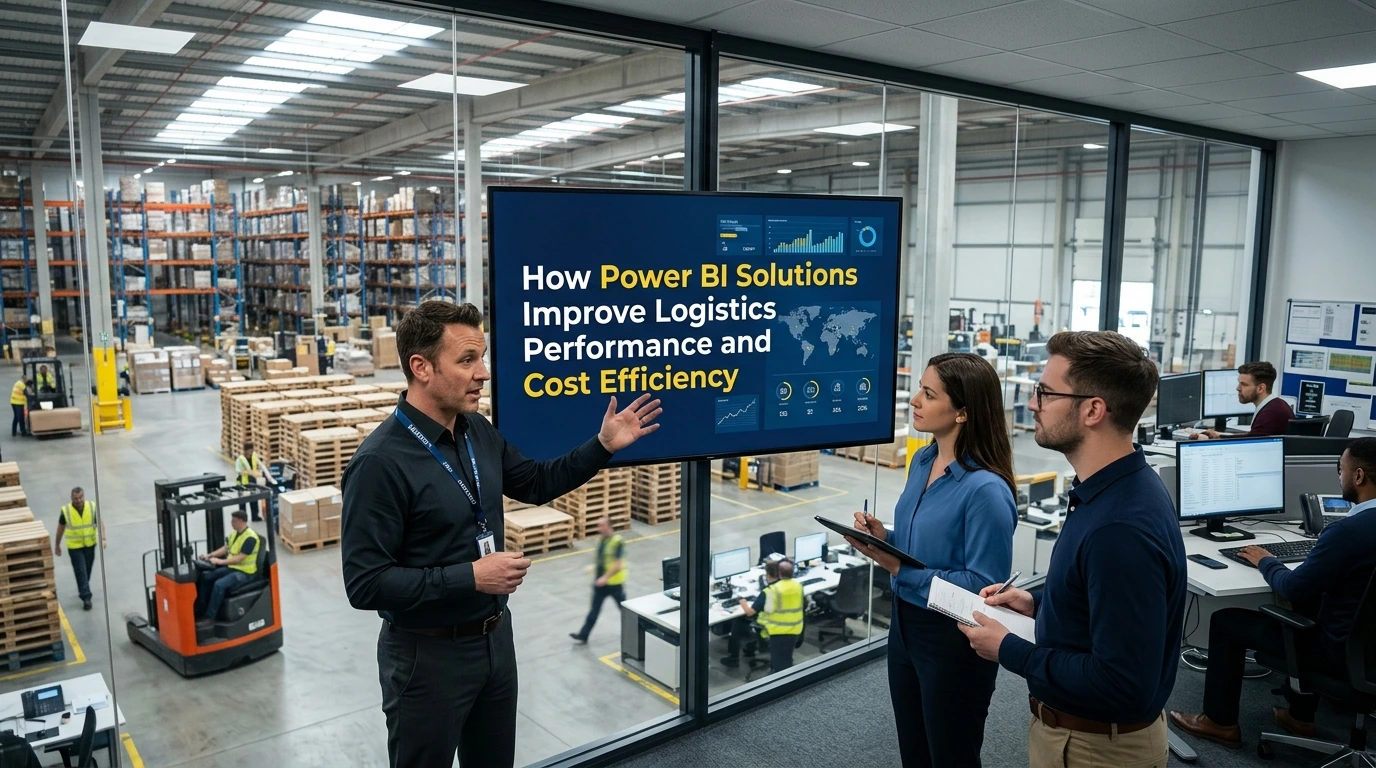
The use of centralized analytics enables organizations to visualize operational metrics, monitor progress against defined targets, and evaluate performance across transport networks in near real time while improving alignment between planning and execution functions. The extension of this capability beyond visibility allows Power BI consulting for logistics companies to improve cost efficiency by aligning finance, transport, procurement, and customer operations around unified definitions for cost, service levels, and asset utilization. The clarification of these shared metrics allows leadership teams to evaluate whether savings should result from route redesign, load consolidation, fleet optimization, or carrier strategy adjustments rather than relying on fragmented assumptions.
The translation of both live and historical data into consistent trends supports more accurate forecasting of demand patterns, operational risks, and recurring bottlenecks, thereby enhancing resource allocation decisions and reducing unnecessary operational reactions. The positioning of analytics at the core of logistics operations enables Power BI consulting for logistics companies to transform fragmented information into a structured decision-making framework that improves execution speed and strengthens financial control. The reinforcement of this transformation through integrated dashboards enables continuous performance improvement by making inefficiencies visible, measurable, and easier to address across the logistics ecosystem.
Reducing transportation costs through data-driven strategies
The reduction of transportation costs through integrated analytics becomes more effective when shipment, fuel, routing, maintenance, and carrier data are evaluated collectively, because cost inefficiencies often result from the interaction of multiple operational factors rather than a single source. The connection of these variables within unified dashboards enables Power BI consulting for logistics companies to identify cost drivers such as empty miles, underutilized capacity, excessive dwell time, and inefficient routing patterns. The highlighting of these relationships supports more accurate cost allocation and reveals hidden inefficiencies that might otherwise remain unnoticed.
The analysis of cost-per-mile, cost-per-delivery, and route profitability alongside service indicators ensures that cost reduction strategies do not compromise delivery performance or customer satisfaction. The strengthening of this balance allows Power BI consulting for logistics companies to provide deeper insights into carrier performance, enabling organizations to evaluate vendor efficiency and renegotiate contracts based on measurable outcomes rather than assumptions. The identification of recurring cost patterns allows decision-makers to quantify the financial impact of delays, re-deliveries, and operational disruptions with greater precision.
The support for faster response to cost fluctuations through automated data refresh and alert mechanisms enables teams to detect anomalies such as rising fuel consumption or declining utilization levels in near real time. The translation of these insights into targeted strategies supports improvements in route planning, load consolidation, and fleet usage. The reinforcement of long-term cost control enables Power BI consulting for logistics companies to establish a structured approach to transportation optimization that continuously reduces expenses while maintaining operational efficiency.
Monitoring KPIs in logistics with interactive Power BI dashboards
The monitoring of logistics performance through interactive dashboards provides a comprehensive operational overview when key performance indicators are presented as interconnected measures rather than isolated figures. The definition of these KPIs within a consistent framework enables Power BI consulting for logistics companies to track delivery performance, transit times, cost metrics, and service reliability across multiple dimensions. The linkage of these indicators provides a more accurate representation of overall logistics health and operational effectiveness.
The enablement of detailed analysis through interactive features allows users to drill down into specific regions, routes, or time periods, facilitating the identification of underlying causes of performance variations. The support of both strategic and operational decision-making ensures that Power BI consulting for logistics companies allows executives and frontline teams to access the same data while interpreting it according to their respective roles. The strengthening of this alignment reduces discrepancies in reporting and promotes a unified understanding of performance metrics across departments.
The connection of real-time data with historical trends enables organizations to distinguish between temporary disruptions and recurring issues requiring long-term solutions. The enhancement of responsiveness through alert mechanisms ensures that teams are notified when performance thresholds are exceeded, enabling quicker intervention and improved service outcomes. The reinforcement of continuous improvement enables Power BI consulting for logistics companies to transform KPI monitoring into an active management process that drives accountability and operational excellence.
Enhancing fleet management using business intelligence tools
The enhancement of fleet management through integrated analytics improves operational control when telematics, maintenance records, fuel usage, and route execution data are analyzed collectively. The combination of these data sources allows Power BI consulting for logistics companies to provide a holistic view of fleet performance, enabling managers to evaluate utilization, efficiency, and operational reliability within a unified environment. The strengthening of this visibility supports informed decision-making regarding asset allocation and performance optimization.
The identification of inefficiencies within fleet operations through analytical dashboards reveals patterns related to vehicle downtime, fuel consumption, and driver behavior, which contribute to increased operational costs if not addressed. The linkage of these insights to operational outcomes enables Power BI consulting for logistics companies to optimize maintenance schedules, reduce unexpected breakdowns, and improve overall fleet productivity. The support of this optimization highlights routes or assignments where performance consistently deviates from expected benchmarks.
The connection of fleet performance with broader logistics metrics provides a clearer understanding of how vehicle management influences delivery reliability and cost efficiency. The extension of analysis to include sustainability indicators enables organizations to monitor emissions and fuel efficiency trends as part of operational strategy. The reinforcement of long-term improvement enables Power BI consulting for logistics companies to transform fleet management into a data-driven discipline that enhances reliability, reduces costs, and supports strategic planning.
Streamlining reporting processes for logistics teams
The streamlining of reporting processes improves efficiency when manual data compilation is replaced with automated and centralized reporting systems. The consolidation of multiple data sources into a single platform allows Power BI consulting for logistics companies to reduce the time and effort required to prepare operational and financial reports. The strengthening of consistency ensures that all stakeholders rely on standardized data definitions and reporting structures.
The automation of data refresh and report distribution provides access to up-to-date information without delays associated with traditional reporting cycles. The enhancement of accessibility enables Power BI consulting for logistics companies to deliver customized dashboards tailored to specific roles while maintaining alignment with overall business objectives. The support of collaboration through shared reporting environments facilitates improved communication between departments and enhances coordination of operational activities.
The reduction of dependency on manual processes minimizes reporting errors and eliminates discrepancies caused by multiple data versions. The strengthening of transparency ensures that centralized dashboards provide a consistent and reliable view of logistics performance across the organization. The reinforcement of operational effectiveness enables Power BI consulting for logistics companies to transform reporting into a streamlined and dependable process that supports faster decision-making and continuous performance improvement.
Key Benefits of Business Intelligence Consulting in the Logistics Industry
Business intelligence consulting drives operational efficiency across complex supply chains by delivering structured visibility into logistics performance, which consequently enables organizations to reduce inefficiencies and optimize resource allocation. The approach enhances data integration from disparate systems by unifying transportation, warehousing, and inventory datasets, thereby allowing stakeholders to access consistent and reliable information across all operational layers. Insights generated through Power BI consulting for logistics companies support strategic alignment by contributing to improved forecasting accuracy, which subsequently reduces costly disruptions and delays.

Advanced analytics strengthen cost control mechanisms by uncovering hidden cost drivers while also enabling better budgeting and financial planning across logistics networks. Predictive models facilitate proactive risk management by identifying potential bottlenecks and disruptions, thus helping organizations respond before issues escalate. Shared dashboards improve collaboration across departments by ensuring that operations, finance, and customer service teams work with synchronized data, which in turn enhances coordination while increasing transparency across the supply chain through clear performance metrics that improve accountability.
Data-driven decision-making reinforces competitive advantage by allowing logistics firms to adapt quickly to market changes, which consequently maintains service reliability. Scalable analytics frameworks ensure that systems grow alongside business expansion and therefore sustain long-term value. Performance monitoring tools embed continuous improvement practices by highlighting inefficiencies and subsequently driving iterative enhancements, while alignment between technology investments and business goals ensures that Power BI consulting for logistics companies delivers measurable return on investment and positions logistics providers as agile, data-driven enterprises.
Custom Power BI solutions tailored for logistics companies
Custom solutions developed through Power BI consulting for logistics companies address the unique operational complexities of logistics providers by delivering highly relevant and industry-specific analytics capabilities, thereby ensuring practical applicability. These solutions integrate data from transportation management systems, warehouse platforms, and IoT devices, allowing tailored dashboards to provide a unified operational view while eliminating data silos. Customized interfaces enhance usability for diverse stakeholders by adapting to roles such as fleet managers, warehouse supervisors, and executives, which consequently improves adoption rates.
These solutions support real-time tracking of shipments and assets, enabling faster response to delays while improving operational reliability. Custom-built data models improve analytical precision by aligning with logistics workflows and therefore producing more accurate insights compared to generic tools. Tailored Power BI implementations enable seamless scalability by accommodating growing data volumes while maintaining performance efficiency, and integration with existing ERP and CRM systems ensures continuity across digital ecosystems and enhances operational cohesion.
Customized reports strengthen compliance monitoring by tracking regulatory requirements and subsequently reducing operational risks. Advanced visualization techniques allow decision-makers to gain intuitive insights while reducing the time required for analysis. Power BI consulting for logistics companies reinforces strategic growth by ensuring that every dashboard and report aligns with business objectives and transforms raw data into actionable intelligence, while long-term adaptability allows tailored solutions to evolve alongside organizational needs and sustain ongoing value creation.
Enhancing decision-making with real-time reporting tools
Real-time reporting tools developed through Power BI consulting for logistics companies enable instant access to operational data, which significantly improves responsiveness and consequently supports faster decision-making. These tools provide live updates on shipment status, inventory levels, and delivery performance, ensuring that stakeholders remain informed at all times while reducing reliance on outdated reports. Real-time dashboards support dynamic decision environments by allowing managers to adjust routes, allocate resources, and address disruptions as they occur, thus minimizing operational delays.
Continuous data streams improve situational awareness by highlighting emerging trends while enabling early intervention. Real-time insights enhance operational agility by allowing logistics companies to adapt quickly to changing conditions and therefore maintain service quality. Shared live dashboards strengthen communication across teams by ensuring consistent information flow while reducing misalignment, and automated data updates reduce manual reporting efforts by eliminating repetitive tasks and freeing resources for strategic activities.
Real-time analytics increase accuracy in decision-making by minimizing errors associated with delayed or incomplete data and thus improving overall outcomes. Continuous data feeds support predictive capabilities by enabling advanced forecasting models while enhancing planning accuracy. Power BI consulting for logistics companies reinforces competitive positioning by ensuring that organizations operate with up-to-date intelligence and drive faster, more informed decisions across the supply chain, while real-time reporting frameworks sustain long-term efficiency by contributing to continuous operational improvement and strengthening business performance.
Scaling logistics operations with data analytics consulting
Data analytics consulting facilitates business growth by empowering logistics companies to scale operations efficiently, which consequently allows them to manage increasing demand without compromising performance. Insights generated through Power BI consulting for logistics companies enable organizations to identify scalable processes while eliminating inefficiencies. Analytics tools support capacity planning by evaluating historical and real-time data and therefore guiding infrastructure and workforce expansion decisions.
Scalable data solutions enhance operational flexibility by adapting to fluctuating demand while maintaining system performance. Data-driven insights improve cost efficiency during scaling by preventing overinvestment in underutilized resources and consequently optimizing capital expenditure. Analytics solutions enable automation of routine processes by streamlining operations while reducing manual intervention, and scalable analytics frameworks strengthen supply chain resilience by allowing companies to respond effectively to disruptions and maintain continuity.
Centralized dashboards support multi-location operations by providing visibility across regions while ensuring consistent performance standards. Long-term data trends enhance strategic planning by informing expansion strategies and subsequently reducing risks associated with growth. Power BI consulting for logistics companies reinforces sustainable scalability by ensuring that data infrastructure evolves alongside business needs and supports continuous operational expansion, while scalable analytics capabilities drive organizational efficiency and contribute to long-term competitiveness and sustained success.
Improving customer satisfaction through data transparency and insights
Data transparency enabled by Power BI consulting for logistics companies enhances customer experience by providing clients with accurate and timely information, which consequently builds trust. Real-time shipment tracking delivers visibility into delivery status while reducing uncertainty. Data-driven insights improve communication by allowing companies to provide proactive updates and therefore enhance service reliability.
Analytics support personalized service delivery by identifying customer preferences and behaviors while enabling tailored solutions. Transparent reporting strengthens accountability by ensuring that service levels are measurable and consequently improves organizational credibility. Timely insights reduce customer complaints by enabling faster issue resolution while enhancing satisfaction levels, and consistent service quality supported by data insights increases loyalty and retention by fostering long-term relationships and driving repeat business.
Analytics enable continuous service improvement by highlighting performance gaps while guiding corrective actions. Superior transparency and responsiveness support competitive differentiation by positioning logistics companies as customer-centric providers and enhancing market reputation. Power BI consulting for logistics companies reinforces overall service excellence by ensuring that customer interactions are informed by accurate data and transforming logistics operations into a reliable and insight-driven experience, while data-driven engagement strategies sustain customer trust over time and contribute to long-term satisfaction and brand loyalty.
In an increasingly complex and data-intensive logistics landscape, the ability to convert information into meaningful insights determines operational success and long-term competitiveness. Power BI consulting for logistics companies enables this transformation by unifying data, enhancing visibility, and empowering decision-makers with real-time and predictive intelligence. From optimizing routes and improving inventory management to reducing costs and strengthening customer satisfaction, its impact extends across every layer of the supply chain. As logistics organizations continue to scale and adapt to evolving market demands, adopting Power BI consulting for logistics companies is no longer a strategic advantage alone—it is a foundational requirement for achieving efficiency, agility, and sustained growth.