










Scaling Power BI in large organizations requires far more than technical deployment because sustainable enterprise success depends on governance maturity, scalable architecture, performance optimization, and organizational enablement working in unison. As analytical demand expands across departments, regions, and leadership functions, organizations must establish disciplined frameworks that balance centralized oversight with distributed innovation. Strengthening governance, semantic architecture, infrastructure planning, and user adoption ensures that Power BI evolves into a resilient enterprise intelligence platform capable of delivering trusted, secure, and high-value business insights at scale. Expert Advice on Scaling Power BI in Large Organizations explores the strategic models, operational disciplines, and enterprise best practices that enable long-term scalability, performance, and measurable business transformation.
Scaling Power BI in large organizations: governance models that support enterprise growth
Establishing sustainable governance frameworks remains central to Scaling Power BI in large organizations because enterprise growth depends on balancing centralized oversight with distributed innovation. Furthermore, defining governance through federated operating models enables executive leadership, IT, security teams, and business units to coordinate responsibilities while preserving organizational agility. Consequently, aligning governance councils with strategic business objectives improves data consistency, investment prioritization, and long-term platform resilience. Moreover, structuring governance around clearly documented policies for data ownership, certification, compliance, and reporting standards reduces fragmentation across departments.
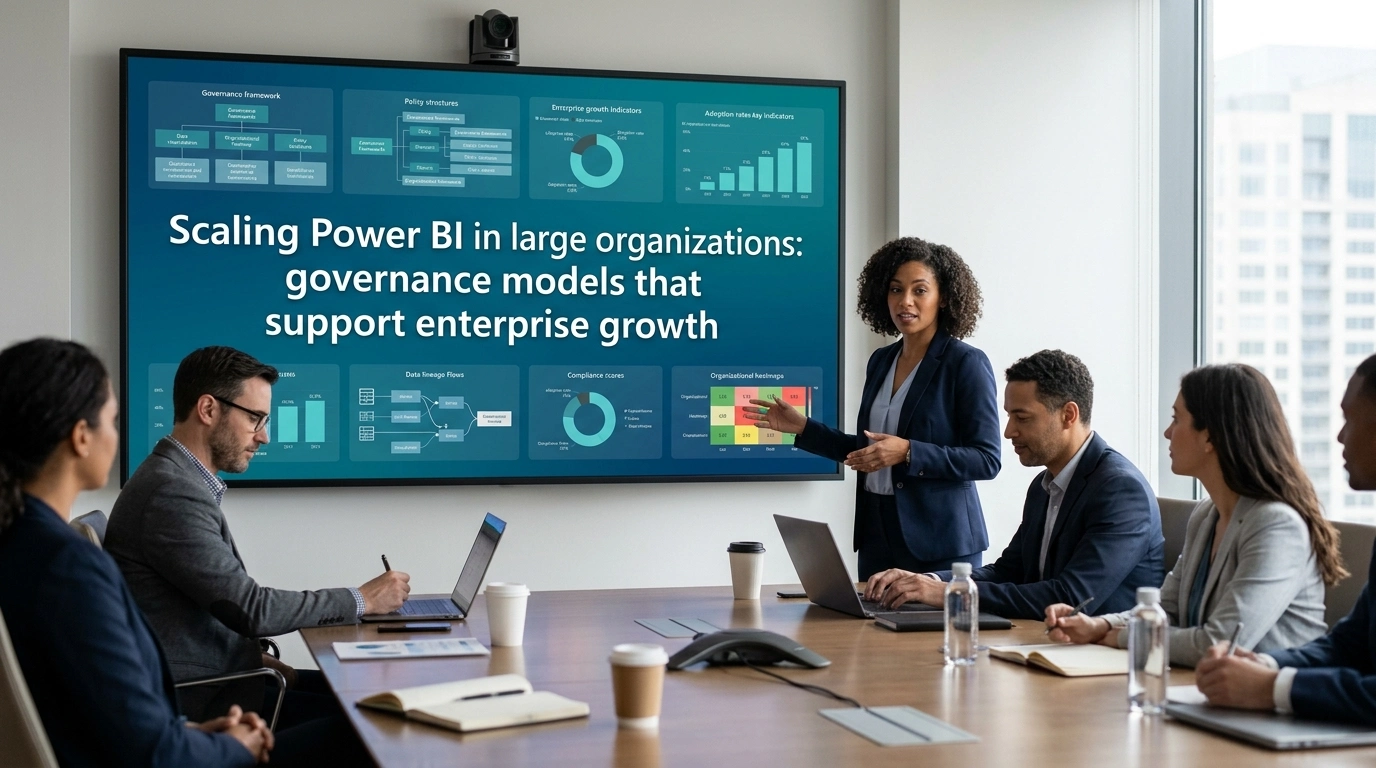
Additionally, Scaling Power BI in large organizations benefits from formal Centers of Excellence that standardize best practices, oversee platform maturity, and promote governed self-service analytics. Likewise, integrating tenant administration controls, audit capabilities, sensitivity labeling, and governance frameworks strengthens enterprise-wide oversight while supporting regulatory obligations. Meanwhile, coordinating governance through role-based stewardship ensures that administrators, data owners, and report creators operate within approved organizational standards. As enterprise adoption expands, embedding lifecycle controls and governance checkpoints preserves operational discipline while supporting innovation.
Therefore, combining centralized strategic governance with decentralized execution supports enterprise scalability, mitigates operational risk, and strengthens business intelligence maturity. Furthermore, evolving governance beyond technical administration into enterprise-wide business enablement allows organizations to sustain reporting consistency while empowering distributed teams. Ultimately, Scaling Power BI in large organizations succeeds most effectively when governance models establish secure, resilient, and growth-oriented frameworks that align analytical capabilities with enterprise transformation goals.
Defining executive sponsorship, ownership, and decision rights for Power BI programs
Securing executive sponsorship provides the strategic authority required for Scaling Power BI in large organizations because enterprise analytics programs demand sustained funding, organizational alignment, and cross-functional accountability. Additionally, positioning executive sponsors at senior leadership levels ensures that Power BI governance remains connected to broader transformation priorities. Consequently, assigning program ownership to dedicated BI leaders, administrators, and governance committees establishes operational continuity and decision-making clarity. Moreover, defining decision rights through structured accountability frameworks clarifies who controls security, licensing, compliance, and platform standards.
Likewise, distributing ownership across both central governance teams and domain-specific business leaders strengthens operational governance while preserving responsiveness to departmental requirements. Furthermore, Scaling Power BI in large organizations benefits from governance councils that evaluate platform changes, approve policy adjustments, and oversee reporting priorities across the enterprise. In parallel, empowering data stewards and semantic model owners improves trust, consistency, and accountability. As governance maturity increases, formalizing sponsorship and ownership structures minimizes policy conflicts and duplicated operational efforts.
Ultimately, strengthening decision rights through executive sponsorship and clearly assigned operational ownership creates scalable governance foundations that support enterprise growth. Furthermore, preserving strategic alignment between leadership, technical administration, and business innovation enables long-term reporting maturity. Therefore, Scaling Power BI in large organizations depends heavily on leadership commitment and governance clarity to preserve accountability while sustaining enterprise-scale analytical development.
Establishing tenant-level policies for security, compliance, and controlled self-service
Implementing tenant-level governance policies strengthens Scaling Power BI in large organizations because enterprise growth requires secure, compliant, and standardized controls across expanding analytics ecosystems. Furthermore, configuring tenant settings for data sharing, export restrictions, collaboration, and workspace creation protects organizations from uncontrolled proliferation. Consequently, enforcing policies around sensitivity labels, compliance classifications, and governance standards enhances regulatory alignment while preserving analytical accessibility. Moreover, restricting risky capabilities such as unmanaged publishing and unrestricted sharing reduces security vulnerabilities.
Likewise, supporting controlled self-service through certified semantic models, governed templates, and approved collaboration pathways empowers business users without compromising governance standards. Additionally, Scaling Power BI in large organizations relies on balancing administrative controls with innovation-enabling frameworks that encourage responsible content development. Meanwhile, leveraging audit trails, activity monitoring, and compliance reviews improves governance transparency. As enterprise complexity increases, automating policy reviews and governance checkpoints sustains security maturity.
Therefore, establishing robust tenant-level governance transforms Power BI into a secure enterprise platform capable of supporting large-scale growth. Furthermore, maintaining strong compliance frameworks while enabling controlled self-service preserves both innovation and governance integrity. Ultimately, Scaling Power BI in large organizations requires tenant-level governance systems that continuously protect enterprise assets while supporting secure analytical expansion.
Designing workspace structures and role assignments for distributed business teams
Structuring workspaces strategically remains essential for Scaling Power BI in large organizations because distributed teams require clear segmentation, role clarity, and governance consistency. Furthermore, designing workspace architectures around business domains, functional teams, and lifecycle stages improves collaboration while reducing administrative complexity. Consequently, separating Development, Test, and Production environments supports deployment discipline and operational stability. Moreover, assigning role-based permissions strengthens security while aligning access with defined responsibilities.
Likewise, standardizing workspace naming conventions, metadata requirements, and ownership assignments improves discoverability and governance oversight across enterprise ecosystems. Additionally, Scaling Power BI in large organizations depends on distributed teams operating autonomously within centrally governed structures. Meanwhile, leveraging shared semantic models and certified enterprise datasets minimizes duplication while strengthening consistency. As organizations scale across departments and regions, implementing structured workspace templates preserves governance while enabling operational flexibility.
Ultimately, designing scalable workspace structures with disciplined role assignments strengthens collaboration, security, and enterprise efficiency. Furthermore, preserving consistency across distributed business functions supports sustainable reporting governance. Therefore, Scaling Power BI in large organizations relies on workspace governance models that balance centralized standards with decentralized execution to support enterprise-wide analytical maturity.
Standardizing lifecycle management and deployment pipelines across environments
Standardizing lifecycle management processes advances Scaling Power BI in large organizations because enterprise-scale analytics requires repeatable, governed, and low-risk deployment structures. Furthermore, implementing structured deployment pipelines across Development, Test, and Production environments improves release quality while minimizing operational disruption. Consequently, leveraging deployment automation, source control, and version governance strengthens platform maturity. Moreover, defining testing standards, approval checkpoints, and rollback frameworks enhances governance consistency.
Likewise, integrating environment-specific deployment rules for data sources, permissions, and configuration settings reduces manual errors while improving operational efficiency. Additionally, Scaling Power BI in large organizations depends on combining DevOps methodologies with governance structures to accelerate innovation while preserving compliance. Meanwhile, incorporating automation, validation processes, and governance monitoring improves deployment transparency and audit readiness. As deployment complexity expands, enterprise-wide lifecycle controls preserve long-term platform resilience.
Therefore, standardizing lifecycle governance and deployment pipelines creates the operational backbone necessary for sustainable analytical growth. Furthermore, aligning deployment consistency with enterprise governance improves scalability, security, and reporting reliability. Ultimately, Scaling Power BI in large organizations requires disciplined lifecycle structures that support secure, resilient, and enterprise-grade business intelligence delivery.
Building semantic models and data architecture for Scaling Power BI in large organizations
Building semantic models and data architecture for Scaling Power BI in large organizations depends on establishing a governed analytical layer that transforms raw enterprise data into trusted business structures. Connecting this layer to a clearly designed architecture supports the separation of ingestion, transformation, modeling, and reporting responsibilities across large organizations. Designing semantic models around reusable measures, dimensions, hierarchies, and business terminology strengthens consistency across executive, departmental, and self-service reporting initiatives. Aligning models with organizational domains such as finance, operations, sales, or customer experience improves clarity because each business function can rely on a shared and certified analytical foundation.

Structuring this architecture as part of Scaling Power BI in large organizations improves governance by assigning ownership to data stewards, BI administrators, and domain specialists. Supporting Microsoft Fabric assets such as dataflows, warehouses, lakehouses, and semantic models strengthens scalability because data can be prepared and refined before report authors consume it. Reducing complexity at the reporting layer improves usability because report developers interact with curated business-friendly structures instead of fragmented operational sources. Preserving standardized naming conventions, security frameworks, and reusable datasets encourages controlled self-service while maintaining compliance.
Treating semantic architecture as an evolving enterprise capability allows organizations to respond to changing business priorities, regulatory demands, and data volumes more effectively. Monitoring data lineage, documentation, and refresh dependencies strengthens operational resilience because technical and business teams can understand how analytical assets interact. Supporting large-scale adoption requires balancing flexibility, governance, and performance continuously. Positioning semantic models as strategic enterprise products enables Scaling Power BI in large organizations to mature into a reliable long-term business intelligence framework.
Choosing between import, DirectQuery, composite, and live connection strategies
Choosing between import, DirectQuery, composite, and live connection strategies for Scaling Power BI in large organizations requires balancing performance, freshness, governance, and infrastructure demands. Using Import mode generally supports high-speed analytical performance because data is stored and optimized within the semantic model. Managing this approach at scale requires careful refresh scheduling, memory management, and data reduction strategies to preserve capacity health. Selecting DirectQuery supports scenarios requiring near-real-time access, although performance remains highly dependent on source-system responsiveness and network conditions.
Combining Import and DirectQuery through composite models offers a hybrid approach that can optimize both flexibility and performance. Preserving frequently accessed aggregated data in Import mode while connecting detailed operational data through DirectQuery often creates balanced enterprise solutions. Applying live connections to centralized semantic models promotes governance because report developers consume trusted business logic without duplicating datasets. Supporting Scaling Power BI in large organizations often requires a portfolio-based connection strategy rather than a single universal approach.
Evaluating security, concurrency, and user expectations remains critical when selecting storage modes across departments and business scenarios. Aligning connection methods with executive dashboards, operational reporting, and analytical exploration allows organizations to maximize value while minimizing infrastructure inefficiencies. Coordinating storage strategies with capacity planning reduces performance bottlenecks and administrative complexity. Treating connectivity decisions as architectural governance rather than isolated technical choices strengthens enterprise-scale Power BI reliability.
Applying star schema, data reduction, and model optimization techniques at scale
Applying star schema, data reduction, and model optimization techniques at scale strengthens Scaling Power BI in large organizations by improving clarity, maintainability, and performance. Structuring data into well-defined fact and dimension tables supports intuitive business analysis because users can navigate data through predictable analytical paths. Reducing unnecessary snowflake complexity improves both usability and DAX calculation stability. Aligning models with star schema principles creates scalable semantic structures capable of supporting large enterprise workloads.
Reducing data volume through column elimination, aggregation, historical filtering, and optimized granularity preserves memory resources and improves refresh efficiency. Limiting high-cardinality fields where possible supports stronger compression and faster query performance. Supporting Scaling Power BI in large organizations requires these reductions because enterprise models often serve broad audiences across multiple regions and functional teams. Separating detailed analytical workloads from executive-level summaries strengthens performance by aligning model design with business consumption patterns.
Optimizing models continuously across source systems, Power Query transformations, semantic design, DAX measures, and reporting layers remains essential for long-term scalability. Avoiding overly complex relationships, excessive calculated columns, and inefficient query patterns preserves predictable performance under growing workloads. Monitoring real-world adoption patterns reveals optimization opportunities beyond isolated development testing. Treating model optimization as an ongoing strategic discipline supports sustainable enterprise Power BI growth.
Managing large semantic models, XMLA endpoints, and shared datasets efficiently
Managing large semantic models, XMLA endpoints, and shared datasets efficiently is essential for Scaling Power BI in large organizations as semantic assets expand into enterprise-wide infrastructure. Treating large semantic models as governed business products strengthens reliability because ownership, certification, and lifecycle controls can be standardized. Supporting Premium or Fabric capacities with large model storage allows organizations to accommodate increasing analytical complexity without compromising scalability. Enabling XMLA endpoints provides advanced management capabilities through automation, scripting, and professional modeling tools.
Using XMLA endpoints to manage partitions, metadata, deployment pipelines, perspectives, and advanced semantic configurations improves operational maturity. Separating semantic model development from report creation supports governance because central teams can maintain trusted business logic while distributed teams create thin reports. Supporting Scaling Power BI in large organizations through shared datasets reduces duplication and improves consistency across diverse reporting ecosystems. Preserving clear security frameworks across model permissions, build rights, and workspace access strengthens governance.
Monitoring refresh performance, capacity health, and user adoption continuously sustains large-model performance. Coordinating deployment strategies, documentation standards, and naming conventions improves usability across enterprise environments. Supporting shared semantic infrastructure transforms Power BI from isolated reporting into a governed analytical platform. Positioning large semantic models strategically enables long-term enterprise intelligence standardization.
Aligning dataflows, warehouses, and Fabric assets with reporting requirements
Aligning dataflows, warehouses, and Fabric assets with reporting requirements strengthens Scaling Power BI in large organizations by ensuring that every data layer supports a defined business purpose. Positioning dataflows as centralized transformation assets allows organizations to standardize cleansing and preparation logic before data reaches reporting layers. Supporting warehouses and lakehouses provides scalable storage and structured access for enterprise-grade analytical workloads. Connecting these assets to semantic models creates a cohesive analytical ecosystem.
Matching reporting requirements to the appropriate Fabric asset improves architectural efficiency because not all reporting scenarios require identical storage or transformation patterns. Supporting executive dashboards, operational monitoring, and self-service analytics may require different combinations of dataflows, warehouses, Direct Lake, or semantic models. Preserving alignment between business requirements and technical architecture reduces redundancy, refresh inefficiencies, and governance risks. Supporting Scaling Power BI in large organizations requires close collaboration between data engineering, BI governance, and reporting stakeholders.
Reducing transformation complexity within reports improves maintainability because upstream data assets handle structural logic consistently. Coordinating workspace design, lifecycle stages, and domain ownership supports organizational scalability. Monitoring lineage, compliance, and performance continuously strengthens long-term operational trust. Integrating Fabric assets strategically with Power BI reporting creates a scalable enterprise architecture capable of supporting evolving business intelligence demands.
Scaling Power BI in large organizations through capacity planning and performance tuning
Treating Scaling Power BI in large organizations as an enterprise-wide operational strategy requires aligning infrastructure resources, semantic model architecture, refresh design, user demand, and governance structures within a unified performance framework. Connecting capacity planning with performance optimization transforms Power BI from isolated reporting solutions into a resilient analytics ecosystem capable of supporting extensive user populations, large-scale datasets, and mission-critical reporting obligations. Recognizing this operational reality requires understanding that sustainable scaling depends not solely on expanded licensing or larger capacities, but also on strategic workload balancing, efficient model engineering, and disciplined governance practices.

Evaluating performance continuously reveals that bottlenecks often emerge from inefficient DAX calculations, excessive visual complexity, poorly coordinated refresh scheduling, overloaded gateways, or uncontrolled workspace growth rather than insufficient capacity alone. Improving performance through data reduction strategies, optimized semantic models, incremental refresh policies, and usage-aware report design preserves computational efficiency while minimizing unnecessary expansion costs. Supporting Scaling Power BI in large organizations through these optimization methods ensures that enterprise environments remain responsive as departmental demand, executive analytics, and operational workloads expand across regions and business functions.
Balancing centralized governance with distributed self-service analytics further strengthens scalability because business-critical reporting can coexist with exploratory workloads without compromising service quality. Separating operational priorities while continuously reviewing capacity metrics, concurrency behavior, refresh performance, and adoption trends enables proactive refinement of resource allocation. Sustaining this lifecycle approach positions Scaling Power BI in large organizations as a continuous governance and optimization discipline that preserves reliable performance, stable costs, and consistent user trust as enterprise adoption matures.
Planning Fabric or Premium capacity for centralized and decentralized workloads
Planning Fabric or Premium capacity for centralized and decentralized workloads requires comprehensive analysis of reporting patterns, workload diversity, user concurrency, and long-term growth trajectories. Estimating demand across semantic model refreshes, executive dashboards, departmental analytics, dataflows, paginated reporting, and DirectQuery operations helps determine whether shared, dedicated, or hybrid capacity strategies best support operational objectives. Connecting these variables to Scaling Power BI in large organizations ensures that infrastructure planning reflects genuine business complexity rather than simplified licensing assumptions.
Differentiating between centralized enterprise workloads and decentralized business unit activity remains essential because strategic dashboards, financial systems, and compliance reporting typically require more stable performance guarantees than localized exploratory reporting. Allocating dedicated capacity to high-priority content while preserving controlled flexibility for decentralized teams protects both innovation and reliability. Structuring capacity around workload criticality, regional demand, refresh timing, and governance requirements reduces performance volatility while supporting organizational autonomy.
Reviewing capacity utilization trends continuously supports proactive operational adjustments as adoption expands. Monitoring peak demand periods, workload collisions, and business growth enables organizations to resize capacities, refine workload placement, and strengthen infrastructure before user experience deteriorates. Maintaining this strategic planning cycle ensures that Scaling Power BI in large organizations remains a sustainable enterprise capability balancing cost efficiency, computational stability, and organizational flexibility over time.
Monitoring refresh behavior, gateway health, and report performance continuously
Monitoring refresh behavior, gateway health, and report performance continuously provides the operational intelligence necessary to preserve reliability within large-scale Power BI environments. Tracking dataset refresh duration, failure frequency, resource consumption, and scheduling overlap reveals whether refresh architecture aligns effectively with enterprise demands. Connecting these operational insights with Scaling Power BI in large organizations supports early identification of capacity strain, source-system delays, and inefficient refresh design before broader disruptions emerge.
Evaluating gateway health remains equally critical because on-premises gateways frequently function as infrastructure bottlenecks within hybrid environments. Monitoring server resources, network throughput, gateway version compliance, and source latency distinguishes connectivity limitations from broader platform constraints. Observing these variables consistently strengthens root-cause analysis while protecting enterprise reporting systems from avoidable operational instability.
Assessing report performance complements infrastructure oversight by exposing inefficient report design, excessive visual load, complex query behavior, and poorly optimized semantic models. Reviewing visual rendering times, DAX execution patterns, and interactive latency enables more precise optimization than reliance on capacity expansion alone. Sustaining this integrated monitoring framework ensures that Scaling Power BI in large organizations remains performance-driven, evidence-based, and resilient as enterprise adoption accelerates.
Separating critical enterprise content from departmental workloads to preserve reliability
Separating critical enterprise content from departmental workloads preserves operational reliability by ensuring that business-essential analytics remain insulated from unpredictable self-service consumption patterns. Classifying content according to business sensitivity, operational importance, and service-level expectations allows organizations to isolate executive dashboards, financial reporting, regulatory compliance datasets, and strategic analytics from exploratory or experimental departmental projects. Connecting this separation strategy with Scaling Power BI in large organizations creates a resilient governance model that protects reliability through intentional workload segmentation.
Allocating critical enterprise content to dedicated capacities or tightly governed workspaces reduces noisy-neighbor effects that emerge when high-volume departmental refreshes or inefficient reports consume disproportionate resources. Structuring workspace governance, refresh policies, deployment controls, and monitoring thresholds differently for enterprise and departmental content supports both reliability and innovation without sacrificing either objective. Preserving these operational boundaries strengthens Scaling Power BI in large organizations by aligning infrastructure resources directly with business criticality.
Maintaining this separation also improves troubleshooting efficiency because performance issues can be isolated more accurately when workloads are segmented by purpose and priority. Reviewing workspace consumption, capacity strain, and service reliability across separated environments enables more strategic infrastructure optimization. Sustaining this governance model ensures that Scaling Power BI in large organizations remains stable, secure, and capable of supporting both enterprise resilience and decentralized analytical growth.
Controlling cost, concurrency, and user experience as adoption expands
Controlling cost, concurrency, and user experience as adoption expands requires disciplined operational management rather than reactive infrastructure spending. Measuring concurrency patterns across report consumption, refresh operations, DirectQuery traffic, and data movement workloads identifies actual resource demand under peak conditions. Connecting this operational visibility to Scaling Power BI in large organizations enables more precise cost control while preserving platform responsiveness.
Balancing cost and performance depends heavily on optimization before infrastructure expansion. Improving semantic model efficiency, reducing unnecessary refresh frequency, refining report design, and segmenting workloads often produce superior outcomes compared with immediate capacity upgrades. Aligning licensing strategies, workspace structures, and refresh schedules with verified business requirements further enhances financial efficiency while preserving user satisfaction.
Protecting user experience remains equally important because slow reports, stale data, and inconsistent performance can undermine enterprise adoption regardless of technical capacity. Monitoring interactive latency, refresh reliability, and workload distribution continuously preserves trust while supporting expanding usage. Maintaining this balanced operational discipline ensures that Scaling Power BI in large organizations supports sustained business intelligence growth without compromising cost control, reliability, or user confidence.
Driving adoption, enablement, and measurable value in enterprise Power BI programs
Viewing adoption as an operational model rather than a software deployment approach strengthens alignment between executive priorities, governance, data culture, and measurable business value while ensuring that Scaling Power BI in large organizations remains directly connected to strategic objectives. Connecting platform expansion with value realization also reinforces sustainable maturity because adoption depends on technical capability, user confidence, trusted information assets, and coordinated organizational participation. Positioning enablement as a structured enterprise function further supports long-term growth by aligning leadership sponsorship, support systems, and workforce development with broader business transformation goals.
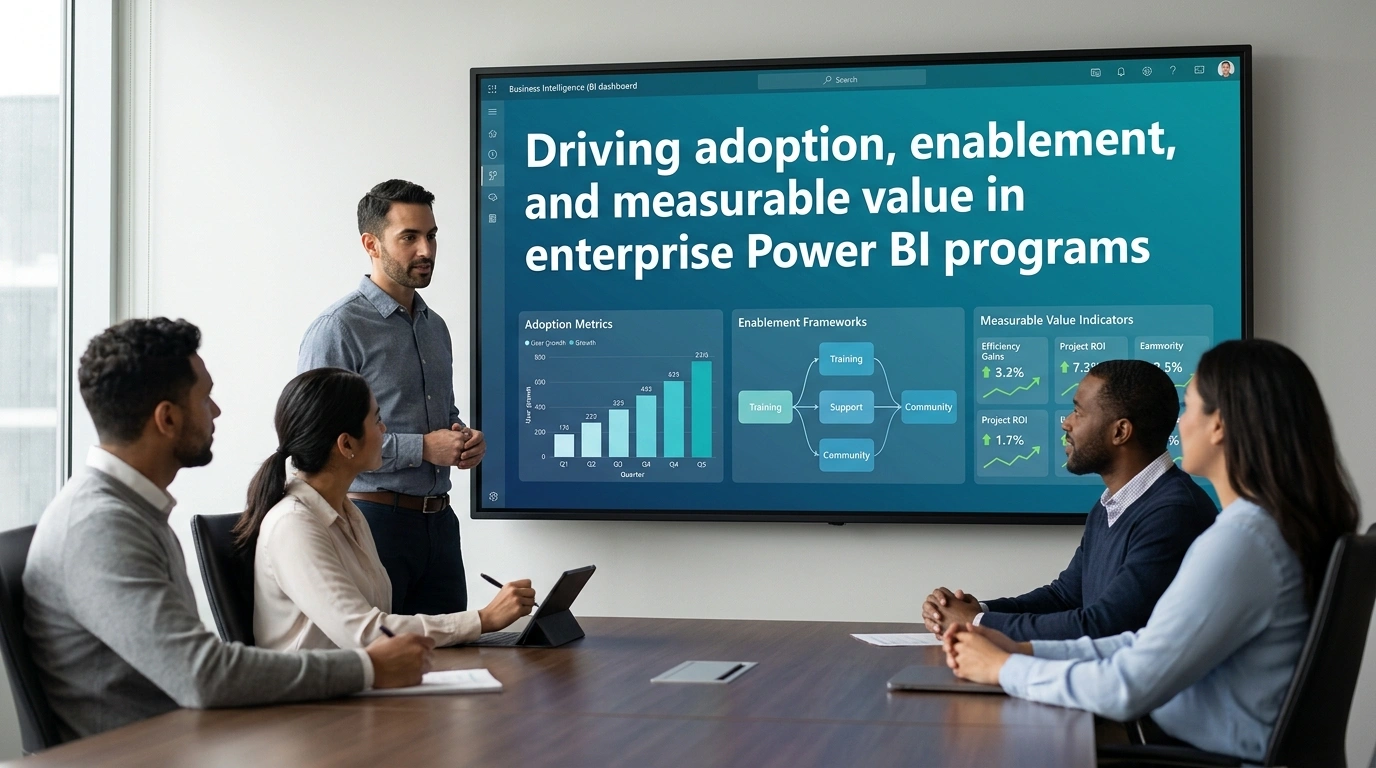
Building adoption through structured role-based learning improves the progression from passive report consumption to advanced analytical ownership while reducing fragmented content creation and inconsistent reporting logic. Supporting users with guided capability development, practical use cases, and accessible support resources increases confidence and strengthens responsible self-service practices across departments. Reinforcing these operational practices through coordinated enterprise frameworks additionally enables Scaling Power BI in large organizations to mature consistently without creating unnecessary governance burdens.
Treating measurable value as a continuous performance cycle ensures that enterprise Power BI programs remain closely associated with operational improvement, decision quality, and strategic business outcomes. Monitoring whether analytical assets influence planning, financial oversight, operational efficiency, and executive decisions also strengthens visibility into measurable organizational impact. Sustaining this cycle through continuous governance refinement, enablement investments, and trusted content management supports enterprise-scale Power BI maturity by transforming adoption into a repeatable strategic capability.
Tracking adoption metrics, usage signals, and business outcomes across teams
Tracking adoption effectively requires distinguishing platform activity from measurable business impact because Scaling Power BI in large organizations depends on more than access metrics alone. Measuring engagement through report consumption, content creation, workspace activity, and semantic model reuse provides critical indicators regarding the depth of analytics integration within organizational workflows. Connecting these usage signals to operational and strategic outcomes further strengthens measurement by ensuring that observed activity corresponds with genuine business performance improvement.
Comparing adoption patterns across departments reveals maturity differences, varying enablement requirements, and governance opportunities because organizational units frequently adopt analytics capabilities at different rates. Evaluating usage alongside decision quality, process acceleration, forecasting improvements, and operational efficiency provides a more comprehensive assessment of enterprise analytical value. Relating platform metrics directly to measurable business outcomes additionally supports informed investment decisions, strategic prioritization, and continuous refinement of adoption strategies.
Reviewing adoption metrics continuously strengthens Scaling Power BI in large organizations by maintaining alignment with evolving business priorities and enterprise objectives. Monitoring user growth, creator maturity, and strategic content utilization over time also provides early indicators regarding governance weaknesses, capability gaps, and discoverability limitations. Maintaining this integrated measurement framework transforms adoption evaluation into an ongoing strategic optimization function that supports enterprise-wide analytical advancement.
Supporting communities of practice, Centers of Excellence, and mentoring models
Establishing communities of practice creates a collaborative foundation for enterprise analytics maturity because Scaling Power BI in large organizations depends heavily on knowledge transfer, peer engagement, and sustained capability development. Connecting analysts, technical specialists, governance leaders, and business stakeholders within structured knowledge-sharing environments improves adoption velocity and analytical quality. Supporting collaboration through shared operational practices also strengthens enterprise data culture while reducing isolated or inconsistent development behaviors.
Positioning Centers of Excellence as strategic enablement hubs reinforces organizational consistency by providing governance support, technical standards, reusable assets, and advisory capabilities across the enterprise. Coordinating mentoring frameworks through experienced practitioners accelerates workforce capability development by helping less mature teams adopt proven practices more efficiently. Combining centralized expertise with distributed learning systems therefore strengthens enterprise resilience while preserving business responsiveness.
Encouraging structured mentoring, peer learning, and reusable knowledge systems enhances Scaling Power BI in large organizations by reducing support bottlenecks and improving user capability. Strengthening internal communities through recognition systems, collaborative forums, and champion networks increases sustained participation and reinforces long-term analytical maturity. Sustaining these layered support structures transforms Power BI growth into an institutional capability supported by coordinated human expertise rather than isolated technical implementation.
Balancing standardized governance with business agility for self-service analytics
Balancing governance with business agility requires recognizing that self-service analytics must operate within structured controls while preserving innovation speed. Defining clear ownership frameworks, security boundaries, and lifecycle expectations helps Scaling Power BI in large organizations maintain operational reliability without restricting departmental responsiveness. Applying governance as an enabling framework rather than a restrictive mechanism also strengthens adoption by allowing users to operate effectively within approved enterprise standards.
Supporting business teams with governed semantic models, certified data sources, and structured workspace environments improves self-service effectiveness by reducing technical barriers and improving consistency. Maintaining governance flexibility based on business criticality ensures that enterprise reporting, departmental analytics, and exploratory analysis receive proportionate oversight. Aligning governance with practical user requirements consequently preserves innovation while protecting enterprise data integrity.
Reviewing governance continuously strengthens Scaling Power BI in large organizations by adapting controls to changing business conditions, regulatory demands, and organizational maturity. Connecting governance directly with enablement also improves standards compliance because informed teams are more likely to follow practices that strengthen trust and performance. Sustaining this balance preserves enterprise consistency while enabling business agility as analytical adoption expands.
Reducing duplication and improving trust with certified content and discoverability
Reducing duplication requires ensuring that trusted enterprise content is more accessible and reusable than independently recreated reports or datasets. Promoting certification, endorsement, and discoverability strengthens Scaling Power BI in large organizations by improving consistency while reducing fragmented reporting logic. Supporting users with governed content pathways also increases operational efficiency by directing analytical efforts toward reusable enterprise assets.
Improving discoverability through transparent ownership, searchable metadata, clear refresh expectations, and accessible documentation increases trust in shared analytical assets. Concentrating official business definitions within governed semantic models reduces reconciliation complexity and strengthens decision-making consistency across departments. Reinforcing trust through structured lifecycle management also ensures that outdated or redundant content does not undermine analytical reliability.
Encouraging broad reuse of certified assets improves Scaling Power BI in large organizations by reducing redundant development, lowering governance complexity, and strengthening reporting consistency. Strengthening enterprise content catalogs through domain-based organization allows users to locate relevant analytical assets more efficiently. Sustaining discoverability and certification as strategic operational priorities transforms governance into a productivity-enhancing function that strengthens trust, efficiency, and enterprise-wide analytical confidence.
Ultimately, Scaling Power BI in large organizations succeeds when governance, architecture, performance, and adoption strategies operate as interconnected enterprise capabilities rather than isolated technical initiatives. Strengthening executive sponsorship, security controls, semantic design, capacity planning, and user enablement allows organizations to preserve analytical consistency while supporting business agility and innovation. Sustaining this balance transforms Power BI from a reporting solution into a strategic enterprise platform that drives measurable operational value, trusted decision-making, and long-term business intelligence maturity. Through disciplined strategic execution, organizations can ensure that Scaling Power BI in large organizations becomes a foundational driver of sustainable growth and enterprise transformation.