










Business Intelligence Consulting for CFOs has become an essential strategic capability for modern financial leadership, enabling CFOs to move beyond traditional reporting into a more proactive role centered on data-driven decision-making, operational visibility, and long-term business growth. By integrating financial intelligence with enterprise-wide performance data, organizations strengthen forecasting accuracy, improve governance, and empower executive leaders to make faster, more informed decisions in increasingly complex business environments. As financial leadership evolves, leveraging business intelligence consulting allows CFOs to transform finance into a strategic engine that drives profitability, resilience, and sustainable competitive advantage.
Business Intelligence Consulting for CFOs: Strategic Value in Modern Finance
Positioning Business Intelligence Consulting for CFOs as a strategic finance capability strengthens modern organizations by transforming finance from a backward-looking reporting function into a proactive source of strategic intelligence. Connecting financial systems with operational, sales, workforce, and procurement data enables broader visibility into organizational performance, allowing CFOs to evaluate profitability, liquidity, cost behavior, and growth opportunities with greater clarity. Expanding the role of finance through integrated business intelligence improves leadership’s ability to identify business drivers, measure strategic execution, and anticipate future challenges through evidence-based analysis.
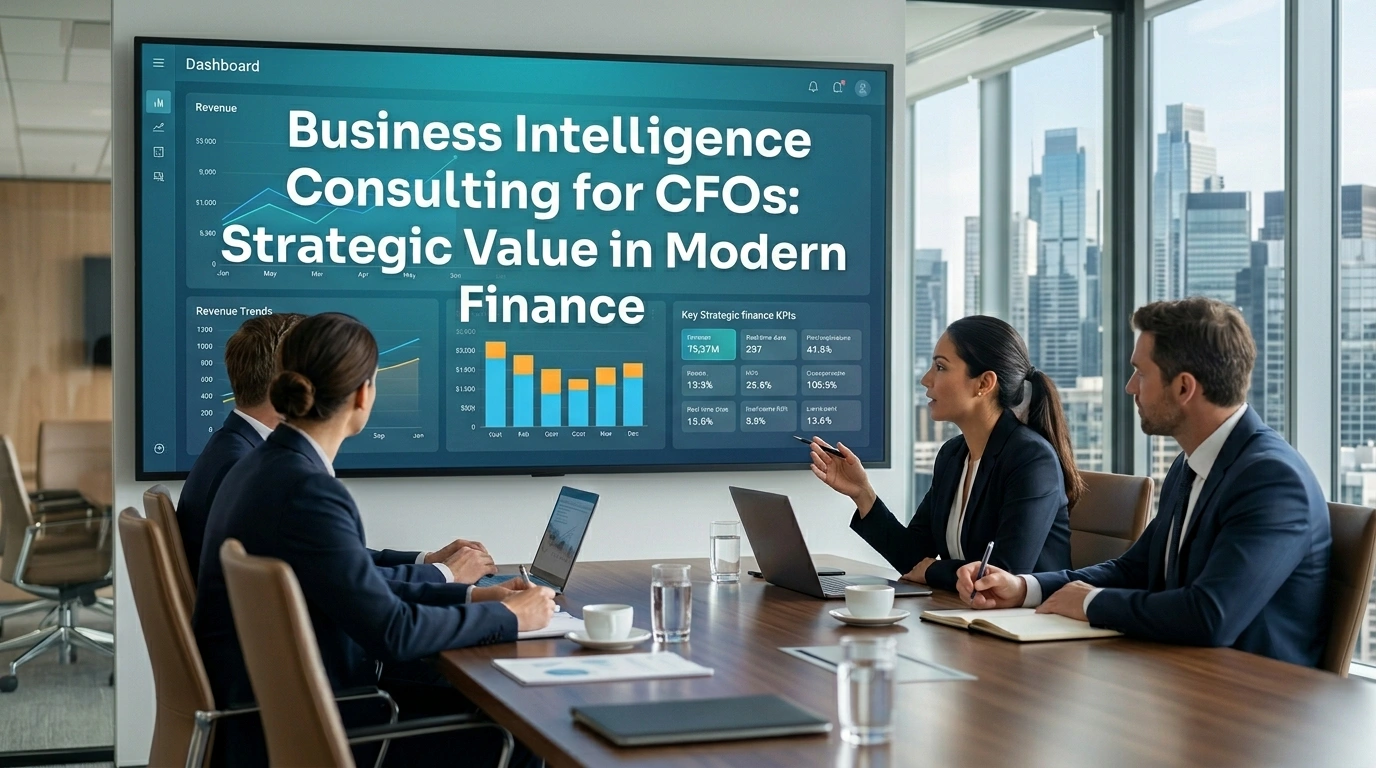
Supporting this transformation requires more than dashboard creation, as Business Intelligence Consulting for CFOs also improves data governance, KPI alignment, and enterprise-wide reporting consistency. Reducing fragmented data sources allows organizations to replace conflicting departmental reports with unified performance frameworks that strengthen accountability and improve executive trust in reported figures. Enabling more accurate forecasting, scenario planning, and resource allocation further increases finance’s strategic value, particularly under volatile economic conditions that require rapid strategic adjustment.
Strengthening executive decision-making through business intelligence consulting enhances resilience by enabling CFOs to detect risks, margin erosion, inefficiencies, and growth opportunities before they significantly affect organizational performance. Aligning strategic objectives with measurable business outcomes allows leadership teams to make more informed decisions across investment, budgeting, and operational planning. Transforming data into actionable intelligence establishes Business Intelligence Consulting for CFOs as an essential capability for modern finance leadership, organizational agility, and sustainable performance improvement.
The Expanding Role of the CFO in Data-Driven Leadership
Reflecting significant shifts in corporate leadership, the CFO role has evolved from traditional financial stewardship into broader strategic influence encompassing performance optimization, digital transformation, and enterprise-wide planning. Linking financial expertise with advanced analytics enables CFOs to participate more directly in shaping pricing strategies, operational efficiency, risk management, and long-term growth initiatives. Expanding these responsibilities requires access to reliable, real-time intelligence that supports faster and more informed executive decisions.
Supporting this broader leadership function, Business Intelligence Consulting for CFOs strengthens the capacity to interpret complex business data and translate it into strategic recommendations. Increasing the use of predictive models, automation tools, and unified dashboards enables CFOs to move beyond historical analysis and focus more heavily on scenario planning, future forecasting, and performance optimization. Connecting financial insight with enterprise-wide operational understanding enhances leadership credibility across departments and strengthens finance’s role in executive collaboration.
Improving this expanded role depends on establishing strong data governance and consistent reporting frameworks that reduce ambiguity and strengthen trust in enterprise data. Aligning departmental metrics with broader business goals ensures that leadership teams rely on consistent information when making critical decisions. Advancing Business Intelligence Consulting for CFOs supports the CFO’s transformation into a data-driven strategist who actively shapes organizational direction, financial resilience, and long-term value creation.
How Business Intelligence Consulting Aligns Finance and Operations
Aligning finance and operations through business intelligence improves organizational performance by connecting financial outcomes directly to operational activities. Integrating data from ERP systems, supply chains, procurement, workforce management, and sales operations enables CFOs to understand how daily operational decisions influence profitability, cost efficiency, and strategic execution. Building this visibility allows finance leaders to move beyond isolated financial reporting and gain a more comprehensive understanding of business performance drivers.
Supporting this integration, Business Intelligence Consulting for CFOs creates shared performance frameworks that align financial metrics with operational KPIs. Reducing departmental silos enables finance and operations teams to work from consistent data definitions, unified dashboards, and coordinated reporting processes. Strengthening these connections improves transparency, reduces internal reporting conflicts, and supports more productive collaboration between departments focused on revenue generation, cost control, and operational efficiency.
Enhancing alignment between finance and operations strengthens budgeting, forecasting, and performance management by clarifying relationships between strategy and execution. Improving visibility into cost drivers, productivity trends, and resource utilization enables CFOs to make more informed recommendations regarding investments, process optimization, and profitability improvement. Converting operational activity into measurable financial intelligence establishes Business Intelligence Consulting for CFOs as a vital mechanism for cross-functional leadership and enterprise-wide strategic coordination.
Why Real-Time Reporting Matters for Executive Decisions
Improving executive leadership increasingly depends on real-time access to accurate business performance data rather than delayed reporting cycles. Replacing static monthly or quarterly summaries with live dashboards enables CFOs and executive teams to monitor revenue performance, expense trends, cash flow changes, and operational risks as they develop. Strengthening access to current information improves responsiveness to financial threats, market changes, and strategic opportunities.
Supporting this capability, Business Intelligence Consulting for CFOs enables organizations to design reporting systems that continuously convert operational and financial data into actionable executive intelligence. Reducing delays in data processing improves decision speed while strengthening confidence in strategic choices because leadership can rely on updated information rather than historical assumptions. Connecting real-time reporting with predictive analysis further enhances leadership agility by allowing organizations to test scenarios and adjust strategies proactively.
Strengthening executive responsiveness through real-time intelligence improves governance by ensuring that urgent decisions remain grounded in consistent, validated data. Improving visibility into changing conditions enables CFOs to detect anomalies, performance gaps, and financial vulnerabilities at earlier stages. Transforming reporting into a dynamic strategic asset reinforces Business Intelligence Consulting for CFOs as a critical driver of organizational adaptability, executive precision, and sustained competitive advantage.
Key Benefits of Unified Financial and Operational Data
Unifying financial and operational data creates a stronger foundation for executive leadership by integrating multiple business functions into a coherent performance model. Connecting sales, procurement, payroll, inventory, and production metrics with financial outcomes enables CFOs to identify performance relationships that isolated systems often obscure. Strengthening this visibility improves understanding of profitability drivers, operational bottlenecks, and strategic opportunities.
Supporting unified data structures, Business Intelligence Consulting for CFOs reduces dependence on fragmented spreadsheets, disconnected reports, and inconsistent departmental definitions. Improving data consistency enhances reporting accuracy, forecasting precision, and executive confidence in performance analysis. Creating shared visibility across departments strengthens accountability because financial and operational teams evaluate performance through a unified strategic framework.
Enhancing business performance through unified data supports stronger scenario planning, more effective resource allocation, and clearer board-level communication. Improving access to comprehensive enterprise intelligence enables CFOs to deliver more reliable strategic recommendations while reducing the burden of manual reconciliation and repetitive reporting processes. Transforming integrated business data into strategic leadership intelligence positions Business Intelligence Consulting for CFOs as a powerful enabler of stronger governance, more effective execution, and long-term enterprise value.
How Business Intelligence Consulting for CFOs Improves Forecasting and Performance
Improving forecasting and performance through Business Intelligence Consulting for CFOs establishes a stronger financial leadership framework by integrating operational realities with strategic financial planning. Strengthening the CFO’s capacity to evaluate revenue trends, cost behavior, working capital, and profitability patterns enables finance teams to move beyond isolated historical analysis toward more connected predictive intelligence. Connecting finance systems with sales, procurement, operations, and accounting functions improves data reliability and enhances executive confidence in future projections.
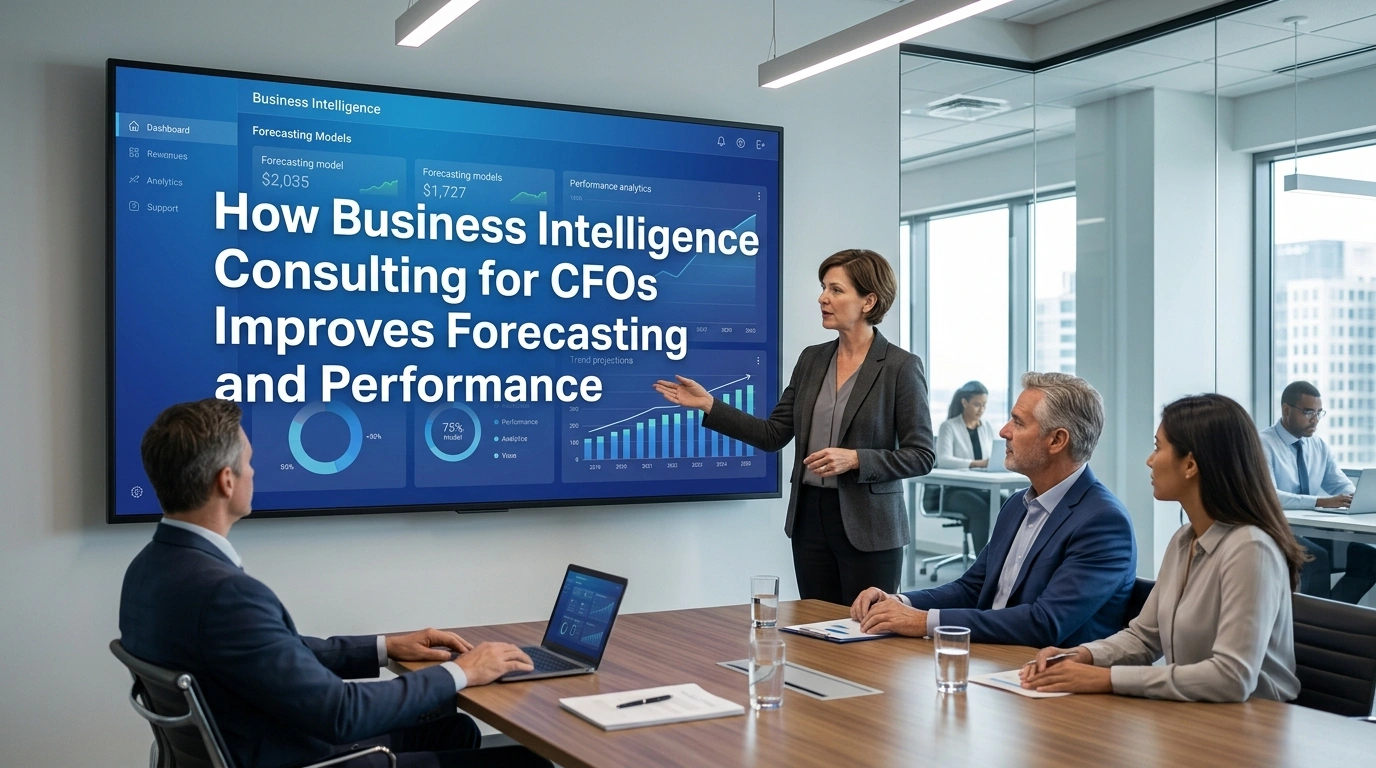
Supporting this transformation through integrated analytics enables forecasting to function as a continuous management discipline rather than a periodic budgeting exercise. Enhancing data visibility across departments improves the organization’s ability to detect early signals of performance shifts, market pressures, and internal inefficiencies. Reducing manual reporting burdens increases the time available for strategic interpretation, allowing CFOs to focus more effectively on leadership decisions.
Aligning advanced reporting models with organizational objectives ensures that financial forecasting directly supports broader business strategy. Measuring financial and operational performance through connected dashboards strengthens accountability while clarifying the relationship between assumptions and outcomes. Enabling Business Intelligence Consulting for CFOs to unify forecasting, performance monitoring, and strategic planning strengthens executive leadership through more accurate, agile, and evidence-based decision-making capabilities.
Strengthening Budgeting Accuracy Through Advanced Analytics
Strengthening budgeting accuracy through advanced analytics improves financial planning quality by replacing static assumptions with data-driven forecasting models. Improving budget precision requires integrating historical financial records, operational trends, departmental plans, and market indicators into a cohesive analytical framework. Connecting multiple data sources reduces inconsistencies and supports more reliable financial projections across the organization.
Supporting Business Intelligence Consulting for CFOs through automated budget modeling increases visibility into cost drivers, revenue opportunities, and operational constraints. Identifying expense anomalies, margin pressures, and shifting resource requirements earlier in the budgeting process improves responsiveness and supports more realistic financial planning. Enabling rolling forecasts further strengthens budget flexibility by allowing organizations to revise expectations as business conditions evolve.
Aligning departmental budgets with enterprise-wide objectives improves accountability and strategic cohesion. Clarifying the relationship between operational activities and financial targets strengthens leadership oversight and supports more disciplined capital allocation. Advancing Business Intelligence Consulting for CFOs transforms budgeting into a dynamic strategic instrument that enhances long-term financial performance and organizational resilience.
Supporting Scenario Planning and Risk Assessment
Supporting scenario planning and risk assessment strengthens the CFO’s role in managing uncertainty by providing structured frameworks for evaluating multiple potential outcomes. Improving financial resilience requires modeling variables such as revenue volatility, inflation, supply disruption, market contraction, and regulatory change. Connecting operational assumptions with financial scenarios enables leadership teams to understand both direct and cascading business impacts.
Enabling Business Intelligence Consulting for CFOs to support scenario analysis improves preparedness by offering measurable comparisons between favorable, expected, and adverse business conditions. Strengthening risk visibility through integrated dashboards allows finance leaders to monitor liquidity pressures, profitability threats, debt obligations, and strategic vulnerabilities with greater precision. Translating complex uncertainties into accessible performance indicators supports more informed executive and board-level evaluations.
Aligning scenario planning with organizational priorities ensures that risk management remains an active strategic function rather than a reactive compliance process. Reducing dependence on delayed reporting enhances leadership agility and supports faster strategic adjustments. Encouraging proactive decision-making through Business Intelligence Consulting for CFOs strengthens financial leadership capacity to manage uncertainty with greater confidence and operational control.
Enhancing KPI Tracking with CFO-Focused Dashboards
Enhancing KPI tracking through CFO-focused dashboards improves executive visibility by consolidating critical financial and operational metrics into accessible decision-support systems. Improving dashboard effectiveness requires prioritizing key indicators such as cash flow, profitability, expense management, revenue growth, and forecast accuracy. Connecting these metrics to validated enterprise systems ensures consistency and strengthens leadership trust in reported performance.
Supporting Business Intelligence Consulting for CFOs through dashboard optimization improves the speed and quality of financial analysis by transforming raw data into strategic intelligence. Highlighting trends, exceptions, and variance drivers strengthens the CFO’s ability to identify risks and opportunities at earlier stages. Comparing actual performance against budget and strategic benchmarks creates a clearer framework for evaluating organizational progress.
Aligning dashboards with executive priorities improves cross-functional understanding while maintaining financial governance. Segmenting reporting views for different leadership audiences strengthens communication without compromising data consistency. Reinforcing Business Intelligence Consulting for CFOs through KPI-focused dashboard systems transforms reporting into a strategic leadership mechanism that supports accountability, agility, and sustained business performance.
Connecting Forecasts, Actuals, and Strategic Targets
Connecting forecasts, actuals, and strategic targets strengthens organizational leadership by creating an integrated financial performance management framework. Improving this connection enables CFOs to evaluate whether business outcomes align with strategic expectations while identifying emerging variances at earlier stages. Linking projected performance with real-time operational and accounting data supports more reliable planning and performance measurement.
Supporting Business Intelligence Consulting for CFOs through unified financial reporting improves visibility into revenue execution, cost management, profitability movement, and strategic progress. Clarifying differences between forecasted and actual performance enables leadership teams to refine assumptions, improve resource allocation, and strengthen accountability. Aligning financial measurement systems with strategic objectives ensures that reporting remains directly relevant to long-term business priorities.
Integrating historical performance, present outcomes, and future objectives creates a comprehensive leadership framework for strategic execution. Reducing fragmented reporting structures enhances consistency and improves confidence in executive decision-making. Strengthening Business Intelligence Consulting for CFOs through connected forecasting and strategic performance systems supports more disciplined growth, improved governance, and empowered financial leadership.
Building Data Governance and CFO Dashboards for Executive Visibility
Establishes a governed finance intelligence layer as the foundation for executive visibility because leadership decisions depend on consistent definitions, trusted ownership, and timely access to financial and operational signals. Connects Business Intelligence Consulting for CFOs with the practical requirement to align board reporting, management accounting, FP&A, treasury, risk, and operational performance into one controlled environment rather than fragmented spreadsheets. Strengthens the CFO’s capacity to oversee cash flow, planning, financial risk, reporting accuracy, and performance analysis through integrated governance structures that support strategic leadership.
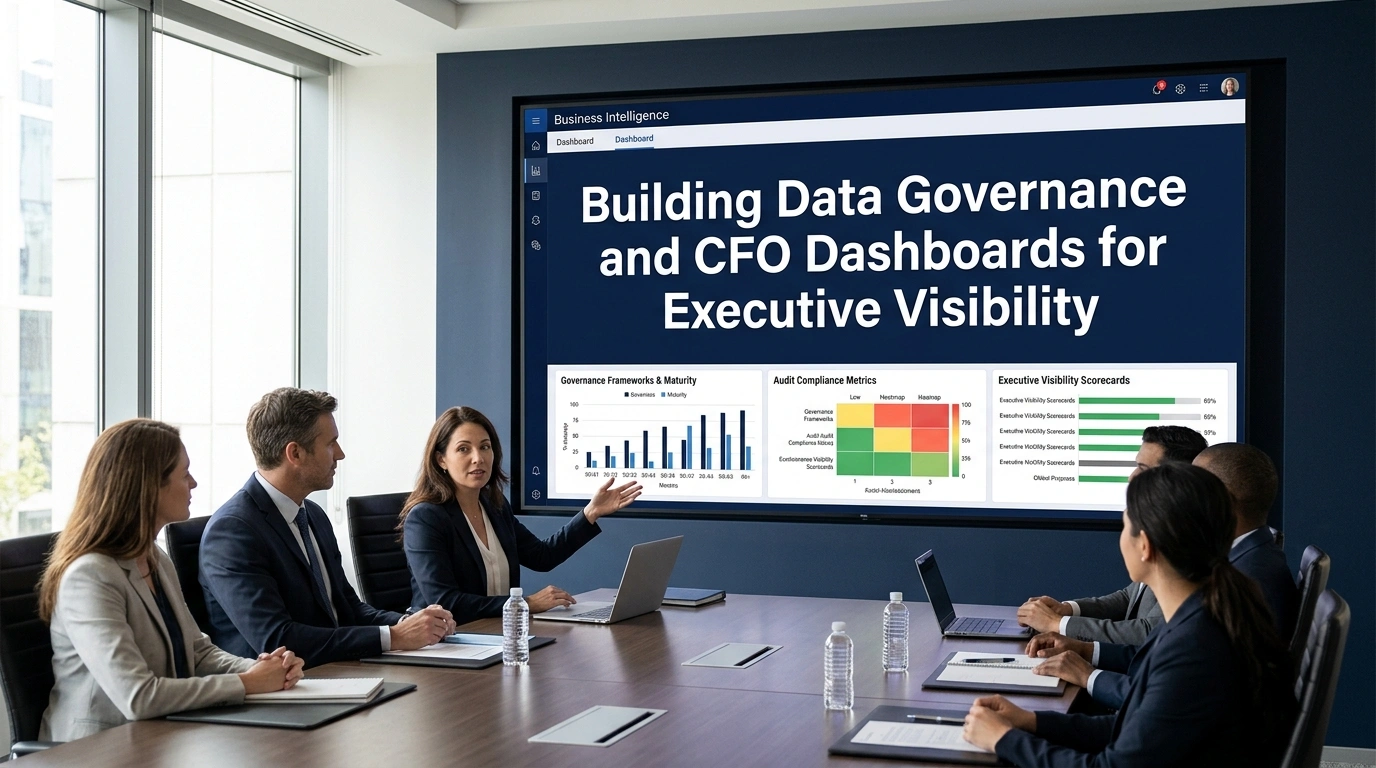
Builds dashboards around governed metrics such as revenue, gross margin, EBITDA margin, operating cash flow, liquidity ratios, working capital, DSO, budget variance, and debt indicators because these measures allow leadership to evaluate profitability, solvency, and operational discipline. Improves executive decision-making by replacing isolated figures with connected insights that clarify outcomes, underlying causes, and areas requiring corrective action. Supports Business Intelligence Consulting for CFOs through defined data ownership, calculation standards, access controls, approval workflows, refresh schedules, and reconciliation procedures before dashboards reach senior leadership.
Reduces the risk of conflicting reports by ensuring that finance, sales, procurement, HR, and operations apply consistent logic to revenue recognition, expense classification, cost allocation, and forecast comparisons. Enhances board-level visibility by presenting strategic targets alongside actual performance, rolling forecasts, scenario assumptions, and risk indicators in formats that emphasize critical exceptions without unnecessary complexity. Aligns Business Intelligence Consulting for CFOs with leadership empowerment by transforming finance data into a disciplined decision system that reinforces transparency, accountability, and informed executive action.
Improving Data Quality Across Finance Systems
Improves data quality across finance systems by identifying weaknesses that commonly arise between ERP platforms, accounting systems, billing tools, CRM records, procurement files, payroll sources, and planning models. Connects Business Intelligence Consulting for CFOs with the structured processes of cleansing master data, standardizing account hierarchies, validating transaction details, and reconciling balances before information enters executive dashboards. Reduces errors caused by duplicated records, inconsistent classifications, outdated mappings, missing cost centers, and delayed financial adjustments.
Strengthens reporting reliability by applying validation controls that compare source totals with dashboard outputs, identify anomalies, and expose incomplete records before they distort profitability, cash flow, or margin analysis. Supports finance leadership by creating a unified data language that standardizes revenue categories, expense definitions, capital expenditures, and operational cost structures across departments. Enhances Business Intelligence Consulting for CFOs by ensuring that dashboards rely on trusted financial architecture rather than fragmented or manually manipulated datasets.
Enables finance teams to detect unusual trends such as margin erosion, delayed collections, cost escalation, inventory valuation issues, and revenue concentration risks with greater precision. Builds data stewardship into daily operations by assigning responsibility for source corrections, exception management, and ongoing quality oversight. Supports executive visibility by ensuring that every financial figure remains traceable, explainable, and consistent, allowing Business Intelligence Consulting for CFOs to convert fragmented financial records into dependable strategic intelligence.
Designing Dashboards for Profitability, Cash Flow, and Margin Analysis
Designs CFO dashboards around the financial priorities most critical to executive leadership, particularly whether the organization is generating sustainable profitability, preserving liquidity, protecting margins, and achieving strategic objectives. Connects Business Intelligence Consulting for CFOs with dashboard structures that unify profit and loss performance, balance sheet strength, cash flow activity, forecast scenarios, and operational drivers into comprehensive leadership frameworks. Highlights essential profitability indicators such as gross margin, EBITDA margin, net income, contribution margin, and segment-level profitability.
Tracks cash flow through operating, investing, and financing movements, enabling leadership to understand where liquidity is generated, constrained, or exposed to future pressure. Shows working capital metrics such as DSO, DPO, inventory turnover, current ratio, and cash conversion cycle because these indicators connect accounting outcomes with actual financial resilience. Supports margin analysis by breaking down performance across products, business units, geographies, customer segments, or delivery channels.
Improves Business Intelligence Consulting for CFOs by transforming raw data into layered executive dashboards that begin with strategic overviews and extend into operational drivers and performance exceptions. Reduces cognitive overload through clear visual hierarchy, consistent metric definitions, and logical drill-down pathways rather than excessive reporting complexity. Reinforces executive leadership by enabling CFOs and boards to evaluate profit sustainability, liquidity resilience, and margin efficiency with greater clarity, speed, and analytical confidence.
Reducing Reporting Delays with Automated Data Pipelines
Reduces reporting delays by replacing manual spreadsheet consolidation, repetitive extraction processes, fragmented approvals, and disconnected reporting cycles with automated finance data pipelines. Connects Business Intelligence Consulting for CFOs with the implementation of scheduled integrations, transformation logic, validation checkpoints, exception monitoring, and controlled dashboard refreshes. Improves finance efficiency by minimizing administrative reporting burdens and increasing capacity for strategic interpretation, forecasting, and executive advisory functions.
Supports faster financial close cycles by integrating general ledger balances, subledger transactions, payroll data, procurement records, and planning assumptions into unified reporting environments. Enables dashboards to deliver near-real-time or regularly refreshed views of revenue, cost structures, liquidity, margins, and forecast performance. Strengthens executive responsiveness because leadership gains timely access to critical metrics without delays associated with manual intervention.
Enhances Business Intelligence Consulting for CFOs by documenting data origins, transformation procedures, refresh timing, and reconciliation status across reporting systems. Reduces operational risk by limiting spreadsheet errors, broken formulas, inconsistent file versions, and undocumented adjustments. Aligns finance reporting with leadership agility by transforming reporting into an adaptive management system that supports timely decisions, proactive intervention, and continuous strategic oversight.
Supporting Compliance, Control, and Audit Readiness
Supports compliance, control, and audit readiness by embedding governance requirements directly into finance intelligence systems rather than treating them as isolated administrative obligations. Connects Business Intelligence Consulting for CFOs with structured controls including role-based permissions, approval chains, audit trails, data lineage, and documented metric standards. Strengthens the CFO’s stewardship responsibilities by ensuring that financial reporting systems consistently support regulatory obligations, internal controls, and transparent governance.
Reduces audit complexity by ensuring that every reported figure remains traceable from executive dashboards back to source transactions, approved adjustments, and documented calculations. Improves internal control by identifying unusual entries, policy breaches, unauthorized changes, and unexplained variances before they escalate into material financial reporting risks. Supports Business Intelligence Consulting for CFOs by aligning dashboard frameworks with governance standards, risk thresholds, and compliance objectives.
Builds confidence in financial reporting by maintaining consistency across leadership reports, board documentation, lender communications, and regulatory disclosures. Enhances accountability by assigning ownership for source data management, correction workflows, and compliance certification. Reinforces the strategic value of Business Intelligence Consulting for CFOs by positioning CFO dashboards as controlled governance systems that strengthen assurance, audit readiness, and responsible executive leadership.
Selecting the Right Business Intelligence Consulting Partner for CFO Priorities
Selecting the right consulting partner for CFO priorities depends on aligning technical capability with strategic financial leadership requirements because Business Intelligence Consulting for CFOs generates maximum value when consulting expertise supports executive visibility, financial governance, and accelerated decision-making. Connecting partner selection with leadership enablement strengthens the role of BI as an executive framework rather than a reporting utility. Evaluating a partner’s understanding of board expectations, cash flow priorities, profitability pressures, operational drivers, and enterprise risk ensures that technology implementation directly supports finance leadership outcomes.
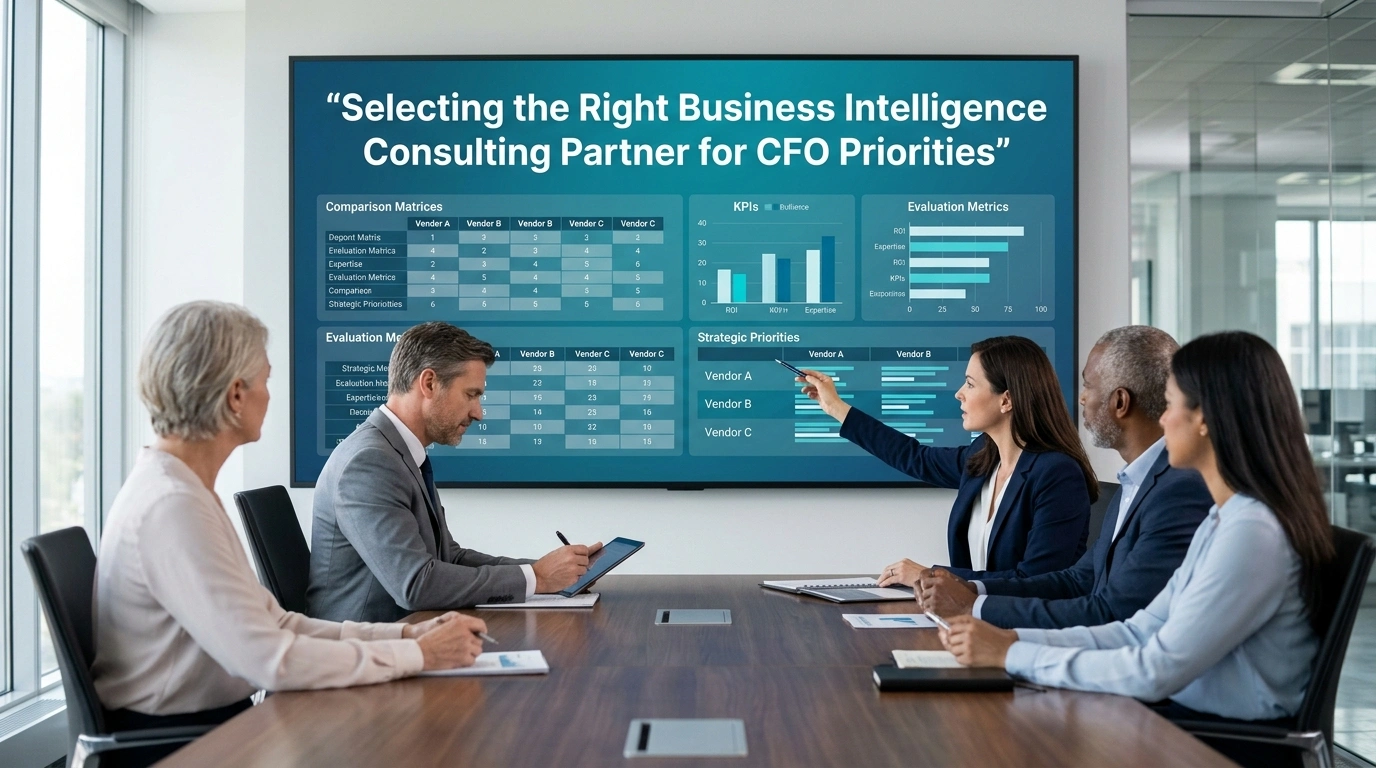
Assessing consulting suitability requires reviewing expertise in financial systems, governance structures, and KPI architecture because effective Business Intelligence Consulting for CFOs relies on transforming fragmented operational and financial data into consistent executive intelligence. Examining previous experience with ERP systems, planning platforms, accounting environments, and reporting transformation initiatives helps determine whether the partner can unify data sources into scalable, finance-centered dashboards. Considering communication capability and strategic advisory strength supports successful outcomes because CFOs require actionable insight rather than isolated technical deployment.
Prioritizing sustainable strategic value over short-term dashboard delivery increases the probability of long-term BI maturity. Supporting finance transformation through governance frameworks, user enablement, and scalable infrastructure ensures that Business Intelligence Consulting for CFOs strengthens internal leadership capabilities over time. Demonstrating measurable success through reduced reporting friction, improved executive confidence, and stronger decision-making positions the consulting relationship as a strategic driver of organizational leadership.
Evaluating Industry Expertise and Financial Reporting Knowledge
Evaluating industry expertise and financial reporting knowledge requires determining whether a consulting partner can interpret sector-specific financial structures because Business Intelligence Consulting for CFOs must reflect operational economics, compliance obligations, and industry-specific performance metrics. Recognizing distinctions among sectors such as manufacturing, healthcare, retail, or services strengthens the design of reporting systems that support relevant executive analysis. Matching consulting capability with sector-specific financial requirements improves dashboard relevance and strategic effectiveness.
Reviewing financial reporting competency involves examining whether consultants understand management reporting frameworks, regulatory compliance obligations, budget controls, consolidation structures, and executive review cycles. Mapping chart-of-accounts systems, entity structures, operational drivers, and planning assumptions into reliable BI models supports accurate strategic reporting. Strengthening consistency across statutory, operational, and management reporting environments ensures that Business Intelligence Consulting for CFOs delivers trustworthy and decision-ready intelligence.
Comparing prior finance transformation experience clarifies whether the consulting partner can design systems that reduce reporting complexity while strengthening analytical power. Supporting CFO priorities through reliable KPI definitions, variance analysis frameworks, and executive financial narratives improves the practical impact of BI investments. Demonstrating financial expertise and industry knowledge positions Business Intelligence Consulting for CFOs as a strategic function that strengthens leadership confidence and organizational performance.
Assessing Technology Integration and Scalability Needs
Assessing technology integration and scalability needs requires evaluating whether the consulting partner can establish a BI environment that connects fragmented enterprise systems into a unified analytical structure. Supporting CFO priorities through integrated data architecture strengthens reporting consistency across ERP systems, accounting platforms, operational software, and external data sources. Ensuring compatibility between existing infrastructure and future growth requirements allows Business Intelligence Consulting for CFOs to remain sustainable as organizational complexity expands.
Reviewing integration strategy involves examining data extraction methods, transformation pipelines, governance layers, semantic models, and user access structures. Building scalable environments requires more than dashboard creation because finance leaders depend on secure, stable, and auditable systems capable of managing expanding data volumes and evolving analytical demands. Strengthening technical architecture through cloud readiness, API integration, automation, and governance controls ensures long-term operational resilience.
Evaluating scalability includes preparing for expansion in reporting complexity, user demand, and strategic forecasting capabilities. Supporting future requirements such as acquisitions, regional expansion, advanced forecasting, and regulatory adaptation increases the enduring value of Business Intelligence Consulting for CFOs. Demonstrating technical adaptability ensures that BI investments continue supporting executive leadership as strategic priorities evolve.
Measuring ROI from Business Intelligence Consulting for CFOs
Measuring ROI from Business Intelligence Consulting for CFOs requires defining performance benchmarks that connect implementation outcomes directly to strategic finance objectives. Evaluating reporting speed, manual workload reduction, forecast precision, and data quality improvements provides measurable indicators of organizational value. Establishing pre-implementation baselines strengthens the ability to quantify improvements in operational efficiency and executive effectiveness.
Calculating ROI must include both direct and indirect benefits because Business Intelligence Consulting for CFOs often produces strategic value beyond immediate cost reductions. Reducing close-cycle duration, improving pricing visibility, strengthening margin analysis, and enhancing strategic forecasting contribute to broader financial performance improvements. Linking dashboard adoption rates and decision-quality improvements to measurable business outcomes strengthens investment validation.
Considering full investment requirements such as licensing, implementation, internal labor, governance preparation, and training ensures realistic financial analysis. Supporting ROI evaluation through phased performance reviews allows CFOs to monitor progress and identify optimization opportunities over time. Demonstrating sustained gains in strategic visibility, decision confidence, and operational efficiency confirms the long-term value of Business Intelligence Consulting for CFOs.
Preparing Internal Teams for Long-Term BI Adoption
Preparing internal teams for long-term BI adoption requires embedding BI capabilities into organizational culture rather than treating implementation as a temporary technology initiative. Strengthening team readiness through governance ownership, role clarity, and finance-centered analytical training supports sustainable operational success. Positioning Business Intelligence Consulting for CFOs as a leadership transformation function improves long-term utilization and organizational resilience.
Building internal capability involves educating finance teams in KPI interpretation, dashboard utilization, data validation, and analytical communication. Establishing shared performance definitions and governance frameworks reduces reporting inconsistency while strengthening trust in financial intelligence systems. Encouraging collaboration among finance, IT, and operational stakeholders further supports long-term system sustainability.
Supporting long-term adoption requires documentation, phased onboarding, performance monitoring, and continuous improvement structures. Tracking user behavior, adoption rates, and reporting quality enables organizations to refine systems as strategic needs evolve. Demonstrating organizational self-sufficiency ensures that Business Intelligence Consulting for CFOs delivers enduring leadership value through empowered teams, reliable governance, and scalable analytical maturity.
In today’s rapidly evolving business landscape, Business Intelligence Consulting for CFOs serves as a critical foundation for stronger executive leadership, enhanced financial governance, and more agile strategic planning. Strengthening data quality, improving forecasting, unifying operational and financial intelligence, and enabling real-time executive visibility position CFOs as powerful strategic partners within their organizations. By embracing advanced business intelligence frameworks, CFOs can improve decision precision, optimize enterprise performance, and build resilient financial leadership models capable of sustaining long-term organizational success.