










Power BI for digital transformation strategy has become a central component of modern enterprise modernization because organizations increasingly depend on connected analytics, centralized reporting, and data-driven decision-making to improve operational efficiency and strategic coordination. Businesses undergoing digital transformation often require unified visibility across departments, scalable KPI governance, and real-time analytical insights capable of supporting executive leadership and long-term modernization objectives. The role of Power BI extends beyond traditional reporting by helping organizations integrate operational, financial, and customer intelligence within governed analytical ecosystems that strengthen collaboration, improve responsiveness, and support sustainable enterprise growth. This article explores how Power BI supports digital transformation initiatives, strengthens organizational performance management, improves enterprise-wide collaboration, and contributes to long-term strategic adaptability.
Power BI for digital transformation strategy: core business value and strategic impact
Power BI for digital transformation strategy supports integrated analytical environments that connect operational data, strategic planning, and enterprise performance visibility within unified reporting systems. Enterprise modernization strategy strengthens organizational coordination by replacing fragmented reporting structures with centralized dashboards, scalable KPI governance, and connected analytics models that improve operational alignment across departments. Organizational consistency improves because executives, operational managers, and department leaders can evaluate shared performance indicators through connected reporting ecosystems rather than isolated data environments. Strategic oversight improves because organizations can measure operational efficiency, customer behavior, financial performance, and transformation progress through integrated analytical structures that support continuous enterprise visibility.
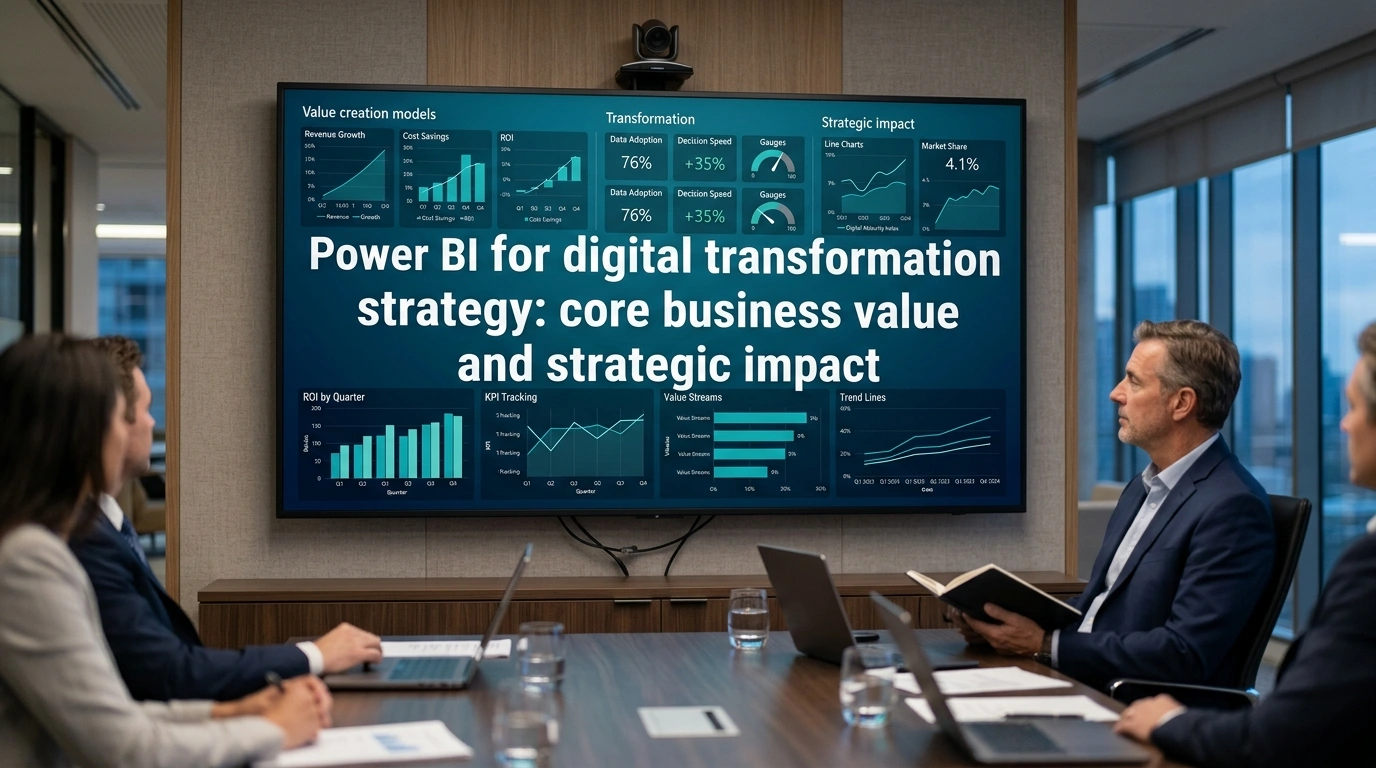
Power BI for digital transformation strategy expands operational value because modernization initiatives increasingly depend on accessible intelligence, cross-functional transparency, and measurable transformation outcomes supported by centralized analytics. Executive transformation leadership strengthens organizational control by providing senior decision-makers with broader visibility into organizational priorities, resource allocation patterns, modernization performance, and operational risks through interactive reporting systems. Strategic responsiveness improves because leadership teams can evaluate performance trends, identify operational gaps, and monitor transformation milestones without relying on delayed reporting cycles or inconsistent manual analysis. Data-driven organizational redesign supports enterprise adaptation because centralized analytics environments help enterprises restructure workflows, redefine accountability models, and align operational processes with measurable strategic objectives.
Enterprise adaptability increases because analytical visibility supports faster responses to market changes, operational inefficiencies, and evolving customer expectations. Competitive advantage through data modernization becomes more sustainable because organizations that operationalize enterprise analytics often improve planning accuracy, decision consistency, and transformation scalability more effectively than businesses dependent on fragmented legacy reporting systems. Long-term enterprise transformation maturity strengthens organizational resilience because Power BI for digital transformation strategy integrates analytical decision-making into daily operations, executive governance, modernization planning, and enterprise performance management.
Why Power BI supports enterprise-wide digital transformation initiatives
Power BI supports enterprise-wide transformation initiatives because the platform creates shared analytical environments capable of connecting finance, operations, sales, marketing, HR, and executive leadership through unified reporting structures and governed performance metrics. Digital transformation frameworks align with enterprise modernization because organizations require centralized visibility, coordinated decision-making, and standardized operational intelligence across multiple departments. Cross-department analytics adoption strengthens organizational collaboration because business units can work through synchronized KPIs, shared dashboards, and integrated reporting workflows that reduce communication barriers and improve strategic consistency. Power BI for digital transformation strategy functions as an enterprise coordination layer by connecting operational systems, cloud platforms, and business applications within scalable analytical ecosystems.
Executive transformation leadership strengthens organizational oversight because centralized reporting environments provide senior management with broader visibility into organizational performance, transformation progress, operational risk, and resource optimization efforts. Enterprise modernization strategy improves operational alignment by reducing duplicated reports, conflicting spreadsheet logic, and disconnected departmental analytics that often weaken large-scale transformation programs. Collaboration between technical teams and business leadership becomes stronger because shared data environments improve alignment between modernization priorities and operational execution. Transformation maturity accelerates because departments gain faster access to reliable insights that support continuous improvement and informed strategic planning.
Business process optimization through BI reinforces operational efficiency because integrated analytics environments allow organizations to identify inefficiencies, monitor workflows, and evaluate operational bottlenecks through real-time performance visibility. Power BI for digital transformation strategy expands operational relevance because enterprise analytics becomes integrated into organizational planning, operational management, and transformation governance processes rather than remaining limited to isolated reporting activities. Long-term enterprise transformation maturity strengthens scalability, accountability, operational consistency, and sustainable modernization across organizational structures.
How data-driven culture strengthens long-term transformation outcomes
Data-driven culture strengthens long-term transformation outcomes because organizations can base operational decisions, strategic planning, and organizational redesign on measurable evidence rather than disconnected assumptions or fragmented reporting practices. Data-driven organizational redesign aligns with transformation initiatives because enterprises often require changes in accountability structures, workflow governance, communication models, and performance evaluation processes. Power BI for digital transformation strategy reinforces sustainable analytics adoption because employees across departments consistently rely on shared dashboards, governed metrics, and accessible performance insights during operational activities. Enterprise-wide analytical behavior improves organizational collaboration because data visibility strengthens coordination between leadership teams, analysts, operational departments, and business units working toward shared transformation objectives.
Executive transformation leadership supports organizational evaluation because senior management can assess organizational progress through transparent reporting environments capable of revealing operational inefficiencies, performance trends, and strategic gaps. Long-term enterprise transformation maturity improves organizational adaptability because enterprises with established analytical cultures often respond more effectively to market changes, modernization pressures, and evolving customer expectations. Transformation continuity improves because analytical decision-making reduces dependence on fragmented institutional knowledge and inconsistent reporting interpretations. Business process optimization through BI improves operational efficiency because continuous data analysis allows organizations to identify workflow inconsistencies, operational waste, process delays, and performance limitations with greater accuracy.
Competitive advantage through data modernization expands organizational capability because enterprises with mature analytical cultures often improve forecasting accuracy, operational resilience, customer responsiveness, and strategic agility more effectively than organizations with limited analytics adoption. Power BI for digital transformation strategy reinforces operational relevance because accessible reporting environments help employees connect operational performance with broader transformation objectives and enterprise modernization priorities. Long-term analytical integration strengthens organizational resilience, strategic governance, enterprise coordination, and modernization sustainability across operational and managerial environments.
Key capabilities of Power BI that align with strategic modernization goals
Strategic modernization goals align with capabilities that support enterprise integration, governed reporting, interactive analytics, AI-assisted insights, and scalable analytical collaboration across business environments. Enterprise modernization strategy requires analytical platforms capable of connecting operational systems, customer data, financial environments, cloud infrastructures, and business applications within unified reporting ecosystems. Power BI for digital transformation strategy strengthens operational visibility, governance consistency, and enterprise scalability while reducing fragmented reporting structures through centralized analytics environments. Business process optimization through BI enhances operational efficiency by enabling organizations to monitor workflows, evaluate performance trends, and identify operational inefficiencies through interactive analytical models and real-time dashboards.
Digital transformation frameworks depend on standardized KPI governance, scalable reporting systems, and enterprise-wide analytical accessibility capable of supporting continuous modernization initiatives. Cross-department analytics adoption improves organizational collaboration because user-friendly dashboards, self-service analysis tools, and interactive reporting capabilities make enterprise analytics more accessible across technical and non-technical teams. Executive transformation leadership strengthens strategic oversight because centralized reporting systems help leadership teams evaluate modernization outcomes, operational performance, strategic progress, and enterprise risks through simplified analytical visibility. Long-term enterprise transformation maturity improves organizational governance because scalable analytical infrastructures help organizations maintain reporting consistency, governance standards, and modernization oversight as operational complexity increases.
Competitive advantage through data modernization strengthens strategic agility because organizations capable of integrating enterprise intelligence into strategic planning often improve forecasting quality, operational coordination, and responsiveness more effectively than competitors dependent on static reporting environments. Power BI for digital transformation strategy expands operational value because analytical capabilities become integrated into governance processes, modernization planning, enterprise performance management, and resource allocation activities rather than functioning solely as reporting tools. Enterprise analytics platforms strengthen modernization resilience because continuous optimization, organizational scalability, and stable transformation ecosystems support sustainable enterprise development.
Common business challenges solved by Power BI in transformation programs
Power BI addresses common transformation challenges by reducing fragmented reporting environments, disconnected operational data, inconsistent KPI definitions, delayed analytics delivery, and limited enterprise visibility across organizational structures. Power BI for digital transformation strategy supports organizational coordination because transformation programs frequently encounter operational inefficiencies when departments rely on isolated reporting systems that prevent unified strategic oversight and coordinated decision-making. Enterprise modernization strategy improves operational transparency by helping organizations centralize data access, standardize reporting governance, and strengthen visibility across finance, operations, customer management, and executive leadership environments. Integrated dashboards reduce workflow inefficiencies because organizations can identify duplicated processes, resource allocation issues, operational bottlenecks, and performance inconsistencies more effectively than through manual reporting systems.
Business process optimization through BI improves operational awareness because interactive analytics environments reveal inefficiencies that often remain hidden within disconnected operational systems or outdated reporting workflows. Cross-department analytics adoption strengthens collaboration because centralized reporting structures improve coordination between departments that previously relied on incompatible data sources or isolated analytical practices. Executive transformation leadership improves organizational visibility because senior decision-makers gain clearer insight into modernization progress, operational performance, enterprise risks, and transformation KPIs through governed enterprise dashboards. Long-term enterprise transformation maturity accelerates because organizations can evaluate modernization outcomes continuously rather than depending on irregular reporting cycles.
Data-driven organizational redesign improves enterprise alignment because accessible analytics environments help enterprises restructure workflows, improve accountability, and align operational activities with measurable transformation objectives. Competitive advantage through data modernization expands strategic capability because organizations capable of integrating enterprise intelligence into operational management often improve responsiveness, efficiency, and strategic coordination more effectively than businesses constrained by legacy reporting limitations. Power BI for digital transformation strategy strengthens enterprise value because integrated analytics ecosystems help organizations overcome governance weaknesses, visibility limitations, reporting fragmentation, and operational misalignment during large-scale transformation programs.
Implementing Power BI for digital transformation strategy across departments
Power BI for digital transformation strategy aligns, therefore, with enterprise modernization strategy by transforming disconnected operational environments into coordinated analytics ecosystems that support unified planning, governance, and performance visibility across departments. Centralized analytics environments strengthen, moreover, digital transformation frameworks because these environments improve coordination between finance, operations, HR, procurement, sales, and executive leadership while reducing dependence on fragmented reporting structures and isolated data ownership models. Data-driven organizational redesign supports, additionally, departmental transitions from reactive decision-making toward continuous operational intelligence supported by shared metrics, governed reporting standards, and scalable data accessibility.
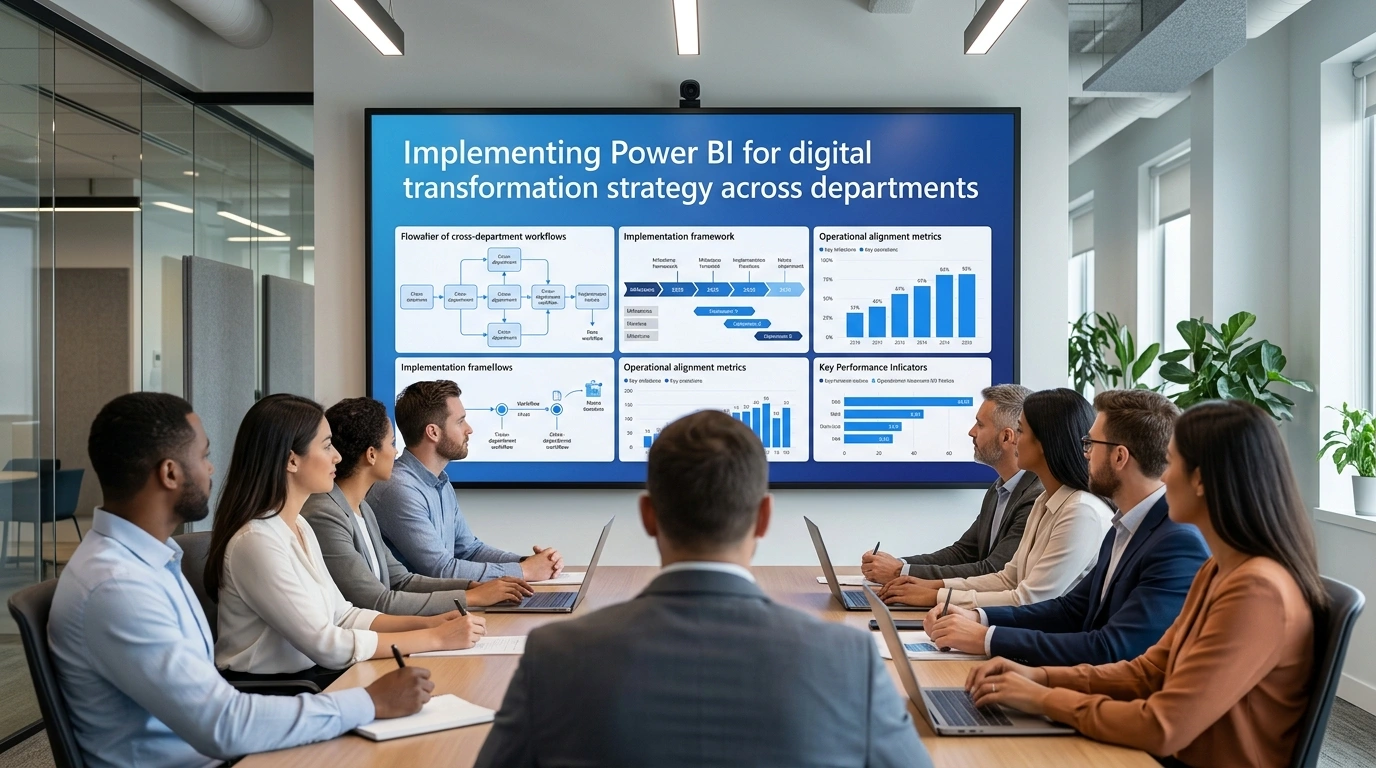
Cross-department analytics adoption expands, furthermore, because standardized dashboards and centralized semantic models encourage consistent reporting methodologies and improve collaboration between operational and strategic functions. Enterprise transformation maturity reinforces, consequently, organizational capabilities by enabling enterprises to monitor strategic KPIs, operational bottlenecks, and departmental performance within a unified analytical architecture that supports long-term modernization initiatives. Business process optimization through BI enhances, meanwhile, operational efficiency because automated reporting, centralized data access, and interactive analytics reduce reporting delays, improve process transparency, and strengthen organizational responsiveness to market and operational changes.
Power BI for digital transformation strategy establishes, therefore, a foundational transformation layer that connects operational modernization, enterprise agility, and scalable decision intelligence within evolving business environments. Centralized analytics infrastructures improve, moreover, organizational adaptability because these infrastructures support more effective responses to changing market conditions, operational disruptions, and evolving customer expectations. Long-term strategic alignment reinforces, additionally, enterprise-wide visibility and modernization consistency by integrating departmental objectives into a shared analytical environment.
Integrating Power BI with existing systems and cloud platforms
Power BI for digital transformation strategy extends, therefore, enterprise modernization capabilities by integrating ERP systems, CRM platforms, cloud environments, operational databases, Microsoft ecosystems, and third-party business applications into a scalable analytics infrastructure. Cloud-connected analytics environments strengthen, moreover, enterprise modernization strategy because these environments improve data accessibility, reporting scalability, and operational flexibility across geographically distributed departments and hybrid business infrastructures. Business process optimization through BI enables, additionally, organizations to consolidate operational, financial, customer, and supply chain information into unified dashboards that accelerate reporting cycles and improve cross-functional visibility.
Competitive advantage through data modernization improves, furthermore, because integrated analytics environments support faster strategic responses, more accurate forecasting, and stronger operational coordination across dynamic business conditions. Long-term enterprise transformation maturity supports, consequently, organizational progress by reducing data fragmentation and enabling enterprises to evolve from legacy reporting environments toward scalable cloud-driven analytical ecosystems. Cross-department analytics adoption reinforces, meanwhile, enterprise consistency because integrated platforms encourage shared access to trusted information sources while improving alignment between departmental reporting standards and enterprise performance metrics.
Power BI for digital transformation strategy positions, therefore, organizations to connect operational systems, cloud scalability, and enterprise intelligence within broader digital transformation frameworks. Integrated analytical ecosystems enhance, moreover, enterprise resilience because these ecosystems improve visibility into operational performance, customer trends, and resource utilization across interconnected business functions. Organizational scalability strengthens, additionally, through secure data expansion, centralized analytics governance, and consistent reporting standards that support enterprise growth initiatives.
Building governance models for secure and scalable analytics adoption
Power BI for digital transformation strategy establishes, therefore, a governed enterprise analytics environment that balances self-service flexibility with organizational control, security, scalability, and long-term operational sustainability. Governance models strengthen, moreover, digital transformation frameworks because these models define ownership structures, access permissions, data quality standards, compliance requirements, and reporting accountability across expanding analytical ecosystems. Long-term enterprise transformation maturity supports, additionally, structured analytics adoption by ensuring that governance policies prevent uncontrolled dashboard proliferation and inconsistent reporting practices.
Enterprise modernization strategy reinforces, furthermore, trust in enterprise data assets because governed environments protect sensitive operational, financial, and customer information across departments. Cross-department analytics adoption enhances, consequently, organizational consistency by standardizing data definitions, workspace management, content certification, and reporting practices across business units. Executive transformation leadership improves, meanwhile, because leadership teams gain clearer visibility into governance performance, adoption maturity, risk exposure, and enterprise-wide reporting alignment.
Data-driven organizational redesign encourages, therefore, scalable collaboration between IT teams, compliance teams, operational leaders, and business analysts while maintaining analytical consistency throughout organizational transformation initiatives. Governed reporting structures reinforce, moreover, operational accountability because these structures improve transparency, auditing capabilities, and confidence in strategic decision-making processes. Enterprise-wide analytical stability strengthens, additionally, through sustainable governance mechanisms that support modernization objectives without compromising security or scalability.
Encouraging collaboration between leadership, IT, and business teams
Power BI for digital transformation strategy strengthens, therefore, collaboration by aligning executive transformation leadership with operational analytics initiatives that require coordination between executives, IT departments, data specialists, and business units. Collaborative analytics environments support, moreover, data-driven organizational redesign because these environments improve communication between strategic leadership and operational teams responsible for implementing transformation objectives. Cross-department analytics adoption expands, additionally, through shared KPI structures, centralized reporting standards, and collaborative analytical workflows that improve enterprise-wide visibility and decision consistency.
Enterprise modernization strategy reinforces, furthermore, sustainable transformation initiatives because coordinated planning enables leadership priorities, operational processes, and technical infrastructures to evolve together rather than through isolated departmental efforts. Business process optimization through BI improves, consequently, operational efficiency because collaborative reporting ecosystems reduce duplicated reporting efforts, strengthen process transparency, and accelerate operational decision cycles across departments. Competitive advantage through data modernization enhances, meanwhile, organizational responsiveness because stronger collaboration between leadership and technical teams improves adaptation to market changes, operational risks, and customer expectations.
Power BI for digital transformation strategy establishes, therefore, a collaborative transformation platform that connects strategic governance, operational intelligence, and enterprise-wide modernization priorities within evolving organizational structures. Shared analytics environments improve, moreover, organizational alignment because these environments encourage consistent communication between decision-makers, analysts, operational managers, and technical specialists. Enterprise transformation maturity reinforces, additionally, continuous cooperation between departments that contributes to long-term modernization, scalability, and analytical innovation.
Managing change and user adoption during analytics transformation
Power BI for digital transformation strategy requires, therefore, organizations to address organizational behavior, operational culture, leadership alignment, and workforce readiness alongside technical deployment and reporting modernization. Long-term enterprise transformation maturity supports, moreover, sustainable analytics adoption because continuous enablement, executive sponsorship, user trust, and gradual operational integration create more stable transformation outcomes than isolated software implementation efforts. Digital transformation frameworks strengthen, additionally, organizational adaptation by encouraging structured change management processes that align employee workflows, reporting responsibilities, and departmental collaboration with broader modernization objectives.
Cross-department analytics adoption improves, furthermore, because role-based training, governed self-service reporting, and ongoing user support reduce resistance to analytical transformation across operational teams. Executive transformation leadership enhances, consequently, organizational oversight because visibility into adoption metrics, reporting utilization, and operational engagement supports more effective refinement of modernization priorities and identification of adoption barriers. Business process optimization through BI reinforces, meanwhile, operational consistency because analytics-driven workflows reduce repetitive manual reporting activities while improving accountability and reporting speed across departments.
Competitive advantage through data modernization advances, therefore, enterprise resilience because organizations that successfully manage analytics adoption often improve responsiveness, operational agility, and adaptability within rapidly evolving digital markets. Organizational adaptability strengthens, moreover, because employees become more capable of interpreting analytical insights and integrating data-driven practices into operational decision-making environments. Power BI for digital transformation strategy establishes, additionally, a sustainable transformation foundation that supports continuous analytical growth, enterprise modernization, and long-term operational evolution.
Power BI for digital transformation strategy in decision-making and performance tracking
Power BI for digital transformation strategy functions as a foundational analytics environment that supports enterprise modernization strategy through connected reporting, centralized governance, and scalable performance visibility. Digital transformation frameworks, therefore, connect with measurable operational outcomes by aligning strategic goals, analytics infrastructure, and business execution within one integrated reporting ecosystem. Executive transformation leadership, moreover, becomes stronger because leadership teams evaluate organizational performance through unified metrics instead of fragmented departmental summaries. Data-driven organizational redesign consequently, supports enterprise restructuring efforts through improved reporting hierarchies, performance accountability models, and operational workflows built around accessible business intelligence.
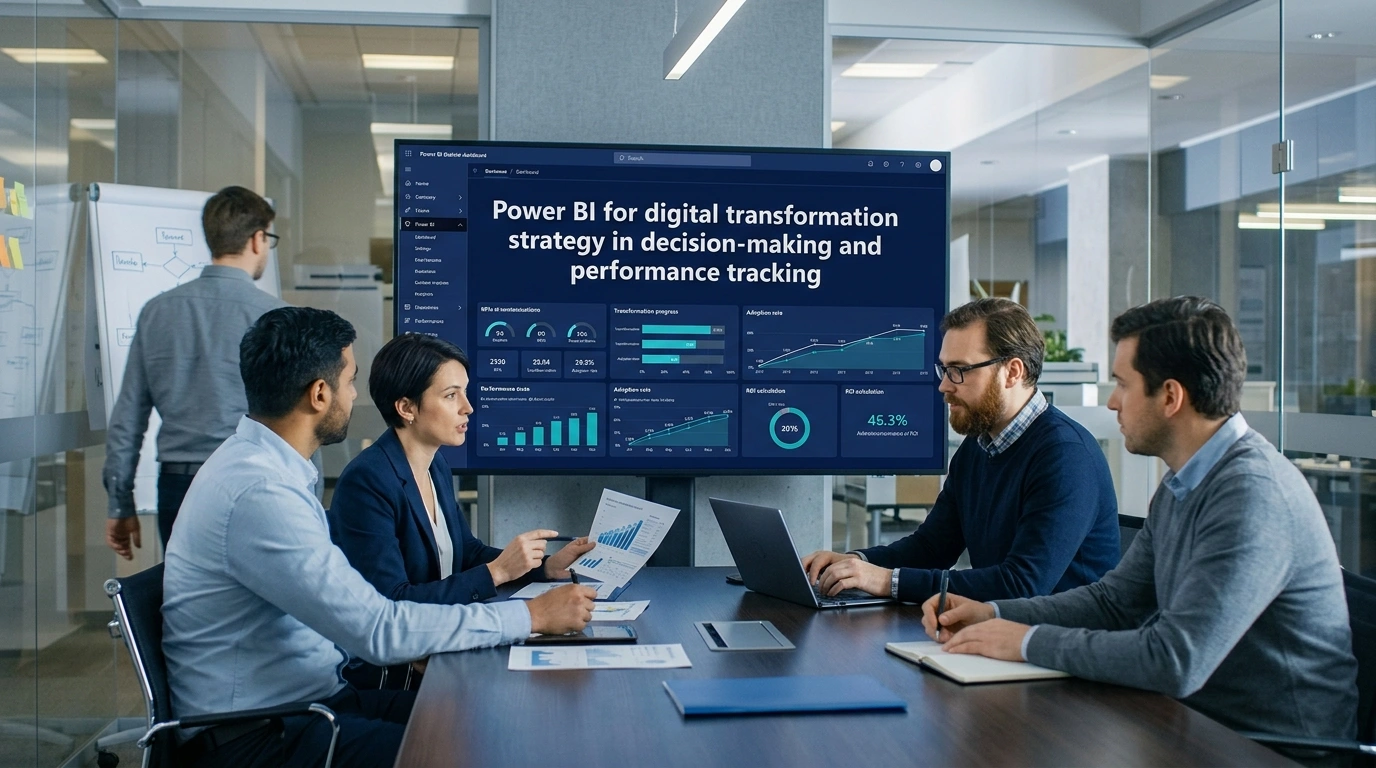
Long-term enterprise transformation maturity, additionally, improves because analytics adoption becomes embedded into planning cycles, operational reviews, and enterprise governance practices rather than remaining isolated within technical departments. The broader role of Power BI for digital transformation strategy, meanwhile, reinforces organizational monitoring capabilities through continuously updated insights related to digital initiatives, modernization investments, and enterprise-wide efficiency improvements. Governed dashboards, centralized datasets, and standardized KPIs, therefore, reduce reporting inconsistency by creating stronger alignment between finance, operations, sales, and leadership functions. Cross-department analytics adoption, in turn, increases because departments analyze shared business outcomes while maintaining role-specific reporting perspectives.
Competitive advantage through data modernization, moreover, expands because organizations gain faster access to operational intelligence, market patterns, customer behavior insights, and performance trends that support adaptation in changing markets. Business process optimization through BI, meanwhile, improves because interactive analytics environments make process bottlenecks, inefficiencies, and operational delays more visible across enterprise systems. Unified reporting structures, consequently, enhance enterprise-wide collaboration by helping leadership teams and operational managers evaluate transformation priorities through the same performance indicators. Integrated analytics environments, finally, strengthen organizational agility by improving responsiveness to operational changes, customer expectations, and modernization requirements with greater speed and strategic precision.
Using real-time dashboards to improve executive visibility
Real-time dashboards assume a strategic role in executive transformation leadership because modern leadership teams require continuous visibility into enterprise performance, operational volatility, and transformation progress. Enterprise modernization strategy, therefore, benefits from the replacement of delayed reporting cycles with continuously refreshed operational insights that improve executive responsiveness. Power BI for digital transformation strategy, moreover, connects with digital transformation frameworks because dashboard environments centralize indicators related to modernization projects, operational restructuring, customer engagement, and financial performance within one executive reporting layer. Executive visibility, consequently, improves because leadership teams track organizational performance across departments, subsidiaries, operational regions, and customer-facing activities simultaneously.
Cross-department analytics adoption, additionally, becomes stronger because executives review connected metrics from finance, operations, sales, customer service, and supply chain environments through one integrated interface. Faster transformation oversight, meanwhile, becomes possible because real-time reporting environments expose delays, risks, cost escalations, operational disruptions, and performance anomalies before they expand into larger enterprise problems. The strategic importance of Power BI for digital transformation strategy, therefore, increases by linking executive awareness directly with enterprise decision velocity. Leadership teams, in turn, evaluate whether modernization initiatives improve operational efficiency, customer responsiveness, and organizational agility over time.
Long-term enterprise transformation maturity, moreover, expands because executive teams become more capable of managing transformation initiatives through measurable visibility rather than reactive reporting cycles. Coordination between business units, meanwhile, improves because shared dashboard environments encourage alignment around common enterprise objectives and operational priorities. Data-driven governance, consequently, becomes stronger because leadership teams monitor transformation progress through trusted metrics and consistent reporting structures. Effective dashboard environments, finally, depend on governed data models, trusted reporting structures, and clearly defined KPI ownership rather than visual presentation alone.
Measuring operational efficiency through KPIs and interactive reports
Operational efficiency transforms into a measurable enterprise capability through the integration of KPIs, interactive reporting environments, and business process optimization through BI. Power BI for digital transformation strategy, therefore, aligns with operational modernization because organizations monitor execution quality, process consistency, productivity trends, and cost efficiency through centralized analytics systems. Enterprise modernization strategy, moreover, supports the replacement of static operational reporting with interactive performance analysis that reveals operational bottlenecks, resource inefficiencies, and workflow delays across departments. Data-driven organizational redesign, consequently, improves because performance insights expose structural inefficiencies, duplicated responsibilities, and disconnected operational processes that slow enterprise execution.
Cross-department analytics adoption, additionally, strengthens because operational managers, finance teams, customer service leaders, and executive stakeholders analyze shared performance metrics through connected reporting frameworks. Operational analytics environments, meanwhile, reveal whether inefficiencies originate from staffing limitations, fragmented workflows, delayed approvals, inconsistent process governance, or outdated operational systems. Power BI for digital transformation strategy, therefore, reinforces its role as an operational transformation enabler rather than only a reporting platform. Long-term enterprise transformation maturity, in turn, increases because continuous KPI monitoring supports ongoing optimization instead of isolated operational improvement initiatives.
Competitive advantage through data modernization, moreover, expands because enterprises with integrated operational intelligence identify inefficiencies faster, allocate resources more effectively, and respond more rapidly to changing market conditions. Business process optimization through BI, meanwhile, develops further by enabling organizations to compare operational units, evaluate process outcomes, and measure whether transformation initiatives produce measurable efficiency improvements across enterprise operations. Operational transparency, consequently, improves because interactive reports provide clearer visibility into productivity levels, process delays, and departmental performance variations. Enterprise decision-making, finally, becomes stronger because operational analytics environments connect efficiency measurement directly with strategic planning and modernization objectives.
Supporting predictive analysis and scenario planning with Power BI insights
Analytics capabilities extend beyond retrospective reporting by supporting predictive analysis, scenario modeling, and forward-looking enterprise planning through intelligent reporting environments. Power BI for digital transformation strategy therefore, connects with digital transformation frameworks that prioritize agility, adaptability, and evidence-based strategic planning. Executive transformation leadership, moreover, benefits because predictive insights allow leadership teams to evaluate potential business outcomes before operational or financial risks become severe. Enterprise modernization strategy, consequently, becomes stronger by enabling organizations to analyze demand volatility, operational capacity, customer retention patterns, and financial exposure through scenario-based analytics models.
Long-term enterprise transformation maturity, additionally, improves because predictive planning environments help organizations transition from reactive management toward proactive strategic decision-making. Competitive advantage through data modernization, meanwhile, strengthens because organizations that anticipate operational disruption and market shifts adapt more effectively than competitors relying only on historical reporting. Data-driven organizational redesign, therefore, becomes more effective by exposing future resource constraints, operational scalability limitations, and emerging performance risks that may require structural adjustments. Cross-department analytics adoption, in turn, expands because finance, operations, marketing, and leadership teams evaluate shared predictive assumptions within unified reporting environments.
Business process optimization through BI, moreover, advances because predictive insights identify where process redesign, automation, or operational restructuring may improve future performance outcomes. Strategic planning accuracy, meanwhile, improves because organizations compare multiple operational scenarios before implementing enterprise-level decisions. Organizational resilience, consequently, becomes stronger because scenario planning environments provide earlier visibility into market uncertainty, operational disruption, and financial pressure. Predictive analytics environments, finally, depend on governed enterprise data, standardized reporting definitions, and transparent analytical assumptions across the organization.
Connecting customer, financial, and operational data for faster decisions
Customer, financial, and operational data integrate into unified analytics environments that improve enterprise coordination, decision velocity, and strategic alignment. Power BI for digital transformation strategy, therefore, supports the elimination of fragmented reporting structures that traditionally separate customer analytics, operational reporting, and financial performance management. Enterprise modernization strategy, moreover, becomes stronger because integrated data environments allow organizations to evaluate enterprise performance through connected operational and financial relationships rather than isolated departmental metrics. Data-driven organizational redesign, consequently, helps enterprises restructure workflows, reporting relationships, and performance governance around unified business intelligence ecosystems.
Cross-department analytics adoption, additionally, improves because finance teams, customer experience leaders, operational managers, and executive stakeholders evaluate interconnected business outcomes through shared reporting frameworks. Business process optimization through BI, meanwhile, reinforces operational visibility because integrated analytics environments expose how operational delays, customer satisfaction changes, and financial performance shifts influence one another across enterprise systems. Executive transformation leadership, therefore, benefits from broader enterprise visibility into modernization progress, organizational efficiency, and customer performance trends. Competitive advantage through data modernization in turn, expands because enterprises with integrated reporting environments respond faster to customer expectations, operational disruptions, and financial performance changes.
Long-term enterprise transformation maturity, moreover, strengthens because unified analytics ecosystems improve governance consistency, operational transparency, and enterprise-wide performance alignment. Enterprise collaboration, meanwhile, improves because integrated reporting structures reduce information silos and encourage coordinated decision-making across business units. Organizational responsiveness, consequently, becomes stronger because connected analytics environments make operational changes and customer behavior shifts more visible across departments. Power BI for digital transformation strategy, finally, delivers greater strategic value when customer, financial, and operational intelligence operate within a connected modernization framework that supports faster, more informed enterprise decisions.
Future trends shaping Power BI for digital transformation strategy success
Increasingly, the future of Power BI for digital transformation strategy reflects a transition toward integrated digital transformation frameworks that connect analytics, governance, automation, and enterprise modernization strategy within unified decision ecosystems. Meanwhile, Microsoft Fabric integration is reshaping enterprise analytics by combining storage, reporting, governance, AI capabilities, and real-time monitoring into scalable environments that support long-term enterprise transformation maturity. Consequently, organizations are moving beyond isolated dashboard initiatives toward data-driven organizational redesign models in which analytics influence operational structures, customer engagement processes, and executive planning cycles. Additionally, Power BI for digital transformation strategy connects with enterprise-wide modernization efforts because transformation programs increasingly require centralized visibility across finance, operations, customer service, compliance, and strategic planning functions.

Moreover, executive transformation leadership is becoming increasingly important because senior decision-makers require real-time insight ecosystems capable of supporting strategic adaptation during operational, technological, and market-related shifts. Furthermore, the value of Power BI expands through stronger alignment with cross-department analytics adoption, particularly when organizations require shared KPI frameworks, standardized semantic models, and collaborative reporting environments across multiple business units. Therefore, business process optimization through BI becomes more effective because modern analytics platforms increasingly automate repetitive reporting cycles, accelerate operational analysis, and improve visibility into performance inefficiencies.
At the same time, long-term transformation success depends on governance maturity, scalable architecture, and organizational readiness rather than dashboard deployment alone. Consequently, enterprises that integrate analytics into long-term planning frameworks often achieve stronger adaptability and operational resilience throughout transformation initiatives. Ultimately, Power BI for digital transformation strategy functions as a foundational capability for competitive advantage through data modernization because organizations increasingly rely on governed analytics ecosystems to strengthen agility, resilience, operational coordination, and enterprise-scale decision quality.
Expanding AI and automation features within the Power BI ecosystem
Increasingly, AI and automation capabilities within Power BI are reshaping enterprise modernization strategy because organizations now require analytics systems capable of supporting faster insight generation, predictive guidance, and automated decision support across operational and strategic environments. Meanwhile, Copilot integration, automated report generation, AI-assisted modeling, natural-language analytics, and smart narrative creation reduce manual reporting workloads while improving responsiveness across executive and operational teams. Consequently, Power BI for digital transformation strategy aligns with digital transformation frameworks that prioritize intelligent automation, adaptive analytics, and scalable data accessibility across business functions.
Additionally, executive transformation leadership plays a growing role because leadership teams increasingly depend on AI-enhanced dashboards and predictive insights to evaluate risks, monitor organizational performance, and align transformation initiatives with measurable outcomes. Moreover, cross-department analytics adoption improves because AI-driven experiences simplify analytics interaction for finance, operations, marketing, customer service, and human resources teams without requiring advanced technical expertise. Furthermore, business process optimization through BI becomes stronger because automated workflows, anomaly detection, forecasting models, and intelligent alerts reduce repetitive operational analysis while improving decision timing.
Therefore, the strategic importance of Power BI for digital transformation strategy continues to expand by enabling organizations to redesign decision processes around faster access to contextual insights and predictive intelligence. At the same time, organizations achieving higher levels of long-term enterprise transformation maturity increasingly differentiate themselves through responsible AI governance, trusted data environments, and scalable automation models. Ultimately, AI-enhanced Power BI ecosystems create a competitive advantage through data modernization because enterprises combining automation with governed analytics often respond more effectively to operational complexity, market shifts, and evolving customer expectations.
Strengthening scalability for growing data volumes and business complexity
Increasingly, scalability within Power BI represents a critical requirement for enterprise modernization strategy because organizations continue expanding their operational ecosystems, data sources, reporting demands, and analytical complexity across multiple departments and geographic regions. Meanwhile, Microsoft Fabric, Direct Lake technologies, cloud-scale semantic models, and unified storage frameworks enable Power BI for digital transformation strategy to support enterprise-scale analytics environments without sacrificing performance or governance consistency. Consequently, scalable analytics infrastructure now forms part of broader digital transformation frameworks designed to unify operational, customer, financial, and strategic intelligence across organizations.
Additionally, scalability aligns with data-driven organizational redesign because businesses increasingly restructure reporting relationships, operational visibility, and KPI ownership around centralized analytics ecosystems rather than fragmented departmental reporting structures. Moreover, cross-department analytics adoption becomes increasingly important because growing organizations require consistent data definitions, shared reporting logic, and synchronized performance metrics across finance, supply chain, customer experience, operations, and executive management teams. Furthermore, business process optimization through BI improves because scalable Power BI environments enhance workflow visibility, accelerate issue identification, and reduce inefficiencies created by duplicated reporting processes.
At the same time, long-term enterprise transformation maturity depends on governance models capable of supporting expanding user bases, increasing refresh demands, and more sophisticated analytical workloads without reducing reliability or user trust. Therefore, organizations investing in scalable Power BI architectures strengthen competitive advantage through data modernization because scalable analytics environments improve resilience, operational coordination, and enterprise responsiveness during periods of rapid growth or market change. Ultimately, Power BI for digital transformation strategy serves as an operational foundation for sustainable enterprise transformation when scalability supports consistent insight delivery across increasingly complex business ecosystems.
Enhancing compliance, privacy, and governance in modern analytics environments
Increasingly, governance and compliance are becoming central pillars of Power BI for digital transformation strategy because enterprise modernization initiatives require trusted analytics environments capable of protecting operational, financial, customer, and regulatory data across interconnected systems. Meanwhile, Microsoft Purview integration, lineage tracking, sensitivity labeling, role-based access management, and policy-driven governance frameworks strengthen accountability within modern analytics ecosystems. Consequently, governance capabilities align with digital transformation frameworks that depend on secure and standardized data management to support enterprise-wide decision consistency.
Additionally, executive transformation leadership is becoming increasingly important because senior stakeholders require transparent oversight into how sensitive data is accessed, shared, classified, and governed throughout transformation programs. Moreover, cross-department analytics adoption improves by creating trusted reporting environments in which departments collaborate through governed datasets without compromising compliance obligations or operational control. Furthermore, data-driven organizational redesign becomes stronger because organizations frequently restructure analytical ownership, reporting accountability, and operational visibility around centralized governance standards.
Therefore, the strategic value of Power BI for digital transformation strategy increases through stronger alignment between analytics accessibility and enterprise risk management requirements. At the same time, long-term enterprise transformation maturity depends heavily on balancing self-service analytics flexibility with centralized oversight, audit readiness, and regulatory compliance. Additionally, business process optimization through BI improves because governed analytics environments reduce duplication, improve data accuracy, and strengthen operational monitoring across departments. Ultimately, governance-driven Power BI ecosystems become a source of competitive advantage through data modernization because organizations maintaining trusted, compliant, and scalable analytics infrastructures often achieve stronger stakeholder confidence and more sustainable transformation outcomes.
Evaluating long-term ROI and competitive advantage from transformation efforts
Increasingly, long-term ROI within Power BI for digital transformation strategy reflects measurable improvements in operational efficiency, executive visibility, reporting automation, forecasting accuracy, and enterprise-wide analytical coordination. Meanwhile, organizations evaluating enterprise modernization strategy now prioritize business outcomes such as reduced reporting delays, improved KPI alignment, enhanced customer visibility, and faster strategic response cycles rather than focusing exclusively on dashboard deployment metrics. Consequently, digital transformation frameworks increasingly evaluate analytics success through operational impact, organizational adaptability, and transformation maturity instead of isolated technical implementation milestones.
Additionally, ROI evaluation aligns with executive transformation leadership because leadership teams rely on governed analytics ecosystems to monitor strategic performance, investment efficiency, and enterprise transformation progress across departments. Moreover, data-driven organizational redesign plays a growing role as businesses restructure operational reporting models, decision hierarchies, and performance accountability around centralized intelligence platforms. Furthermore, cross-department analytics adoption improves because enterprise-wide reporting consistency strengthens collaboration between operational, financial, commercial, and executive functions while reducing fragmented decision-making practices.
Additionally, business process optimization through BI becomes stronger because automated reporting, real-time visibility, and standardized performance tracking reduce inefficiencies, accelerate analysis cycles, and improve organizational responsiveness. Therefore, long-term enterprise transformation maturity becomes increasingly important because sustainable ROI frequently depends on governance consistency, scalable infrastructure, organizational adoption depth, and leadership alignment throughout extended transformation periods. At the same time, competitive advantage through data modernization emerges when organizations consistently convert governed insights into operational improvements, customer experience enhancements, strategic adaptability, and stronger market responsiveness. Ultimately, Power BI for digital transformation strategy functions as a long-term enterprise capability that strengthens modernization authority, analytical maturity, and strategic resilience across evolving business environments.
Power BI continues to strengthen enterprise modernization efforts by supporting centralized analytics, scalable governance, real-time visibility, and data-driven operational management across evolving business environments. Organizations that successfully integrate Power BI into transformation initiatives often improve collaboration, decision consistency, operational transparency, and strategic responsiveness through connected reporting ecosystems and governed analytical frameworks. Long-term transformation success increasingly depends on sustainable analytics adoption, cross-department coordination, scalable infrastructure, and executive alignment that enable enterprises to respond more effectively to operational complexity and market change. Ultimately, Power BI for digital transformation strategy represents a foundational enterprise capability that supports modernization maturity, analytical resilience, and competitive advantage through integrated intelligence and continuous organizational improvement.