










BI Solutions for competitive analysis have become essential for organizations seeking stronger market visibility, faster strategic adaptation, and more accurate decision-making in increasingly competitive industries. Modern enterprises rely on advanced intelligence frameworks to evaluate competitor performance, monitor pricing movements, analyze customer behavior, and identify emerging market opportunities before they significantly affect operational growth or market positioning. Organizations also integrate competitor benchmarking, predictive analytics, market share tracking, and industry forecasting into centralized BI environments that transform fragmented market signals into actionable strategic insight. Stay Ahead: Using BI Solutions for competitive analysis explores how enterprises use competitive intelligence frameworks, dashboards, KPI structures, automation systems, and forecasting models to strengthen long-term competitive advantage through evidence-based market intelligence and continuous analytical visibility.
BI Solutions for competitive analysis: Core Frameworks for Market Intelligence
Positioning BI Solutions for competitive analysis as a market-intelligence framework requires connecting operational analytics, competitor intelligence, customer behavior, and strategic planning into one continuously evolving ecosystem that supports enterprise-scale decision-making. Modern organizations increasingly rely on structured competitor benchmarking frameworks to compare pricing structures, campaign effectiveness, product differentiation, digital visibility, customer engagement, and commercial performance across multiple market segments. BI environments organize fragmented information into repeatable analytical workflows that strengthen market positioning intelligence and help leadership teams evaluate how competitors influence demand patterns, customer expectations, and long-term strategic direction.
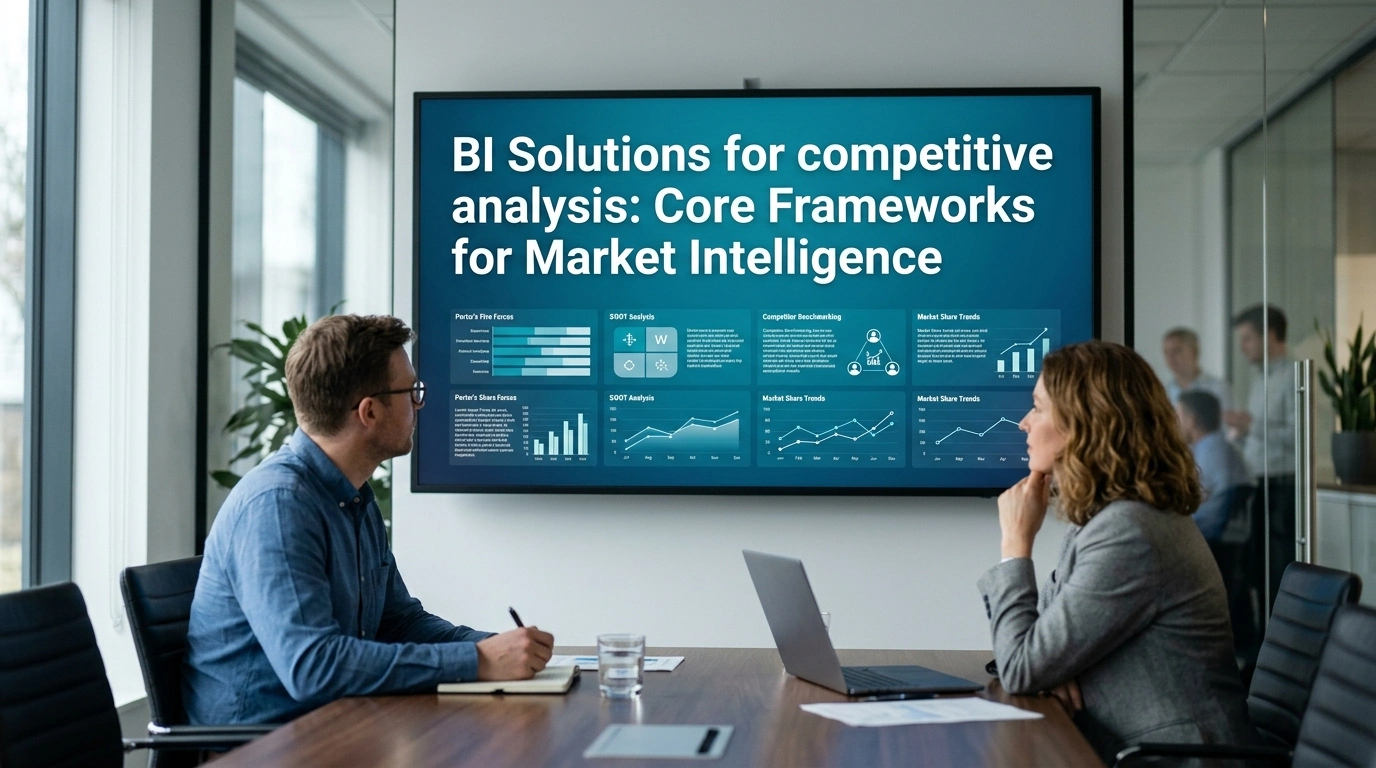
Rival performance monitoring enables enterprises to track competitor growth signals, operational shifts, acquisition activity, regional expansion, and evolving customer sentiment in near real time. BI Solutions for competitive analysis help enterprises understand not only where competitors currently operate, but also how their strategic trajectories may reshape market conditions over time. Organizations combine internal intelligence such as CRM analytics, sales performance, financial reporting, and customer retention metrics with external intelligence including pricing pages, investor briefings, social activity, industry reports, analyst coverage, and digital engagement indicators to strengthen operational visibility and improve strategic evaluation.
Strategic gap identification exposes weaknesses in product positioning, service coverage, market responsiveness, and innovation capability relative to rival organizations. Industry trend forecasting enables organizations to detect emerging technologies, changing consumer behavior, evolving purchasing patterns, and shifting competitive dynamics before those factors materially affect revenue or market share. Dashboards and analytical frameworks transform raw market signals into evidence-based strategic insight that helps leadership teams prioritize investment, optimize competitive positioning, improve long-term planning accuracy, and strengthen long-term competitive advantage through BI-driven visibility and faster organizational adaptation to changing market environments.
Defining BI Solutions for competitive analysis in modern organizations
Defining BI Solutions for competitive analysis in modern organizations requires viewing them as integrated intelligence systems that combine business analytics, market intelligence, and strategic monitoring into one decision-support environment. Traditional reporting platforms focus primarily on historical performance, whereas these solutions create a broader analytical structure capable of monitoring competitors, evaluating market shifts, and strengthening enterprise positioning across dynamic industries. Organizations increasingly use competitor benchmarking frameworks to compare operational efficiency, pricing consistency, customer engagement quality, digital performance, and commercial growth against both direct and emerging rivals.
BI Solutions for competitive analysis enable executives to move beyond isolated reporting toward continuous market positioning intelligence that aligns operational decisions with changing competitive realities. These systems integrate dashboards, benchmarking engines, alert systems, forecasting models, and automated reporting layers that transform fragmented market signals into strategic business insight. Rival performance monitoring allows organizations to evaluate competitor expansion patterns, brand visibility changes, hiring acceleration, campaign influence, and evolving customer perception without relying solely on periodic research studies.
Organizations also use BI Solutions for competitive analysis to support market share tracking across regions, channels, products, and customer segments, which helps leadership teams evaluate whether growth initiatives are outperforming or underperforming relative to competitive movement. Strategic gap identification exposes operational weaknesses, positioning limitations, product deficiencies, and customer experience gaps that may reduce long-term competitiveness if organizations leave those issues unresolved. Predictive analytics and industry trend forecasting help organizations anticipate market disruption, regulatory changes, technological evolution, and consumer preference shifts before competitors fully capitalize on them while strengthening long-term competitive advantage through BI-enabled intelligence.
Key data sources that strengthen competitor tracking and benchmarking
Strengthening competitor tracking depends heavily on the quality, diversity, and strategic relevance of the data sources integrated into BI Solutions for competitive analysis. Organizations frequently analyze CRM systems, ERP platforms, sales pipelines, customer support interactions, campaign analytics, revenue trends, retention metrics, and operational performance reports to understand how market competition affects internal business outcomes. Enterprises increasingly combine external intelligence sources such as competitor websites, pricing structures, digital advertising activity, product launches, investor communications, financial disclosures, review platforms, social engagement data, search visibility trends, analyst reports, and industry databases to support more advanced competitor benchmarking frameworks.
BI Solutions for competitive analysis create broader market positioning intelligence by revealing how competitors influence pricing pressure, customer loyalty, product perception, and purchasing behavior across different market conditions. Competitive pricing analysis allows enterprises to compare discount strategies, pricing consistency, value positioning, and promotional intensity across rival organizations while also evaluating how those strategies influence conversion rates and customer acquisition costs. Rival performance monitoring enables organizations to observe competitor hiring trends, geographic expansion, acquisition activity, channel partnerships, and technology investments that may indicate future market movement.
Industry trend forecasting models combine structured and unstructured data sources to identify emerging market disruptions, evolving consumer priorities, and future competitive risks earlier than traditional reporting methods allow. Market share tracking enables enterprises to measure shifts in customer preference, channel dominance, and regional performance across multiple competitors and business segments. BI Solutions for competitive analysis transform these connected data ecosystems into strategic intelligence environments capable of supporting long-term competitive advantage through BI-driven benchmarking, predictive visibility, and continuous market adaptation.
How dashboards translate market signals into strategic insight
Translating market signals into strategic insight requires dashboards capable of transforming complex competitive data into actionable analytical visibility that supports executive-level decision-making. BI Solutions for competitive analysis use dashboards to consolidate pricing trends, competitor activity, customer sentiment, engagement metrics, financial indicators, market share tracking, and rival performance monitoring into centralized visual environments. These dashboards allow organizations to identify unusual movement patterns, competitive threats, customer behavior shifts, and emerging market opportunities before those developments significantly affect business performance.
Visual analytics frameworks help leadership teams compare organizational performance against competitor benchmarking frameworks across pricing efficiency, digital visibility, product differentiation, customer acquisition, and campaign effectiveness. Dashboards organize large-scale data into charts, comparative scorecards, benchmark indexes, forecasting indicators, and automated alerts that simplify the identification of strategic patterns and operational anomalies. Competitive pricing analysis dashboards help organizations evaluate pricing volatility, promotional pressure, discount consistency, and value positioning changes across different competitors and customer segments.
Strategic gap identification exposes weaknesses in product coverage, channel performance, customer engagement, and operational responsiveness that may limit future growth potential. Industry trend forecasting models integrated within dashboards help organizations visualize long-term market movement, technological adoption patterns, demand fluctuations, and evolving consumer expectations. BI Solutions for competitive analysis increasingly rely on predictive dashboards that move beyond historical reporting toward forward-looking strategic interpretation capable of supporting long-term competitive advantage through BI-enabled agility, faster adaptation, and continuous intelligence-driven optimization.
Common business goals supported by competitive analysis initiatives
Competitive analysis initiatives support organizational responsiveness, strengthen strategic positioning, and sustain long-term business growth in increasingly competitive markets. BI Solutions for competitive analysis help organizations monitor rival activity, evaluate market conditions, identify growth opportunities, and improve decision-making accuracy across operational and executive environments. Enterprises frequently use competitor benchmarking frameworks to compare pricing models, product quality, customer engagement performance, digital reach, and operational efficiency against leading market participants.
Organizations analyze competitor messaging, audience targeting, brand perception, and customer satisfaction indicators to strengthen market positioning intelligence and improve commercial relevance. Rival performance monitoring allows leadership teams to evaluate competitor expansion speed, promotional effectiveness, partnership development, customer acquisition patterns, and market penetration activity across multiple business segments. Market share tracking helps organizations measure competitive movement across geographic regions, customer categories, digital channels, and product portfolios while identifying areas of declining influence or emerging opportunity.
Competitive pricing analysis supports margin optimization, pricing stability evaluation, discount control, and customer value perception analysis within highly dynamic industries. Strategic gap identification enables organizations to detect weaknesses in innovation speed, customer experience quality, operational scalability, service coverage, and digital maturity before those deficiencies reduce long-term competitiveness. Industry trend forecasting supports earlier detection of market disruption, evolving consumer behavior, technology adoption trends, and competitive realignment across rapidly changing sectors while helping organizations create long-term competitive advantage through BI-enabled intelligence ecosystems that improve agility, strengthen cross-functional alignment, reduce uncertainty, and accelerate evidence-based strategic adaptation across enterprise-scale operations.
Choosing BI Solutions for competitive analysis tools and capabilities
A strategic selection process reflects the connection between market intelligence, operational visibility, enterprise governance, and long-term competitive planning within one analytical ecosystem. BI Solutions for competitive analysis function as enterprise intelligence frameworks capable of supporting competitor benchmarking frameworks, market positioning intelligence, and strategic gap identification while maintaining alignment between analytical workflows and business execution. Advanced analytical environments combine capabilities such as automated data integration, predictive modeling, visualization layers, competitor tracking dashboards, and collaborative reporting systems that help organizations compare internal performance against evolving market conditions.
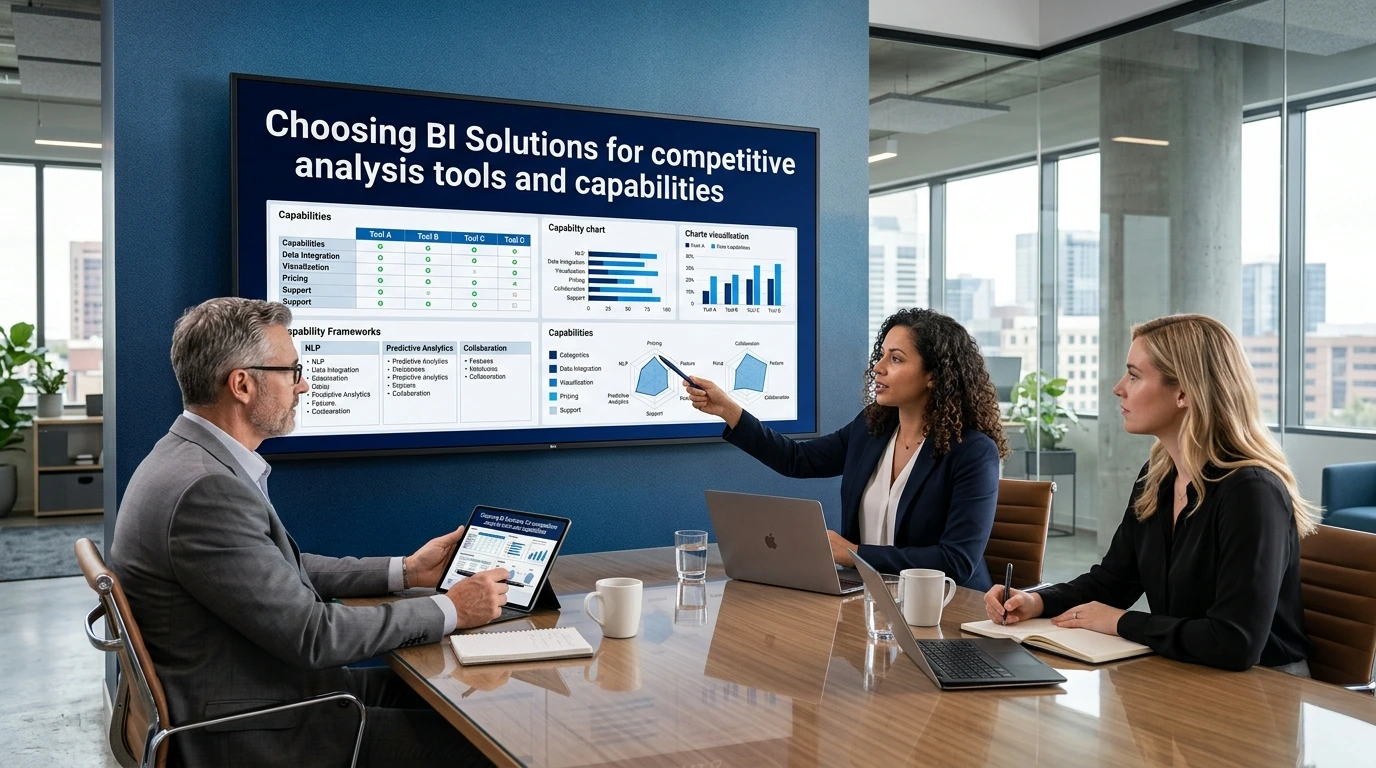
Integrated analytical platforms support market share tracking and rival performance monitoring through the consolidation of competitor pricing activity, campaign movement, product launches, customer sentiment, and sales trends into unified executive dashboards that improve strategic awareness across departments. Business leaders can evaluate how competitor behavior influences revenue performance, customer acquisition, retention metrics, pricing sensitivity, and regional demand fluctuations through connected analytical environments rather than fragmented reports. Enterprise organizations require careful evaluation of whether BI Solutions for competitive analysis can scale beyond static reporting into adaptive intelligence systems capable of supporting long-term competitive advantage through data-driven decision models.
Modern BI ecosystems include advanced capabilities such as anomaly detection, benchmark scoring, role-based governance, automated alerts, scenario forecasting, and embedded analytics that strengthen enterprise-scale competitive analysis initiatives. Effective analytical practices strengthen market positioning intelligence when organizations compare competitor strengths, weaknesses, and strategic priorities against internal operational realities instead of relying on isolated market observations. Enterprise modernization efforts reinforce transformation value when BI Solutions for competitive analysis operate as strategic intelligence platforms that align competitive benchmarking, predictive visibility, and long-term decision resilience within one coordinated analytical framework.
Essential features for monitoring competitor performance in real time
Continuous competitor monitoring requires automated systems capable of processing large volumes of market and operational data simultaneously. BI Solutions for competitive analysis connect with rival performance monitoring workflows that capture pricing fluctuations, advertising activity, campaign launches, customer engagement shifts, executive announcements, partnership activity, and product releases in near real time. Organizations strengthen market positioning intelligence by identifying how competitor actions influence customer expectations, conversion behavior, and regional demand patterns across rapidly changing markets.
Configurable dashboards support competitor benchmarking frameworks by comparing internal KPIs against external market signals such as engagement rates, traffic visibility, product sentiment, and pricing movement. Real-time monitoring systems translate raw market events into measurable strategic indicators including market share tracking, conversion pressure, share-of-voice movement, and strategic gap identification that help leadership teams evaluate competitive risk exposure more accurately. Automated alert systems improve response speed when decision-makers receive notifications about sudden pricing changes, sentiment deterioration, campaign surges, or emerging market threats before those signals create measurable business disruption.
Reliable monitoring frameworks depend on data quality controls, refresh frequency optimization, and source validation processes because excessive low-value signals can weaken analytical precision rather than strengthen it. Effective intelligence systems strengthen BI Solutions for competitive analysis when monitoring frameworks distinguish between temporary digital noise and meaningful competitive transformation indicators that influence long-term business performance rather than reactive reporting practices.
Comparing self-service analytics with enterprise BI platforms
A practical distinction exists between decentralized analytical flexibility and enterprise-scale governance designed for sustained strategic intelligence management. Self-service analytics environments provide faster dashboard creation, simplified data exploration, and accessible reporting workflows that allow departments to evaluate competitor behavior, campaign trends, and market performance independently. Operational environments support BI Solutions for competitive analysis when marketing, sales, and product teams require immediate visibility into competitor benchmarking frameworks, customer engagement trends, and regional market movement without waiting for centralized reporting cycles.
Interactive analytical interfaces encourage faster strategic experimentation by allowing business users to explore market positioning intelligence, campaign effectiveness, and competitive pricing analysis through flexible reporting environments. Decentralized analytics environments present governance limitations when inconsistent KPI definitions, fragmented competitor datasets, or conflicting interpretations of market share tracking metrics emerge across departments. Enterprise BI platforms provide stronger controls over governance, security, semantic modeling, data lineage, auditability, and enterprise-wide reporting consistency that support larger-scale strategic transformation initiatives.
Organizations can standardize BI Solutions for competitive analysis across business units while preserving trusted definitions for revenue performance, competitor benchmarks, customer acquisition metrics, pricing models, and strategic gap identification processes. Enterprise BI platforms balance analytical agility and governance maturity when self-service exploration operates alongside certified datasets, centralized controls, and governed data pipelines. Long-term strategic initiatives strengthen competitive advantage through BI when organizations integrate flexible analytical access with enterprise-grade governance frameworks capable of supporting sustained competitive intelligence transformation across evolving business environments.
Integrating external market data with internal business metrics
An integrated analytical foundation transforms isolated competitor observations into enterprise-level strategic intelligence capable of influencing measurable business outcomes. BI Solutions for competitive analysis connect with external datasets such as competitor pricing structures, advertising activity, customer sentiment, search demand, financial disclosures, industry reports, and product launch announcements while simultaneously linking those signals to internal operational metrics. Organizations strengthen market positioning intelligence by evaluating how competitor activity affects revenue trends, customer acquisition performance, retention stability, regional demand, and profitability indicators across multiple business units.
Integrated dashboards support competitor benchmarking frameworks by allowing decision-makers to compare internal performance against external market standards that reveal performance strengths, weaknesses, and emerging opportunity gaps. Unified analytical environments improve competitive pricing analysis when external market prices become connected to margin performance, sales velocity, customer behavior, and conversion fluctuations. Strategic analysis reveals gap identification opportunities by exposing areas where competitor innovation, product expansion, or customer engagement outpaces internal business capabilities.
Standardized integration pipelines depend on accurate source validation, format reconciliation, dataset normalization, and alignment between external indicators and governed internal KPI definitions. Trusted analytical models strengthen BI Solutions for competitive analysis when organizations prevent misleading comparisons or fragmented strategic interpretations across departments. Enterprise intelligence initiatives reinforce enterprise-scale decision precision when organizations integrate external intelligence with operational performance data in ways that improve strategic timing, modernization planning, and enterprise-scale decision precision.
Evaluating scalability, governance, and data quality requirements
A scalable governance structure defines the foundation required for sustainable competitive intelligence transformation across expanding enterprise environments. BI Solutions for competitive analysis must support growing data volumes, larger user populations, faster refresh frequencies, broader integrations, and increasingly complex analytical models without weakening reporting performance or governance reliability. Stable analytical infrastructures support long-term competitive advantage through BI during periods of organizational growth, market expansion, and increasing competitive complexity.
Enterprise governance mechanisms include role-based access controls, certified datasets, lineage tracking, metadata management, auditability frameworks, and KPI ownership structures that preserve analytical consistency across departments. Unified business definitions protect competitor benchmarking frameworks from fragmented interpretations by ensuring that pricing metrics, market share calculations, customer segmentation models, and performance indicators remain consistent across the organization. Governed analytical processes improve market positioning intelligence when executives and analysts can trace strategic conclusions back to verified data sources and approved transformation logic.
Comprehensive data quality disciplines address duplication, inconsistency, incomplete records, outdated feeds, source reliability concerns, and inaccurate normalization procedures before insights reach decision-makers. Automated validation systems strengthen BI Solutions for competitive analysis when unusual market fluctuations, conflicting competitor data, or unreliable forecasting signals are identified before those issues distort strategic planning. Enterprise modernization strategies reinforce transformation authority when organizations deploy governed, scalable, and high-quality BI ecosystems capable of sustaining competitive intelligence initiatives across long-term operational and strategic environments.
Building dashboards and KPIs with BI Solutions for competitive analysis
Combining BI Solutions for competitive analysis with enterprise dashboard architecture strengthens competitive visibility because organizations increasingly depend on centralized intelligence environments to evaluate internal performance and external market behavior simultaneously. Connecting KPI frameworks with competitor benchmarking frameworks also improves strategic consistency since benchmark-driven dashboards compare operational performance, pricing structures, customer engagement, conversion efficiency, and category momentum against rival organizations operating within the same industry environment. Integrating market positioning intelligence into dashboard structures further supports executive decision-making because positioning indicators reveal whether competitors are strengthening premium perception, expanding into underserved segments, or increasing brand authority within strategic markets.
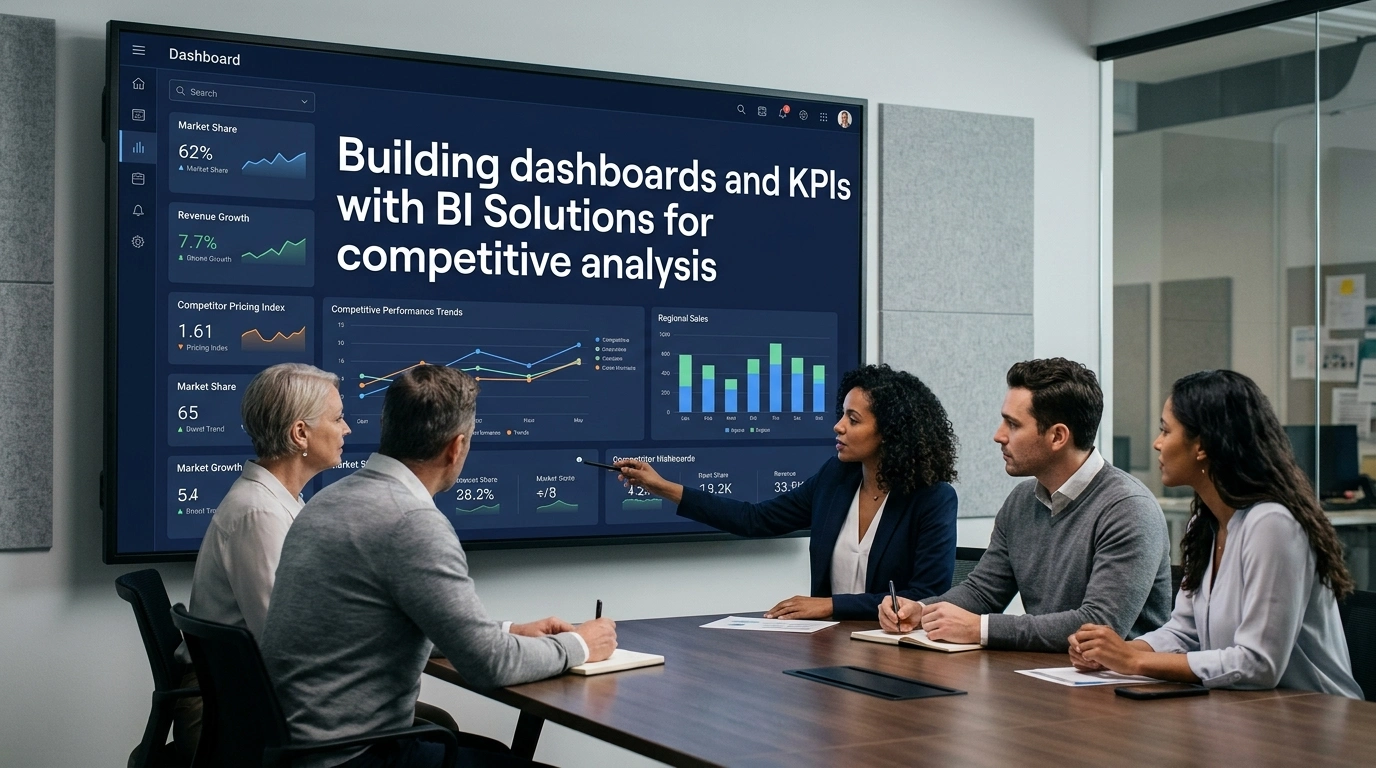
Linking BI Solutions for competitive analysis with long-term competitive advantage initiatives additionally strengthens modernization efforts because organizations can evaluate whether operational improvements are generating sustainable market differentiation instead of temporary performance gains. Comparing market positioning indicators, rival performance monitoring metrics, competitive pricing analysis dashboards, customer engagement comparison metrics, market share tracking indicators, and revenue trend measurements consequently improves enterprise-wide analytical precision. Aligning KPI reporting with enterprise objectives also increases cross-functional adoption because finance, marketing, product, sales, and executive leadership teams interpret performance through a unified analytical framework.
Connecting dashboard environments with industry trend forecasting models further improves decision readiness since emerging behavioral patterns, pricing shifts, and demand fluctuations become visible before they significantly affect revenue performance. Integrating automated refresh cycles and governed KPI definitions additionally reduces reporting inconsistency because standardized calculations maintain alignment across enterprise departments. Supporting BI Solutions for competitive analysis through visual benchmarking and predictive performance tracking therefore strengthens measurable, intelligence-driven competitive strategy across enterprise operations.
Selecting competitor benchmarks across pricing, share, and engagement
Selecting competitor benchmarks across pricing, share, and engagement requires a structured analytical framework because isolated comparisons rarely explain the broader forces shaping competitive movement. Connecting BI Solutions for competitive analysis with competitor benchmarking frameworks therefore improves evaluation quality since organizations compare performance against direct competitors, disruptive entrants, category leaders, and aspirational market references simultaneously. Integrating competitive pricing analysis into benchmark selection also strengthens commercial visibility because pricing structures often reflect broader positioning strategies, margin priorities, promotional behavior, and customer acquisition tactics.
Linking market share tracking with engagement metrics additionally improves strategic interpretation because audience attention frequently precedes measurable revenue movement. Comparing search visibility, social interaction, customer sentiment, content reach, review activity, and campaign engagement therefore provides deeper insight into whether competitor growth is accelerating organically or being driven primarily through promotional investment. Incorporating rival performance monitoring into benchmark systems further strengthens operational intelligence because continuous tracking reveals whether competitors are improving retention, strengthening channel expansion, or increasing customer loyalty over extended periods.
Connecting BI Solutions for competitive analysis with strategic gap identification additionally increases enterprise value because benchmark deviations often expose weaknesses in product differentiation, pricing alignment, customer experience, or market communication. Aligning benchmark selection with industry trend forecasting models also supports long-term planning since rapidly evolving sectors may experience substantial shifts in customer expectations, digital engagement behavior, and competitive positioning structures. Supporting competitive benchmarking through integrated pricing, engagement, and share analysis therefore strengthens long-term competitive advantage by transforming market data into actionable strategic intelligence.
Designing visual reports for trends, gaps, and opportunity signals
Designing visual reports for trends, gaps, and opportunity signals requires analytical structures capable of translating large-scale competitive data into executive-level strategic insight. Connecting BI Solutions for competitive analysis with visual storytelling frameworks therefore improves interpretability because trend-based reporting environments expose hidden market movement patterns that traditional spreadsheets rarely communicate effectively. Integrating market positioning intelligence into visual dashboards additionally strengthens strategic visibility because organizations can identify whether competitors are shifting toward premium branding, value-focused positioning, innovation leadership, or geographic expansion.
Linking strategic gap identification with trend visualization also improves competitive planning because performance gaps frequently emerge before financial outcomes fully reflect operational risk. Comparing competitor growth rates, engagement momentum, pricing movements, review sentiment, and campaign visibility therefore helps organizations recognize where rivals are outperforming expectations or where underserved market opportunities remain available. Integrating industry trend forecasting into visual reporting structures further strengthens modernization initiatives because predictive indicators reveal emerging customer behavior, digital adoption patterns, and category transformation trends before competitors fully capitalize on them.
Connecting BI Solutions for competitive analysis with rival performance monitoring frameworks also enhances operational responsiveness because visual alerts and comparative charts simplify the detection of competitor expansion, campaign escalation, or customer sentiment shifts. Aligning visual structures with executive priorities further improves cross-department interpretation since leadership teams, product divisions, sales departments, and marketing functions require different levels of analytical depth. Supporting opportunity analysis through contextualized visual intelligence therefore strengthens long-term competitive advantage because organizations gain earlier visibility into emerging risks, operational weaknesses, and growth opportunities before those conditions materially affect market position.
Using alerts and automation to detect competitive shifts faster
Using alerts and automation to detect competitive shifts faster strengthens enterprise responsiveness because modern competitive environments evolve more rapidly than traditional reporting cycles can effectively capture. Connecting BI Solutions for competitive analysis with automated rival performance monitoring systems therefore improves intelligence speed since organizations receive continuous visibility into competitor pricing changes, campaign launches, product releases, engagement spikes, market announcements, and customer sentiment fluctuations. Integrating competitive pricing analysis into automated alert systems additionally increases operational agility because sudden discount activity, aggressive promotional campaigns, or pricing realignments frequently indicate broader market positioning strategies.
Linking alerts with market positioning intelligence also improves strategic interpretation because automated systems identify when competitors shift branding direction, expand into new audience segments, or increase visibility within specific regions or digital channels. Comparing those developments against internal performance metrics consequently helps organizations determine whether competitive movement reflects temporary experimentation or sustained strategic transformation. Incorporating industry trend forecasting into alert environments further strengthens long-term planning because predictive monitoring models identify recurring behavioral patterns, rising demand categories, and emerging market disruptions before they become mainstream competitive threats.
Connecting BI Solutions for competitive analysis with workflow automation also improves cross-functional coordination because pricing teams, marketing departments, sales leaders, and executive stakeholders receive relevant alerts linked directly to operational responsibilities. Reducing dependence on manual competitor tracking consequently increases reporting consistency because automated systems continuously evaluate predefined intelligence sources across standardized intervals. Supporting competitive monitoring through intelligent automation ultimately strengthens long-term competitive advantage because organizations reduce the time required to convert market movement into strategic awareness and operational response.
Measuring campaign, product, and sales impact through BI reporting
Measuring campaign, product, and sales impact through BI reporting connects competitive intelligence directly with enterprise performance outcomes because organizations increasingly require measurable evidence linking market behavior with financial and operational results. Connecting BI Solutions for competitive analysis with campaign performance reporting therefore strengthens strategic accountability since organizations compare internal marketing effectiveness against competitor visibility, audience engagement, search dominance, and share-of-voice movement. Integrating rival performance monitoring into campaign evaluation additionally improves strategic interpretation because rising competitor engagement often influences conversion rates, customer acquisition efficiency, and retention performance across overlapping market segments.
Linking product reporting with market positioning intelligence also strengthens modernization planning because feature adoption trends, review sentiment, usability feedback, and competitor product expansion frequently reveal how customer expectations evolve within the broader industry environment. Comparing product adoption against competitor launches consequently helps organizations determine whether innovation investments are strengthening differentiation or merely maintaining parity within increasingly competitive markets. Incorporating strategic gap identification into product reporting further improves operational insight because gaps in pricing alignment, feature maturity, digital experience, or customer support often emerge through comparative performance analysis rather than isolated internal reporting.
Connecting BI Solutions for competitive analysis with industry trend forecasting models also improves long-term planning because campaign effectiveness, product relevance, and sales momentum frequently change alongside broader market transformation patterns. Comparing competitor expansion activity, pricing evolution, customer behavior shifts, and engagement acceleration therefore helps organizations anticipate future performance conditions instead of reacting solely to historical outcomes. Aligning campaign, product, and sales reporting within one integrated intelligence framework consequently strengthens sales performance because decision-makers evaluate operational performance within the broader context of market evolution, competitive pressure, and strategic positioning dynamics.
From insight to action: competitive strategy with BI platforms
Positioning BI Solutions for competitive analysis as a central intelligence layer within enterprise strategy enables organizations to convert fragmented operational data, competitor movements, market behavior indicators, and customer interaction patterns into coordinated strategic action that supports sustainable growth and stronger market positioning intelligence. Connecting internal performance metrics with external intelligence sources such as competitor pricing updates, customer sentiment analysis, advertising visibility, product launch activity, industry reports, and digital engagement trends allows executive teams to evaluate how market conditions evolve relative to organizational objectives and rival performance monitoring benchmarks. Supporting enterprise decision-making through competitor benchmarking frameworks strengthens the ability to compare operational efficiency, campaign effectiveness, customer acquisition performance, and product differentiation against leading market participants while identifying structural gaps that may weaken long-term competitiveness.
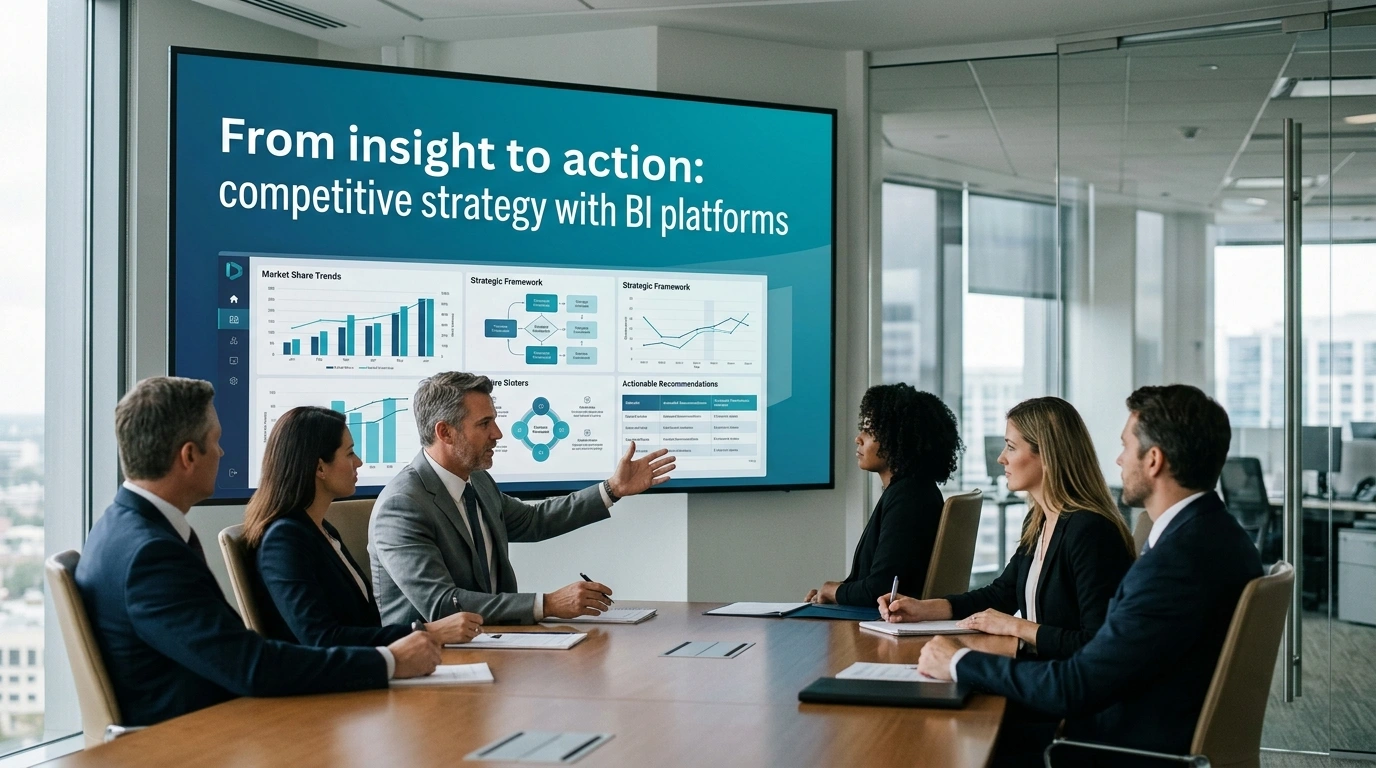
Translating complex market intelligence into visual dashboards, strategic scorecards, forecasting models, and automated alerts improves the speed at which leadership teams recognize shifts in competitor behavior, emerging demand patterns, or declining engagement signals before those changes influence revenue stability or market share performance. Strengthening the strategic role of BI Solutions for competitive analysis requires aligning intelligence systems with long-term planning priorities so that marketing, finance, sales, operations, and executive leadership evaluate market developments through consistent KPI structures and governed analytical frameworks rather than through disconnected reporting environments. Improving enterprise responsiveness through industry trend forecasting and strategic gap identification allows organizations to recognize underserved customer segments, operational inefficiencies, changing pricing expectations, and evolving competitive pressures with greater precision across multiple business units.
Reinforcing long-term competitive advantage through BI depends on transforming market insight into measurable enterprise action that supports pricing resilience, stronger customer retention, scalable operational planning, and more adaptive strategic execution in highly competitive markets. Expanding analytical visibility across multiple operational layers improves organizations’ ability to connect competitive developments with customer behavior changes, regional performance differences, and shifting commercial priorities. Sustaining enterprise-wide intelligence maturity through BI Solutions for competitive analysis strengthens coordination between strategic planning, operational execution, and market responsiveness while supporting more resilient long-term growth initiatives.
Applying competitor insights to pricing and positioning decisions
Guiding pricing and positioning decisions through BI Solutions for competitive analysis enables organizations to evaluate how competitor pricing structures, promotional strategies, feature differentiation, customer perception, and channel performance influence buyer behavior across changing market conditions. Integrating competitive pricing analysis with internal profitability metrics, conversion trends, retention performance, and customer lifetime value creates a balanced framework for determining whether strategic pricing adjustments should protect margins, improve acquisition efficiency, strengthen premium positioning, or respond selectively to rival discounting behavior. Supporting market positioning intelligence through competitor benchmarking frameworks helps organizations compare their value proposition against competing brands by measuring delivery speed, service quality, feature depth, customer satisfaction, support responsiveness, and overall brand perception within target segments.
Revealing pricing inefficiencies through BI Solutions for competitive analysis allows commercial leaders to identify situations in which products are undervalued relative to competitor offerings or overpriced in segments experiencing stronger competitive pressure. Strengthening strategic positioning through rival performance monitoring improves the ability to observe how competitors adapt pricing models, revise subscription structures, launch bundled services, or reposition products in response to customer demand shifts and industry trend forecasting signals. Connecting qualitative intelligence from reviews, search behavior, campaign engagement, and social sentiment with quantitative indicators such as win rates, market share tracking, and revenue growth creates a more accurate understanding of how pricing and positioning decisions influence competitive standing over time.
Reducing reactive decision-making requires treating competitor intelligence as a structured analytical discipline rather than as a trigger for short-term imitation. Reinforcing long-term competitive advantage through BI allows organizations to preserve pricing consistency, strengthen differentiation strategies, and maintain stronger alignment between enterprise value delivery and evolving customer expectations. Supporting sustainable commercial performance through BI Solutions for competitive analysis improves organizations’ ability to balance competitive responsiveness with profitability protection while maintaining strategic clarity across increasingly competitive markets.
Supporting leadership teams with scenario analysis and forecasting
Enabling leadership teams to evaluate strategic outcomes through BI Solutions for competitive analysis transforms competitive intelligence into an enterprise forecasting capability that supports scenario analysis, investment prioritization, operational planning, and long-range strategic development. Combining historical performance trends with rival performance monitoring data, macroeconomic indicators, customer demand shifts, pricing volatility, and industry trend forecasting models allows executives to evaluate how future market conditions may influence profitability, market share tracking performance, supply stability, and customer retention across multiple strategic scenarios. Supporting executive forecasting with competitor benchmarking frameworks improves visibility into how leading competitors allocate resources, expand into new markets, optimize operational efficiency, or strengthen digital engagement strategies during periods of economic or competitive disruption.
Clarifying strategic trade-offs through BI Solutions for competitive analysis enables leadership teams to compare best-case, expected-case, and downside projections based on variables such as competitor expansion, customer acquisition costs, pricing compression, evolving consumer behavior, and emerging technology adoption patterns. Strengthening forecasting precision through market positioning intelligence helps organizations evaluate whether current product strategies, channel investments, or service capabilities remain aligned with long-term competitive conditions and enterprise growth objectives. Connecting predictive analytics with strategic gap identification reveals areas in which operational limitations, product weaknesses, or declining market responsiveness may reduce future competitiveness if corrective action is delayed.
Improving executive readiness through scenario modeling allows organizations to align staffing, infrastructure, product development, marketing investment, and financial planning with anticipated market developments before competitive pressure intensifies. Reinforcing long-term competitive advantage through BI requires integrating forecasting intelligence into enterprise governance structures so that leadership decisions remain evidence-based, adaptable, and strategically coordinated across rapidly changing markets. Strengthening enterprise resilience through BI Solutions for competitive analysis improves executive teams’ ability to manage uncertainty, evaluate alternative strategic pathways, and maintain operational flexibility during periods of market transformation.
Reducing blind spots through continuous market monitoring practices
Reducing competitive blind spots through BI Solutions for competitive analysis depends on establishing continuous intelligence processes capable of capturing real-time competitor activity, pricing fluctuations, customer sentiment changes, campaign launches, operational disruptions, and evolving market share tracking indicators before those developments create significant strategic exposure. Integrating rival performance monitoring systems with automated dashboards, anomaly detection tools, digital engagement analytics, and external intelligence feeds strengthens organizational awareness across fast-moving competitive environments in which delayed visibility often weakens response effectiveness. Supporting continuous market monitoring through competitor benchmarking frameworks allows organizations to compare operational performance, customer responsiveness, promotional intensity, and digital reach against industry leaders while identifying structural performance gaps that may otherwise remain undetected.
Strengthening enterprise agility through BI Solutions for competitive analysis enables strategy teams to recognize early signals related to competitor repositioning, pricing pressure, product innovation cycles, or changing customer expectations before those trends influence sales performance or brand perception at scale. Improving market positioning intelligence through ongoing monitoring practices helps organizations distinguish between temporary competitive fluctuations and long-term industry trend forecasting signals that may require structural operational adjustments or strategic repositioning initiatives. Connecting automated alerts with strategic gap identification frameworks improves coordination between executive leadership, marketing teams, sales operations, and product divisions by clarifying which market developments require immediate action and which trends should remain under observation.
Reducing analytical fragmentation requires consolidating competitor intelligence, customer analytics, operational KPIs, and market forecasting into centralized reporting ecosystems that support faster interpretation and stronger cross-functional alignment. Reinforcing long-term competitive advantage through BI depends on sustaining continuous monitoring disciplines that transform scattered market signals into measurable strategic awareness capable of supporting resilient enterprise decision-making. Expanding enterprise intelligence visibility through BI Solutions for competitive analysis strengthens organizations’ ability to recognize emerging threats, identify hidden market opportunities, and maintain stronger responsiveness to competitive disruption across evolving industries.
Strengthening long-term decision-making with evidence-based intelligence
Strengthening long-term decision-making through BI Solutions for competitive analysis requires building enterprise intelligence frameworks that support strategic consistency, operational transparency, market adaptability, and evidence-based governance across changing competitive environments. Establishing reliable analytical foundations through governed datasets, standardized KPIs, competitor benchmarking frameworks, and integrated reporting structures enables organizations to evaluate performance trends with greater precision while reducing inconsistency between departments and executive decision layers. Supporting enterprise strategy with market positioning intelligence improves organizations’ ability to evaluate how customer expectations, pricing structures, product capabilities, and competitive differentiation evolve over extended planning horizons rather than through isolated quarterly assessments.
Reinforcing strategic resilience through BI Solutions for competitive analysis allows organizations to combine historical performance data, rival performance monitoring insights, market share tracking indicators, and forecasting models into a unified intelligence structure capable of supporting long-range investment planning and operational modernization initiatives. Improving strategic gap identification practices helps leadership teams recognize areas in which declining efficiency, limited innovation capacity, weak digital engagement, or delayed product adaptation may gradually reduce competitiveness despite stable short-term performance indicators. Connecting industry trend forecasting with enterprise planning models enables organizations to anticipate regulatory changes, technological shifts, customer behavior evolution, and emerging market expectations before those developments create operational disruption or revenue instability.
Strengthening long-term competitive advantage through BI depends on transforming intelligence systems into continuous learning environments in which market evidence, customer analytics, competitor activity, and strategic performance indicators remain interconnected across the full decision-making lifecycle. Preserving enterprise adaptability through BI Solutions for competitive analysis supports more disciplined governance, stronger strategic alignment, improved investment prioritization, and more resilient competitive positioning across increasingly data-driven markets. Sustaining executive confidence through evidence-based intelligence improves organizational readiness for future competitive challenges while reinforcing strategic continuity across long-term enterprise transformation initiatives.
Organizations that invest in BI Solutions for competitive analysis gain stronger visibility into competitor behavior, customer expectations, market trends, and operational performance across rapidly evolving industries. Integrated intelligence frameworks support more accurate forecasting, faster strategic adaptation, stronger pricing decisions, improved benchmarking practices, and better alignment between operational execution and long-term business objectives. Continuous monitoring, predictive analytics, automated alerts, and centralized dashboards also help enterprises reduce competitive blind spots while improving responsiveness to changing market conditions. In conclusion, BI Solutions for competitive analysis strengthen enterprise decision-making by transforming competitive intelligence into a continuous strategic capability that supports sustainable growth, operational resilience, and long-term market leadership.